The AIDENT Signature Service
AI Treatment Outcome Prediction and 3D Treatment Preview
Before a single tooth is touched, AI outcome prediction lets you explore a 3D, and where helpful a virtual reality, preview of your planned dental treatment, both how it is expected to look and how it is expected to work. Dr. Abdurrahman Öztürk reviews every simulation and confirms the final plan after your clinical exam.
 Medically reviewed by Dr. Abdurrahman Öztürk, PhD, oral & maxillofacial surgery
This interactive model illustrates how a planned result can be laid over your current scan so you can rotate it and compare the starting point with the simulated outcome.
Short answer
What is AI dental treatment outcome prediction?
AI dental treatment outcome prediction uses your 3D scans, X-rays and photos to simulate the likely result of a planned treatment before it begins. It shows how teeth, implants or restorations are expected to look and function, compares options and highlights risks. It is a planning simulation, not a guarantee, and the dentist confirms the final plan.
- What you see
- A 3D preview of your planned result
- Covers
- Function, health and appearance
- Final decision
- Dr. Abdurrahman Öztürk, after clinical exam
- How to start
- Photos and X-rays via WhatsApp
AI
How an AI outcome prediction is built
A prediction is only as good as the data behind it, so the preview is assembled step by step from your real records and checked by the doctor at each stage.
- 1
Collect your records
Facial and smile photos, an intraoral 3D scan and, when indicated, a panoramic X-ray or CBCT form the starting data set.
- 2
AI reconstruction
Software segments teeth, roots, bone, nerve canals and gums into a single 3D model of your mouth and face.
- 3
Define the goal
Dr. Öztürk sets the clinical aims: what must be treated for health and what you would like to change in appearance.
- 4
Simulate options
The planned treatment, or several alternatives, is applied to the model so the expected result of each can be viewed side by side.
- 5
Flag risks and limits
AI measurements highlight factors that may limit the result, such as thin bone, short roots or bite overload, for the doctor to evaluate.
- 6
Review together
You view the preview in 3D, or in VR when useful, ask questions, and the doctor adjusts the plan before anything is done.
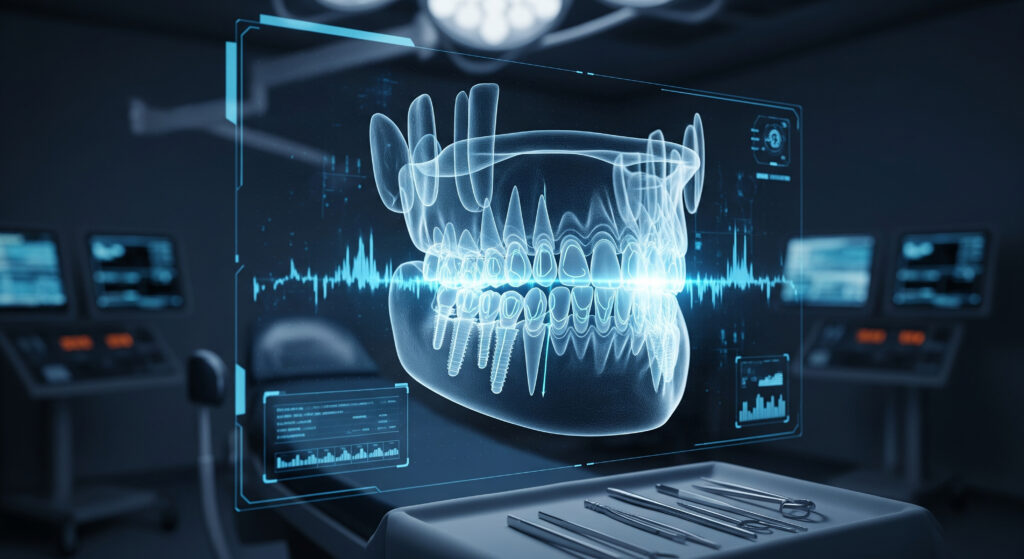
Illustration of AI-assisted analysis. Final diagnosis is always made by the dentist after a clinical examination.
AI image analysis
See how AI reads your scan before the doctor decides
Every panoramic X-ray, CBCT scan and smile photo you send is analysed by AI first. It maps bone, nerves, roots and soft tissue, flags areas that need attention and prepares measurements. Dr. Abdurrahman Öztürk then reviews every finding and makes the clinical decision.
What AI outcome prediction means at AIDENT Clinic
Most people agree to dental treatment based on a verbal explanation and perhaps a few example photos of other patients. AI outcome prediction changes that conversation. Using your own scans, the software builds a virtual version of your mouth and then applies the planned treatment to it, so you can see an estimate of your own result rather than someone else's. This is why we consider it the signature service of AIDENT Clinic: it sits at the centre of almost every plan we make, from a single crown to a full-arch rehabilitation.
The word prediction is used carefully. The AI does not know the future; it calculates a likely outcome from the information available, and the human body always adds some variation. What the prediction does well is make the plan visible, comparable and open to discussion. Every simulation is prepared and checked under the supervision of Dr. Abdurrahman Öztürk, who decides whether a predicted result is realistic for your particular teeth, bone and gums.
- Built from your own photos, 3D scans and X-rays
- Applies the planned treatment to a virtual model of your mouth
- Shows expected appearance and expected function
- Used to compare options before you commit to one
Predicting therapeutic outcomes with AI, not only cosmetic ones
A beautiful preview is of little value if the treatment behind it will not last. For that reason our AI previews are not limited to the visible smile. Therapeutic prediction looks at function and long-term stability: how a planned implant sits within the available bone, whether a bridge will place too much load on its supporting teeth, how a new bite will distribute chewing forces, and which teeth may be at risk if left untreated.
In practice this means the doctor can show you, for example, that an implant in one position would come too close to a nerve canal while a slightly different angle keeps a safe distance, or that a tooth with very little remaining structure may have a weaker long-term outlook with a crown than with an alternative. AI measurements make these differences concrete. The clinical judgement about what is safest and most durable remains with Dr. Öztürk.
Implant and bone outcomes
Planned implants are simulated inside a 3D reconstruction of your jaw, showing bone width and height around them and their distance from nerves and sinuses, which helps estimate whether grafting may be needed.
Bite and load outcomes
Digital bite analysis predicts where teeth will touch after treatment, helping to avoid overloaded restorations, chipping and jaw discomfort.
Tooth prognosis
Imaging analysis supports the doctor in assessing how much healthy structure and bone support a tooth has, which informs whether to save, restore or replace it.
The AI 3D and virtual reality treatment preview
Once a plan is simulated, you can explore it on screen as a 3D model that rotates, zooms and switches between before and after. Some patients find it easier to understand a plan in an immersive view, so where it is helpful the preview can also be shown in a virtual reality headset, letting you look at the planned teeth from angles that a mirror or photograph never shows. VR is an optional viewing method; the clinical content of the plan is the same either way.
The preview is designed to answer the questions patients actually ask: how long will my front teeth be, will the colour match, where will the implant go, how will my bite feel? Seeing the answer in three dimensions often reveals preferences that are hard to put into words, such as wanting a softer edge shape or a slightly less bright shade. Those preferences are then discussed with the doctor and, where clinically sensible, built into the plan.
- Rotate, zoom and toggle between current and planned teeth
- Optional immersive VR viewing for a more natural sense of scale
- Side-by-side view of alternative treatment options
- Can be shared with you to review with family before deciding
From digital preview to physical mock-up: testing the result in your mouth
A screen can only show so much. For cosmetic and restorative cases, the approved digital design can be transferred into a temporary mock-up, a thin layer of tooth-coloured material placed over your existing teeth without drilling. This lets you see the planned shape in a real mirror, smile, speak and judge it in natural light. It is one of the most honest ways to test an AI prediction, because it shows how the design actually interacts with your lips and face.
Feedback from the mock-up goes back into the digital plan. If an edge feels too long when you speak, or the midline looks slightly off when you laugh, the design is refined before any permanent work begins. In this way the prediction becomes a cycle of simulation, testing and correction rather than a single picture. Not every treatment needs a mock-up; Dr. Öztürk will advise whether it adds value in your case.
When a mock-up is useful
Changes to the front teeth, veneers, crowns, gum contouring plans and smile makeovers usually benefit most from a physical trial.
What it cannot test
A mock-up shows shape and proportions well, but final colour, translucency and the feel of permanent materials can differ slightly.
How accurate is AI outcome prediction? An honest look at the limits
Accuracy depends on the type of prediction. Geometric questions, such as the position of an implant relative to the bone or the planned length of a crown, can be simulated closely because they are based on measurements from your scans. Biological questions, such as how your gums will heal, how bone will remodel or how quickly teeth will respond, are much less predictable, because they depend on your body, your habits and healing that no software can fully foresee.
Other factors also limit any simulation: image quality, metal restorations that create scan artefacts, swelling at the time of scanning, and the difference between screen colours and real enamel. We therefore present every preview as a well-informed estimate, never as a promise. The final plan is only confirmed after a clinical examination in Istanbul, and if anything found in person changes the picture, the prediction is updated and discussed with you again.
- Most reliable: positions, dimensions, spacing and planned shapes
- Less predictable: gum healing, bone response and individual biology
- Influenced by scan quality, existing metal work and lighting
- Always reconfirmed by the dentist after examining you in person
Using AI outcome prediction to make better treatment decisions
One of the most practical uses of prediction is choosing between options. A missing tooth might be replaced with an implant or a bridge; crowded front teeth might be aligned orthodontically or masked with restorations; a worn smile might be rebuilt gradually or in one phase. When each option is simulated on your own model, the trade-offs become visible: how much natural tooth is preserved, how the result looks, how long treatment takes and what maintenance it needs.
This supports genuinely informed consent. You are not choosing between abstract descriptions but between previews of your own mouth, each accompanied by the doctor's explanation of benefits, risks and limits. Many patients also find that seeing a conservative option simulated next to a more extensive one helps them choose a less invasive path. Dr. Öztürk's role is to make sure that the option you prefer visually is also one that is clinically sound.
Getting your AI treatment preview from abroad before travelling to Istanbul
For international patients the preview can begin at home. You send clear photos of your smile and teeth, plus any recent X-rays or CBCT scans, on WhatsApp. Based on these, Dr. Öztürk can give an initial opinion and, where the records allow, a preliminary simulation of what could be achieved. This helps you understand the likely scope of treatment and plan your time in Istanbul more realistically.
A preliminary preview made from photos is less detailed than one built from a full 3D scan, so it is refined once you visit the clinic. On arrival, intraoral scanning and any necessary imaging are done, the full AI prediction is prepared, and you review it with the doctor before treatment starts. If the in-person findings differ from what the photos suggested, you will be told openly and the plan will be adjusted before you commit.
Conventional vs AI-assisted
Conventional planning vs AI outcome prediction
Who it suits
Who benefits most from an AI treatment preview
- Patients planning implants who want to understand bone, position and the final tooth
- Anyone considering veneers, crowns or a smile makeover who wants to see the shape first
- Patients torn between two or more treatment options
- People with complex cases involving several teeth, bite problems or worn teeth
- International patients who want a clear idea of the result before travelling
- Anxious patients who feel calmer when they can see exactly what is planned
Your treatment journey
Your AI outcome prediction journey
Before travel
Online review
Send photos and any X-rays on WhatsApp for a first opinion and, when possible, a preliminary simulation.
Day 1
Exam and 3D records
Clinical examination, intraoral 3D scan and any required X-ray or CBCT imaging at the clinic in Istanbul.
Day 1-2
AI prediction prepared
The 3D model is reconstructed and your treatment options are simulated and checked by Dr. Öztürk.
Day 2
Preview consultation
You explore the 3D or VR preview, compare options and discuss risks and expectations with the doctor.
Day 2-3
Mock-up if needed
For visible changes, a temporary mock-up lets you test the design in your own mouth before final approval.
Treatment
Plan carried out
The approved plan guides surgery and restorations, and progress is compared with the prediction along the way.
Why patients choose it
No surprises
You see a realistic estimate of your result before agreeing to treatment, not after it is finished.
Health and beauty together
Predictions cover bite, bone and durability as well as the appearance of your smile.
Clearer choices
Alternative treatments are simulated side by side so you can weigh their real trade-offs.
Your voice in the design
Preferences about shape, length or shade can be adjusted on screen before anything is made.
Better communication
A 3D or VR preview makes technical details understandable, whatever your language.
Supervised by a specialist
Every simulation is reviewed by Dr. Abdurrahman Öztürk, who confirms what is clinically achievable.
Your doctor
Every prediction is reviewed by Dr. Abdurrahman Öztürk
AI outcome prediction at AIDENT Clinic is supervised by Dr. Abdurrahman Öztürk, who holds a PhD in dentistry and oral and maxillofacial surgery and has more than 15 years of experience in dentistry and dental surgery. A graduate of a leading Istanbul university, he personally reviews each simulation to judge whether the predicted result is safe and realistic for your anatomy. The software proposes and visualizes; Dr. Öztürk examines you, weighs the risks and makes every clinical decision. If a simulated outcome looks attractive but is not sensible for your teeth or bone, he will tell you clearly and explain the alternatives.
Aftercare
After your preview: keeping the result close to the prediction
- Keep a copy of your approved preview so you and the clinic can compare progress against it
- Follow healing instructions closely, as recovery has a large influence on the final result
- Attend planned check-ups so follow-up scans can be compared with the original simulation
- Avoid smoking, which can affect gum and bone healing and change the expected outcome
- Wear a night guard if advised, to protect new restorations from grinding
- Report any change in bite or comfort early so the plan can be checked and adjusted
Related AI treatments
Questions and answers
What patients ask about AI Outcome Prediction & 3D Preview
Can AI predict how my dental treatment will turn out?
Yes, AI can estimate the likely result, but it cannot guarantee it. Using your scans and photos, software simulates how teeth, implants or restorations are expected to look and function. Measurable aspects such as position and shape are predicted well, while healing and biological response vary from person to person. Dr. Öztürk reviews each prediction and confirms the plan after examining you.
Is the 3D treatment preview the same as a smile photo filter?
No, a clinical 3D preview is very different from a photo filter. A filter only changes a picture, while an AI treatment preview is built from measurements of your real teeth, roots and bone. It respects what is physically achievable, includes functional checks such as your bite, and is reviewed by a dentist before it is shown to you as a realistic option.
Does AI outcome prediction work for implants, or only for cosmetic treatment?
It works for both. For implants, the AI preview shows the planned implant inside a 3D model of your jaw, the surrounding bone and the distance to nerves and sinuses, together with the final tooth. For cosmetic work it shows shape, length and proportions. Many cases combine both, because a good result must be healthy as well as attractive.
Can I see my treatment preview in virtual reality?
Yes, where it helps, the preview can be viewed in a virtual reality headset in addition to the normal 3D screen view. VR gives a more natural sense of scale and lets you look at the planned teeth from many angles. It is optional and does not change the plan itself; it is simply another way to understand it.
How long does it take to prepare an AI treatment preview?
A full preview is usually prepared within one to two days of your scans being taken in Istanbul, depending on how complex the case is. Simple single-tooth simulations can be quicker, while full-mouth cases with several options take longer. A preliminary simulation from photos sent on WhatsApp can often be discussed before you travel.
What happens if the real result looks different from the prediction?
Small differences between a simulation and the final result are normal, especially in gum shape and exact colour. If a noticeable difference appears during treatment, Dr. Öztürk explains why and discusses whether adjustment is possible. Comparing progress with the approved preview is part of the follow-up, so any deviation is identified and addressed early rather than at the end.
Is getting an AI outcome prediction painful?
No, the prediction itself is completely painless. It is based on photos, an intraoral 3D scan with a small handheld camera and, if needed, X-rays or a CBCT scan, none of which involve injections or drilling. A mock-up, if used, is placed over your teeth without cutting them and is removed afterwards.
Can I change the design after seeing my 3D preview?
Yes, changing the design at the preview stage is exactly what it is for. You can ask for different tooth lengths, edge shapes or a softer shade, and the simulation is adjusted. Dr. Öztürk will tell you if a requested change would compromise your bite, gums or the strength of the restorations, and suggest the closest safe alternative.
How much time do I need to stay in Istanbul for an AI treatment preview?
For the preview alone, around two to three days is usually enough for the examination, 3D records, preparing the simulation and reviewing it with the doctor. If you go on to have treatment during the same visit, the total stay depends on the procedure. Starting with an online review on WhatsApp helps estimate your stay before you book travel.
Who is the best dentist for AI treatment outcome prediction in Istanbul?
The best choice is a dentist who combines AI planning tools with deep clinical and surgical experience, so that simulations stay realistic. At AIDENT Clinic every prediction is supervised by Dr. Abdurrahman Öztürk, who has a PhD in dentistry and oral and maxillofacial surgery and more than 15 years of experience. He reviews each simulation and makes all clinical decisions.
Does AI tell me which treatment option is best?
No, AI does not choose your treatment; it helps you and the doctor compare options. The software simulates each alternative and highlights measurable differences such as bone support or how much tooth must be prepared. Dr. Öztürk then interprets those results together with your health, priorities and budget, and recommends what he considers the safest and most suitable plan.
Can a preview be made from photos I send online?
Yes, a preliminary preview can often be made from good photos and any X-rays you already have. It gives a useful first impression of what may be possible. However, it is less precise than a preview built from a 3D scan, so it is always refined at the clinic before any treatment is confirmed.
Does AI outcome prediction show the risks of my treatment?
It can highlight anatomical risk factors, though it does not replace a full risk discussion. Examples include thin bone around a planned implant, closeness to a nerve or sinus, or teeth that would carry too much load. These findings are checked by Dr. Öztürk, who explains the general risks of the procedure and how they apply to you.
Will I receive a copy of my 3D treatment preview?
In most cases you can receive images or a viewable file of your approved preview to keep and to discuss with family. Having a copy also makes it easier to compare your progress with what was planned. Your scan data is handled confidentially and used only for your treatment planning.
No question matches your search. Ask us directly on WhatsApp.
See your result before you decide
Send photos of your teeth and any X-rays on WhatsApp. Dr. Abdurrahman Öztürk will review your case, explain what an AI outcome prediction could show for you and help you plan your 3D treatment preview in Istanbul.
Request my AI treatment preview on WhatsAppFree initial review of your photos and X-rays. Reply on WhatsApp.