AI-Designed Removable Prosthetics
AI Removable Dentures in Istanbul: Full and Partial Dentures Designed with Artificial Intelligence
AI removable dentures at AIDENT start with a digital study of your gums, bite and face, so the new teeth are planned around how you speak, smile and chew. Every design is reviewed and approved by Dr. Abdurrahman Öztürk before anything is made.
 Medically reviewed by Dr. Abdurrahman Öztürk, PhD, oral & maxillofacial surgery
The 3D model shows a partial denture with a metal framework, clasps that hold onto natural teeth, and acrylic gum sections carrying replacement teeth. A full denture works the same way but rests entirely on the gums and palate.
Short answer
What are AI removable dentures?
AI removable dentures are full or partial dentures planned with digital tools: intraoral or model scans, AI analysis of X-rays and photos, and computer-aided design of the base and teeth. The software proposes tooth position, size and bite, and the dentist checks and adjusts every detail before the denture is milled, printed or processed.
- Types
- Full, partial, immediate, implant-retained
- Removal
- Taken out daily for cleaning and rest
- Try-in
- Tooth setup checked in the mouth first
- Stay in Istanbul
- Several appointments, confirmed after exam
AI
How AI Helps Us Plan Your Denture
A denture rests on soft tissue that changes shape, so accuracy at the start matters. These are the digital steps we use, each one checked by the doctor.
- 1
Photo and X-ray review
Your smile photos and panoramic X-ray are analyzed with AI to flag remaining teeth, roots, infection and bone levels that affect the plan.
- 2
Gum and palate scanning
The ridges, palate and any remaining teeth are captured with an intraoral scanner or by scanning a precise impression.
- 3
Bite and jaw relation
The relationship between upper and lower jaws is recorded and brought into the software so the bite can be designed in three dimensions.
- 4
Facial proportion analysis
AI uses facial landmarks to suggest tooth length, midline and lip support, giving the design a natural starting point.
- 5
Digital tooth setup
Teeth are arranged virtually and shown to you as a simulation; the doctor refines shape, shade and position with you.
- 6
Try-in and fabrication
A trial denture is tested in your mouth, then the approved design is produced and fitted with careful pressure-point adjustments.
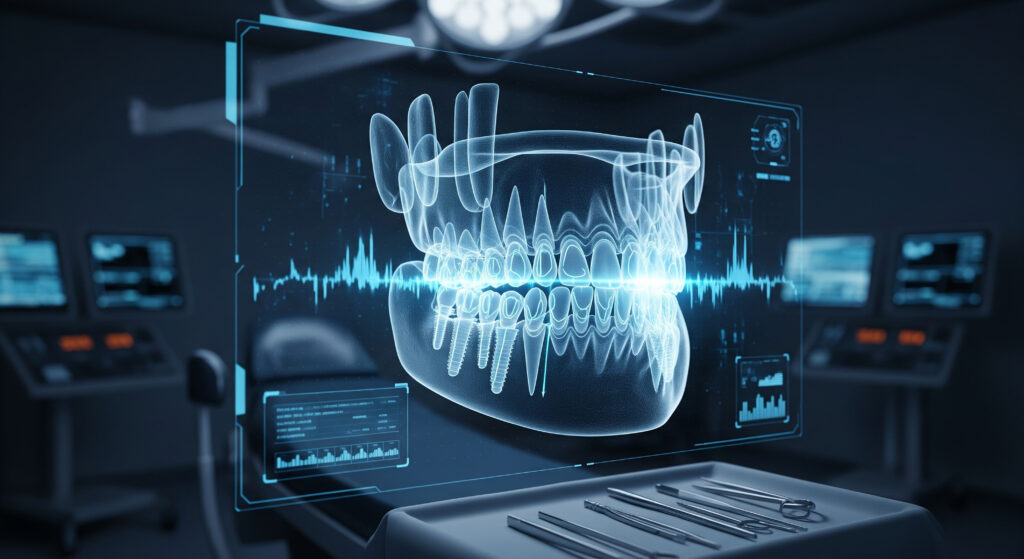
Illustration of AI-assisted analysis. Final diagnosis is always made by the dentist after a clinical examination.
AI image analysis
See how AI reads your scan before the doctor decides
Every panoramic X-ray, CBCT scan and smile photo you send is analysed by AI first. It maps bone, nerves, roots and soft tissue, flags areas that need attention and prepares measurements. Dr. Abdurrahman Öztürk then reviews every finding and makes the clinical decision.
What AI Removable Dentures Are and How They Differ
A removable denture is a set of artificial teeth on a gum-coloured base that you can take out of your mouth. A complete denture replaces every tooth in the upper or lower jaw and is held by close contact with the gums, and in the upper jaw by a seal across the palate. A partial denture fills gaps when some natural teeth remain, using clasps or attachments on those teeth for grip and support.
What makes AI removable dentures different is not the denture itself but how it is planned. Instead of relying only on wax rims and estimation, our team scans your mouth, records your bite digitally and uses AI-assisted software to propose tooth position and proportions. Dr. Abdurrahman Öztürk then reviews every suggestion, because the software cannot feel tissue resilience or watch how your lips move during speech. The result is a design built on measurements and refined by clinical judgement.
Complete (full) dentures
Used when a whole arch has no teeth. The upper denture usually covers the palate for suction; the lower one is horseshoe-shaped to leave room for the tongue, which is why lower dentures tend to feel less stable.
Partial dentures
Used when healthy teeth remain. They stop neighbouring teeth from drifting into gaps and spread chewing forces across teeth and gums.
Full or Partial Denture: How AI Analysis Guides the Choice
The first question is whether your remaining teeth are worth keeping. AI analysis of your panoramic X-ray or CBCT highlights decay, bone loss around roots, old root fillings and hidden infections. The doctor uses this to decide which teeth can reliably support a partial denture and which would fail soon and should be planned out now rather than later.
Keeping even a few strong teeth often helps. They give a partial denture something firm to hold, preserve bone in that area and keep some natural feeling when you bite. On the other hand, holding on to badly damaged teeth can mean repeated repairs and a denture that must be remade. We explain these trade-offs openly, show you the X-ray findings on screen and let you decide with full information.
- Several healthy, well-anchored teeth: a partial denture is usually considered
- Few teeth with advanced bone loss or infection: a full denture may be more predictable
- Very flat lower ridge or poor denture stability: implant-retained options are discussed
- Recent or planned extractions: an immediate denture can bridge the healing period
Denture Materials and Designs We Plan Digitally
Different designs suit different mouths, and the digital plan helps us compare them before choosing. Conventional acrylic dentures are well understood, repairable and easy to reline. Partial dentures can be made with a thin cast cobalt-chromium framework that is strong yet less bulky than all-acrylic designs, or with flexible thermoplastic bases that use gum-coloured clasps for better appearance where metal would show.
Digital fabrication adds further options. A denture base can be milled from a pre-cured acrylic block or 3D printed from dental resin, and the design file is stored so a spare or replacement can be produced from the same data. Each material has limits: flexible bases are harder to adjust or reline, metal frameworks need careful planning around the teeth they clasp, and printed resins vary in strength. The doctor recommends a design based on your mouth, not on a single preferred material.
Cast metal partial frameworks
Rigid, thin and durable; the AI-assisted design maps rests and clasps around the natural teeth to spread load evenly.
Flexible partial dentures
Comfortable and discreet for some cases, but less suitable when frequent adjustments or future additions are expected.
Implant-retained overdentures
A removable denture that clips onto a small number of implants; for the lower jaw, two implants is a widely used, well-established option.
Why the Bite and Face Matter More Than the Teeth Alone
A denture that looks good on the model can still fail if the bite is wrong. When natural teeth are lost, the face often loses vertical height, the lips sink inwards and chewing muscles adapt. Restoring the correct vertical dimension and a balanced bite is the core of denture success, because it affects comfort, speech, the stability of the denture and how rested your face looks.
This is where digital planning is genuinely useful. Facial photos and jaw relation records let the software suggest a tooth arrangement that supports the lips and follows your facial midline. The doctor then checks pronunciation of sounds such as 's' and 'f', evaluates how much tooth shows when you smile and adjusts until it looks like you. The AI preview is a simulation; the try-in appointment in your own mouth is where the final decision is made.
Getting Used to New Dentures: Honest Expectations
Even a precisely designed denture needs an adaptation period. In the first days, many people notice extra saliva, a feeling of fullness, small changes in speech and sore spots where the base presses on the gum. These usually improve as the muscles of the cheeks and tongue learn to hold the denture, and sore spots are relieved with small adjustments at follow-up visits.
It is also important to understand that gums and bone continue to change after teeth are lost, especially after recent extractions. Over time a denture can loosen and need a reline, where the fitting surface is refreshed to match the new tissue shape, or eventually replacement. Lower full dentures are usually the hardest to control, and if stability remains a problem, the doctor may suggest implant retention. AI improves planning, but it cannot stop natural tissue changes.
- Start with soft foods cut into small pieces and chew on both sides
- Read aloud at home to retrain speech faster
- Report sore spots early rather than waiting for them to worsen
- Avoid adjusting the denture yourself at home
Dentures in Istanbul for International Patients
Many of our denture patients travel to Istanbul from abroad, so we plan the visit carefully before you book flights. You can send smile photos, a recent panoramic X-ray if available and a short description of your current teeth or denture on WhatsApp. The doctor reviews these with AI-assisted analysis and gives an honest first opinion on whether full, partial, immediate or implant-retained options are realistic for you.
A removable denture involves several appointments: examination and scans, bite records, a try-in, delivery and at least one adjustment visit. The exact number of days depends on whether extractions are needed, which design is chosen and how your tissues respond, so we confirm the schedule after the clinical exam. If extractions are planned, an immediate denture lets you leave with teeth, with the understanding that it will need relining once healing has settled.
Conventional vs AI-assisted
Conventional vs AI-Assisted Denture Planning
Who it suits
Who AI Removable Dentures Can Suit
- People who have lost all teeth in one or both jaws
- Patients with several missing teeth who still have some healthy ones
- Those whose current denture is loose, worn or uncomfortable
- Patients who need extractions and want teeth during healing
- People who prefer to avoid or postpone implant surgery
- Those with lower dentures that may benefit from implant retention
Your treatment journey
A Typical AI Denture Journey
Before travel
Online review
Photos and X-rays sent on WhatsApp are analyzed and the doctor gives a first opinion.
Day 1
Exam and scanning
Clinical exam, X-ray or CBCT if needed, AI analysis and digital capture of gums and teeth.
Next visit
Bite records and design
Jaw relation and facial references recorded; the digital tooth setup is prepared and previewed.
Try-in
Trial denture
A trial version is checked for fit, speech, smile and bite, and changed if needed.
Delivery
Fitting and adjustment
The final denture is fitted, pressure points relieved and care instructions given.
Later
Follow-up and relines
Online check-ins and relining when the gums change over time.
Why patients choose it
Planned around your face
Tooth length, midline and lip support start from facial analysis rather than guesswork.
Preview before commitment
You see a digital simulation and a physical try-in before the final denture is made.
Smarter tooth decisions
AI-assisted X-ray review helps decide which teeth can support a partial denture.
Reproducible design
Your digital file can be used later to make a spare or replacement more easily.
Non-surgical option
A removable denture replaces teeth without implant surgery when that suits you better.
Expert supervision
Every AI suggestion is checked and approved by Dr. Abdurrahman Öztürk.
Your doctor
Every Denture Case Reviewed by Dr. Abdurrahman Öztürk
Dr. Abdurrahman Öztürk holds a PhD in dentistry and oral and maxillofacial surgery and has more than 15 years of experience in dentistry and dental surgery. He graduated from a leading Istanbul university and supervises every AI-analyzed case at AIDENT. For dentures, that means he personally evaluates which teeth to keep, approves the bite and tooth setup, checks the try-in and decides whether implant retention is worth considering. AI helps him measure and visualize, but each clinical decision about your denture is his.
Aftercare
Caring for Your Removable Denture
- Remove the denture after meals and rinse away food particles
- Brush it daily with a soft brush and non-abrasive denture cleaner, not ordinary toothpaste
- Take it out at night, unless told otherwise, to let the gums rest
- Store it in water or a soaking solution so it does not dry out or warp
- Clean remaining natural teeth and clasps carefully to prevent decay
- Never use hot water, which can distort acrylic
- Have the fit checked regularly and ask about a reline if it loosens
Related AI treatments
Questions and answers
What patients ask about AI Dentures (Full & Partial)
How long do I need to stay in Istanbul for dentures?
Most removable denture cases need several appointments over a number of days, and we confirm the exact plan after your exam. The visits cover scanning, bite records, a try-in, delivery and an adjustment. Extractions, healing or implant retention can change the schedule, so we review your photos and X-ray online first and give you a realistic timeframe before you travel.
Can AI really design my false teeth?
AI can propose a design, but it does not decide alone. The software uses scans, bite records and facial landmarks to suggest tooth position, size and arrangement. Dr. Öztürk then changes what does not suit your face, speech or bite, and the trial denture in your mouth is the final test before anything is produced.
Are dentures painful to wear at first?
New dentures are usually not painful, but some sore spots are common in the first days. They appear where the base presses on the gum and are eased by small adjustments at follow-up visits. Speech and eating also feel unusual at first, and most people adapt gradually with practice.
Should I choose a full or a partial denture?
It depends on the health of your remaining teeth. If several teeth are strong and well supported, a partial denture usually keeps them working for you. If the remaining teeth have advanced bone loss or infection, a full denture may be more predictable. AI-assisted X-ray analysis helps the doctor show you the evidence.
What is the difference between a flexible and a metal partial denture?
A flexible partial denture uses a bendable thermoplastic base with gum-coloured clasps, while a metal partial uses a thin cast framework. Flexible designs can look more discreet, but they are harder to adjust or extend. Metal frameworks are rigid and slim, and can usually accept added teeth later.
Can I get teeth on the same day my teeth are extracted?
Yes, an immediate denture can often be fitted right after extractions so you are not without teeth. Because the gums and bone shrink while they heal, an immediate denture usually loosens and needs a reline or replacement later. The doctor explains this before treatment so you can plan follow-up.
Why does my lower denture feel loose?
Lower full dentures are often less stable because they rest on a smaller area and the tongue and cheeks move them. Bone loss after many years without teeth can make this worse. A reline may help, and if not, an overdenture that clips onto implants is a common solution.
Will people be able to tell I wear dentures?
A well-planned denture is designed to look natural in conversation and when you smile. We use facial analysis, shade selection and a try-in to check tooth length, colour and lip support. Partial dentures with visible metal clasps may show in some smiles, which is why clasp position and flexible options are discussed.
Can I sleep with my dentures in?
It is usually better to remove dentures at night. Giving the gums several hours without pressure helps keep the tissue healthy and lowers the risk of irritation and fungal infection under the denture. Exceptions can apply in the first days after an immediate denture, and the doctor will tell you what applies in your case.
How long do removable dentures last?
Dentures can last many years, but they do not stay perfect forever. The teeth wear, the base can stain and the gums keep changing shape, so relines and eventual replacement are normal. Regular check-ups catch fit problems early, and a stored digital design can make a replacement simpler.
Can I eat normally with dentures?
Most people return to a varied diet, but chewing with dentures takes practice and is not identical to natural teeth. Start with soft foods, cut food into small pieces and chew on both sides. Very hard or sticky foods remain difficult for many denture wearers, especially with lower full dentures.
Can my existing denture be copied or improved with AI?
Often, yes. If you like how your current denture looks but it no longer fits, it can be scanned and used as a reference for a new design. The doctor checks the bite and tissue first, then corrects what is wrong, such as worn teeth or reduced facial height.
Who is the best dentist for AI dentures in Istanbul?
The right dentist for AI dentures combines digital planning with real prosthetic and surgical experience. At AIDENT, Dr. Abdurrahman Öztürk, who holds a PhD and has more than 15 years of experience, supervises every case, so AI analysis is always checked by a specialist before your denture is made.
Can I start my denture consultation online?
Yes. Send clear photos of your smile and teeth, any recent X-ray and a description of your current situation on WhatsApp. The doctor reviews them with AI-assisted analysis and replies with an honest first opinion. A final plan is only confirmed after a clinical exam in Istanbul.
No question matches your search. Ask us directly on WhatsApp.
Start Your AI Denture Assessment
Send us photos of your smile and any recent X-ray on WhatsApp. Dr. Abdurrahman Öztürk will review them with AI-assisted analysis and tell you honestly which denture options suit you.
Get my free AI denture assessment on WhatsAppFree initial review of your photos and X-rays. Reply on WhatsApp.