AI-Assisted Endodontics
AI Root Canal Treatment in Istanbul: Endodontics Planned with Artificial Intelligence
AI root canal treatment at AIDENT Clinic combines artificial-intelligence analysis of your X-rays and 3D CBCT scans with the clinical judgment of Dr. Abdurrahman Öztürk, so that infected or injured teeth can be diagnosed precisely and, whenever it is realistic, saved instead of extracted.
 Medically reviewed by Dr. Abdurrahman Öztürk, PhD, oral & maxillofacial surgery
The interactive model shows a tooth cut open to reveal the pulp chamber, the canals running down each root and the bone around the root tip, the areas AI examines on your scan.
Short answer
What is AI root canal treatment?
AI root canal treatment is endodontic care in which artificial intelligence helps analyze dental X-rays and 3D CBCT scans to detect infection at the root tip, map the number and curvature of canals and flag risks before treatment. The dentist still removes the infected pulp, disinfects and seals the canals; AI supports planning, the doctor makes every decision.
- Specialty
- Endodontics (pulp and root)
- Main goal
- Keep the natural tooth
- Anesthesia
- Local anesthesia
- Typical visits
- 1–2 for most root canals
AI
How AI supports every endodontic case at AIDENT
From the first photo you send on WhatsApp to the final crown, each step of AI root canal treatment is supported by software and checked by Dr. Abdurrahman Öztürk.
- 1
Remote image review
You send existing X-rays, photos and a description of your symptoms on WhatsApp. AI pre-screens the images and the doctor gives you a first opinion.
- 2
AI X-ray analysis
Panoramic and periapical radiographs are analyzed by AI that highlights dark areas around root tips, deep decay, old fillings and possible missed canals for the dentist to review.
- 3
3D CBCT segmentation
When the case needs it, a CBCT scan is segmented by AI into teeth, roots, canals, bone, sinus and nerve so the anatomy can be studied in three dimensions.
- 4
Canal map and risk flags
The software estimates canal number, length and curvature and marks risks such as calcified canals, possible cracks or a root tip close to the sinus or nerve.
- 5
Treatment decision
Dr. Öztürk compares options such as primary root canal, retreatment, apicoectomy or extraction and explains the realistic prognosis of each in plain language.
- 6
Restoration and follow-up
After the canals are sealed, the final filling or crown can be designed digitally, and follow-up X-rays are compared with the originals to track healing.
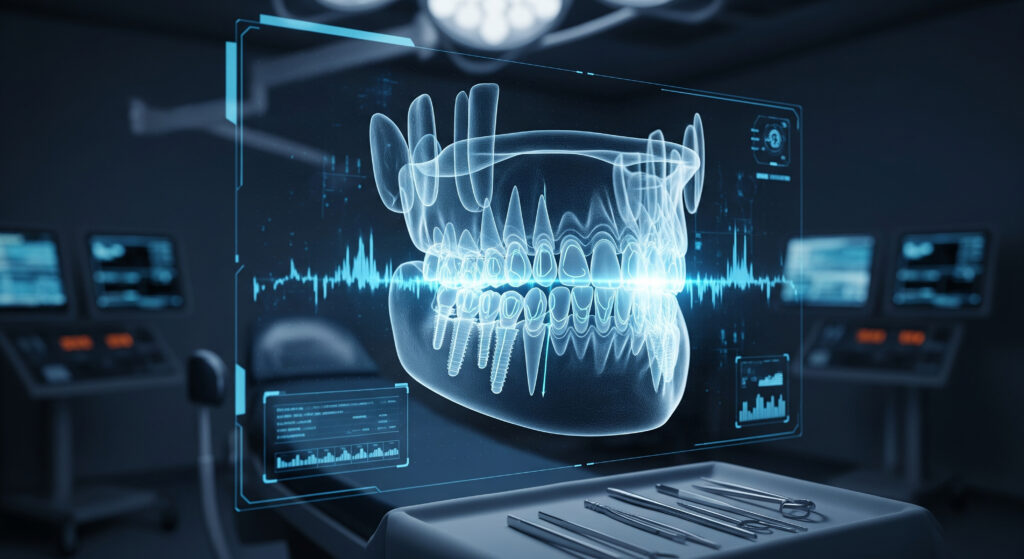
Illustration of AI-assisted analysis. Final diagnosis is always made by the dentist after a clinical examination.
AI image analysis
See how AI reads your scan before the doctor decides
Every panoramic X-ray, CBCT scan and smile photo you send is analysed by AI first. It maps bone, nerves, roots and soft tissue, flags areas that need attention and prepares measurements. Dr. Abdurrahman Öztürk then reviews every finding and makes the clinical decision.
What endodontics treats and why AI root canal treatment matters
Endodontics is the branch of dentistry that cares for the inside of the tooth: the pulp, which contains nerves and blood vessels, and the canals that run through each root down to the jawbone. When deep decay, a crack, repeated dental work or a blow to the face allows bacteria to reach the pulp, it becomes inflamed and later infected. Left alone, the infection can spread beyond the root tip, dissolve bone and form an abscess. Endodontic treatment removes the damaged pulp, cleans and disinfects the canals and seals them, so the tooth can stay in your mouth.
AI root canal treatment does not replace that proven sequence. What it changes is how carefully the case is understood before the first instrument is used. Root canal anatomy is hidden, highly variable and hard to judge on a flat X-ray. Artificial intelligence trained on dental images helps the dentist notice subtle signs of infection, extra canals and risk factors that are easy to miss, and it turns a 3D scan into a model that can be studied from every angle. The result is a more informed plan, always reviewed by Dr. Abdurrahman Öztürk.
- Deep decay that has reached the nerve
- Lingering pain with hot or cold, or pain when biting
- Swelling, a gum pimple or a bad taste from an abscess
- A tooth that has darkened after an injury
- An old root canal that is painful or infected again
How artificial intelligence reads your X-rays and CBCT scans
On a standard dental X-ray, the earliest sign of infection at the root tip is a small dark area where bone has been lost. These areas can be faint, overlapped by other structures or partly hidden by the sinus. AI analysis of panoramic and periapical X-rays scans every tooth systematically and highlights suspicious zones, deep cavities close to the pulp, overhanging fillings and old root fillings that look short or incomplete. The dentist then looks at each highlighted area and decides whether it is truly a problem.
For complex teeth, a CBCT scan gives a three-dimensional view. AI segmentation separates enamel, dentin, pulp, each root and canal, the surrounding bone, the maxillary sinus and the mandibular nerve. This makes it easier to see where canals branch, how sharply they curve and whether a root has a lesion on one side only. In molars, which often have three or four canals and sometimes more, this 3D map helps the dentist look for every canal rather than discovering anatomy during treatment.
AI is a second pair of eyes, not the final word
AI can produce false alarms and can miss things, especially on low-quality images. That is why every finding is confirmed clinically and radiographically by Dr. Öztürk before any treatment is recommended.
Why a 3D scan is not always needed
Many straightforward root canals can be planned from good two-dimensional X-rays. A CBCT scan is suggested when anatomy, symptoms or a previous failure justify the extra radiation and information.
Choosing the right endodontic treatment: a guide to our sub-treatments
Endodontics is not one single procedure. The right treatment depends on whether the tooth has been treated before, where the infection sits, how much healthy tooth structure remains and whether the problem was caused by decay or by an injury. AI analysis helps sort these factors, but the choice is made together with Dr. Öztürk after an examination. Below is a short overview of each option; every one has its own detailed page on this site.
AI Root Canal Therapy
The first-time treatment for a tooth with an inflamed or infected pulp. The nerve tissue is removed, the canals are shaped, disinfected and filled, and the tooth is then restored.
AI Root Canal Retreatment
For a tooth that was treated before but is painful or infected again, often because a canal was missed, the filling was short or the seal leaked. The old material is removed and the canals are cleaned again.
AI Apicoectomy (Surgical Root Treatment)
A small surgical procedure through the gum when infection at the root tip persists and cannot be reached well through the crown. The root tip and infected tissue are removed and the end is sealed.
AI Dental Abscess Treatment
Urgent care for a collection of pus caused by infection. The goal is to drain and control the infection quickly and then treat its source, ideally saving the tooth.
AI Treatment of Traumatic Dental Injuries
Care for teeth that are cracked, broken, pushed out of place or knocked out in an accident, including protection of the pulp and monitoring over time.
AI Preservation of Natural Teeth
Our overall philosophy: keep your own teeth whenever their long-term outlook is reasonable, using endodontics, restorations and prevention before considering extraction and implants.
What happens during AI-assisted root canal treatment in Istanbul
After the AI-supported diagnosis and your consent, the tooth is numbed with local anesthesia. A thin rubber sheet, called a dental dam, is usually placed to isolate the tooth from saliva. The dentist opens a small access through the crown, locates the canals and measures their working length, typically with an electronic apex locator confirmed by X-ray. The canals are then shaped with fine instruments and flushed repeatedly with disinfecting solutions to remove bacteria and tissue debris.
Once clean and dry, the canals are filled with a rubber-like material called gutta-percha and a sealer, and the access is closed with a temporary or permanent filling. Back teeth that have lost a lot of structure usually need a crown afterwards to protect them from fracture. Many root canals are completed in one or two visits; teeth with severe infection, very complex anatomy or retreatment may need more time, and the dentist may place medication inside the canals between sessions.
- Local anesthesia so the procedure itself should not be painful
- Isolation of the tooth to keep the canals clean
- Length measurement guided by the AI canal map and clinical tools
- Cleaning, disinfection and sealing of every canal found
- Final restoration, often a crown for molars and premolars
AI outcome prediction: realistic expectations for saving your tooth
Patients often ask one key question: will this tooth last if I treat it? AI tools can help answer it more clearly by combining what the images show, such as the size of a lesion, the amount of remaining tooth structure, bone support and signs of cracks, into a structured risk assessment. Dr. Öztürk uses this as decision support when explaining whether a root canal, a retreatment, surgery or an extraction is the most sensible path for you.
It is important to be honest about limits. An AI prediction is a simulation based on patterns, not a guarantee. Vertical root fractures, for example, can be very difficult to see even on CBCT, and healing depends on your immune response, oral hygiene and the quality of the final restoration. If the prognosis of a tooth is poor, we will tell you openly and discuss alternatives, including implants, rather than performing treatment that is unlikely to succeed.
Signs that favor saving the tooth
Enough healthy structure for a solid restoration, good bone and gum support, no visible root fracture and canals that can be reached and cleaned.
Signs that may favor extraction
A crack running down the root, very little remaining tooth, advanced gum disease around the tooth or repeated failures where further treatment offers little benefit.
Root canal treatment in Istanbul for international patients
Many of our patients travel to Istanbul from abroad, so we plan endodontic treatment around your schedule. You can start before your trip by sending existing X-rays, CBCT files, photos and a description of your symptoms on WhatsApp. AI pre-screens the images and Dr. Öztürk tells you what is likely needed and roughly how many visits to plan. Final decisions are made only after an in-person examination and fresh images at the clinic.
A simple root canal can often be completed within a short stay, while a retreatment, surgical root procedure or treatment combined with a crown may need several days so the tooth can be checked and the restoration fitted. If you have an active abscess or severe pain, tell us before you travel: flying with an untreated acute infection can be uncomfortable, and we may advise you to see a local dentist first for initial relief.
Risks, limits and why the dentist always decides
Root canal treatment is a common and well-established procedure, but like any medical treatment it carries risks. These can include temporary tenderness after treatment, a flare-up of infection, a small instrument fragment separating inside a very curved canal, a perforation of the root wall, persistent infection that later needs retreatment or surgery, and fracture of a tooth that is not protected by a crown. AI planning aims to reduce surprises, but it cannot remove every risk.
This is why AI at AIDENT is only ever a tool. Dr. Abdurrahman Öztürk reviews each AI finding, examines your tooth, takes responsibility for the diagnosis and explains the benefits and risks of every option. You will always know what the images show, what the software suggested and why the doctor recommends a particular plan, so you can make an informed decision about your own tooth.
- No treatment is started on AI output alone
- All AI findings are checked against clinical tests and X-rays
- Alternatives, including extraction, are always discussed
- Follow-up images are used to confirm healing over time
Conventional vs AI-assisted
Conventional endodontics versus AI-assisted endodontics at AIDENT
Who it suits
Who is a good candidate for AI root canal treatment?
- People with lasting tooth pain, sensitivity to heat or pain on biting
- Patients with a diagnosed or suspected infection at the root tip
- Anyone with a previously treated tooth that hurts or shows a lesion
- Patients with facial swelling or a gum boil linked to a tooth
- Children, teens and adults whose teeth were injured in an accident
- Anyone who wants to keep a natural tooth rather than replace it
Your treatment journey
A typical AI endodontic journey in Istanbul
Before travel
Online AI pre-assessment
Send your X-rays, photos and symptoms on WhatsApp for an AI-supported first opinion from Dr. Öztürk.
Day 1
Examination and imaging
Clinical tests, new X-rays and a CBCT scan if needed, followed by AI analysis and a clear treatment plan.
Day 1–2
Endodontic treatment
Root canal therapy, retreatment or another procedure under local anesthesia, in one or more sessions.
Day 3–5
Restoration
A permanent filling or a digitally designed crown when the tooth needs extra protection.
After you return home
Follow-up
Control X-rays, often after several months, can be sent to us so healing can be compared with the original images.
Why patients choose it
Earlier detection
AI highlights small changes around root tips that might otherwise be overlooked on a routine X-ray.
Better anatomy planning
3D canal maps help the dentist look for every canal before treatment starts.
Clearer choices
Structured risk assessment helps decide between root canal, retreatment, surgery or extraction.
Safer surgery planning
The root tip's relation to the sinus and nerve can be studied in 3D before an apicoectomy.
Understandable explanations
You can see your own tooth in a 3D model and understand exactly what is being treated.
Focus on your own teeth
Every plan starts from the question of whether your natural tooth can be saved predictably.
Your doctor
Every AI-analyzed case is supervised by Dr. Abdurrahman Öztürk
Dr. Abdurrahman Öztürk holds a PhD in dentistry and oral and maxillofacial surgery and has more than 15 years of experience in dentistry and dental surgery. He graduated from a leading Istanbul university and personally oversees every endodontic case at AIDENT Clinic. AI software helps him read X-rays and CBCT scans, map canals and compare treatment options, but he is the one who examines your tooth, confirms the diagnosis and decides whether a root canal, retreatment, surgery or extraction is right for you. His approach is simple: technology supports, the doctor decides, and the natural tooth is saved whenever that is realistic.
Aftercare
Aftercare following root canal treatment
- Avoid chewing on the treated side until the numbness wears off
- Expect mild tenderness for a few days; take pain relief only as advised
- Do not bite hard foods on the tooth until the final filling or crown is placed
- Brush and floss normally, keeping the area clean
- Contact us if swelling, fever or severe pain appear
- Attend the crown appointment if one was recommended
- Send follow-up X-rays when requested so healing can be checked
Explore every treatment in this specialty
Questions and answers
What patients ask about AI Root Canal Treatment
Does AI really make root canal treatment better?
AI makes the diagnosis and planning more thorough, but the treatment itself is still done by the dentist. Software can highlight early bone loss at root tips, possible extra canals and other risks on X-rays and CBCT scans. Dr. Öztürk reviews every finding, so AI acts as a careful second reader that supports, rather than replaces, clinical judgment.
Is AI root canal treatment painful?
The procedure itself should not be painful because the tooth is fully numbed with local anesthesia. Many patients say it feels similar to having a deep filling. Some tenderness when biting is common for a few days afterwards and usually responds to ordinary pain relief. Teeth with an acute infection can be harder to numb, so the dentist may take extra steps.
How do I know whether I need a root canal, a retreatment or an apicoectomy?
The deciding factors are whether the tooth was treated before and where the infection is. A first-time infected pulp usually needs root canal therapy, a previously treated tooth with new problems often needs retreatment, and a persistent lesion at the root tip that cannot be cleaned through the crown may need an apicoectomy. AI images help, but Dr. Öztürk decides after an exam.
How much time do I need to stay in Istanbul for root canal treatment?
Many single root canals can be finished within a short stay of a few days. If the tooth needs a crown, retreatment of several teeth or a surgical root procedure, plan for a longer stay. Sending your X-rays on WhatsApp before travel lets Dr. Öztürk give you a more realistic estimate of the number of visits.
Who is the best dentist for AI root canal treatment in Istanbul?
The best choice is a dentist who combines modern imaging with experience and honest advice about whether a tooth can be saved. At AIDENT, every AI-analyzed endodontic case is supervised by Dr. Abdurrahman Öztürk, who has a PhD in dentistry and oral and maxillofacial surgery and more than 15 years of experience in dentistry and dental surgery.
Can AI tell me if my tooth can be saved?
AI can give a structured estimate, but the final answer comes from the dentist. The software weighs signs such as lesion size, remaining tooth structure, bone support and possible cracks. Dr. Öztürk combines this with clinical tests. Some problems, such as fine root fractures, remain hard to detect, so the prediction is a guide, not a guarantee.
Do I always need a CBCT scan for a root canal?
No, many root canals are planned well from standard X-rays. A CBCT scan is recommended when anatomy looks complex, symptoms do not match the X-ray, a previous treatment failed, surgery is planned or a fracture is suspected. When a scan is taken, AI segmentation turns it into a detailed 3D map of canals, bone and nearby structures.
Can I send my X-rays on WhatsApp before coming to Turkey?
Yes, you can send existing X-rays, CBCT files, photos and a short description of your symptoms to +90 534 445 9444. The images are pre-screened with AI and reviewed by Dr. Öztürk, who gives you a first opinion and an idea of what to plan. A final diagnosis still requires an examination in Istanbul.
What should I do if my face is swollen from a tooth infection?
Facial swelling from a tooth needs prompt dental care, and swelling with fever, difficulty swallowing or breathing is an emergency that needs immediate medical attention. Contact a dentist or emergency service near you without delay. Once the acute infection is controlled, the cause can be treated, which may include root canal treatment at our clinic.
Will I need a crown after root canal treatment?
Back teeth usually need a crown after a root canal, while front teeth with little damage may only need a filling. Molars and premolars take strong chewing forces and often have lost structure to decay and access, so a crown helps protect them from fracture. The final restoration can be designed digitally at AIDENT.
What happens if my old root canal is infected again?
A failed root canal can often be treated again rather than extracted. Common causes are a missed canal, a filling that is too short or bacteria leaking in under an old restoration. AI-supported CBCT analysis helps locate the cause, and Dr. Öztürk then advises whether retreatment, an apicoectomy or, in some cases, extraction is the most sensible option.
Can a knocked-out tooth be saved?
Sometimes, if you act quickly. Pick the tooth up by the crown, not the root, rinse briefly without scrubbing and, if possible, put it back into its socket or keep it in milk or saliva, then see a dentist immediately. Time is critical. Afterwards the pulp often needs endodontic care and regular monitoring.
Is a root canal better than pulling the tooth and getting an implant?
When a tooth has a reasonable long-term outlook, keeping it with a root canal is usually the preferred first option, because nothing fully replaces a natural tooth and its ligament. If the tooth is cracked, badly broken or repeatedly failing, an implant may be wiser. AI risk assessment helps Dr. Öztürk explain both paths honestly.
How long does a root canal appointment take?
A single appointment often takes roughly one to two hours, depending on the tooth. Front teeth with one canal are usually quicker, while molars with three or four curved canals take longer. Retreatment and teeth with severe infection may be split across more than one visit, with medication placed in the canals in between.
Can children and teenagers have AI-assisted endodontic treatment?
Yes, young patients can benefit, especially after an injury to a front tooth. In teeth whose roots are still developing, special techniques aim to keep the pulp alive or encourage root growth. AI image analysis helps track development over time, while Dr. Öztürk decides the safest approach for each child together with the parents.
No question matches your search. Ask us directly on WhatsApp.
Find out if your tooth can be saved with AI root canal treatment
Send your X-rays, CBCT scan or photos on WhatsApp. Our AI pre-screens the images and Dr. Abdurrahman Öztürk reviews your case personally, then tells you which endodontic treatment makes sense and how long to plan in Istanbul.
Get my free AI root canal assessment on WhatsAppFree initial review of your photos and X-rays. Reply on WhatsApp.