AI-Planned Bite & Jaw Correction
AI Bite Correction in Istanbul: Overbite, Underbite, Crossbite and Open Bite
AI bite correction at AIDENT Clinic starts by measuring how your teeth and jaws actually meet, using AI analysis of photos, X-rays and 3D CBCT scans. Dr. Abdurrahman Öztürk, an oral and maxillofacial surgeon, then decides whether orthodontics alone can fix your bite or whether the jaw itself needs to be repositioned.
 Medically reviewed by Dr. Abdurrahman Öztürk, PhD, oral & maxillofacial surgery
The 3D model combines your CBCT scan and intraoral scan so the upper and lower jaws can be moved virtually. It shows how the teeth meet now and how a planned correction may change the bite.
Short answer
What is AI bite correction?
AI bite correction is the treatment of overbite, underbite, crossbite or open bite planned with artificial intelligence. AI measures teeth, jaw angles and facial profile on X-rays and 3D scans, and simulates possible results. The dentist then chooses orthodontics, jaw surgery or a combination, and confirms the plan after a clinical examination.
- Bite types treated
- Overbite, underbite, crossbite, open bite
- Key question
- Teeth problem or jaw problem?
- AI imaging
- Cephalometric X-ray + 3D CBCT
- Supervision
- Dr. Abdurrahman Öztürk, OMFS
AI
How AI analyzes your bite before anything is decided
A bad bite can come from tilted teeth, from jaws that grew to different sizes, or from both. The AI workflow is built to separate these causes, because the right treatment depends on it.
- 1
Face and smile photos
Front, side and smiling photos are analyzed with AI to assess facial thirds, lip support, chin position and the visible midline.
- 2
AI cephalometric tracing
On a side skull X-ray, AI places anatomical landmarks and calculates the jaw angles that show whether the upper and lower jaws are in balance.
- 3
3D CBCT segmentation
The CBCT scan is segmented into upper jaw, lower jaw, teeth, nerve canals and airway, so asymmetry and bone thickness can be measured in three dimensions.
- 4
Intraoral 3D scan
A digital scan of both arches records how the teeth meet, where they hit first and how they slide when you close and chew.
- 5
Movement and surgery simulation
Software simulates tooth movements and, where needed, virtual jaw repositioning, showing an estimated effect on the bite and profile.
- 6
Doctor's decision
Dr. Öztürk reviews every measurement, examines you clinically and decides the plan. The AI output is a planning aid, never the final word.
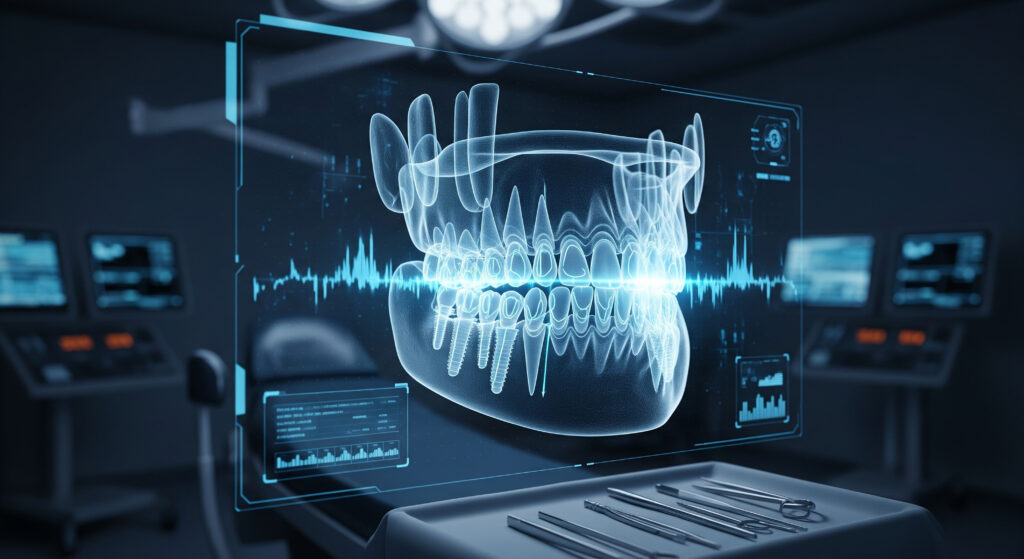
Illustration of AI-assisted analysis. Final diagnosis is always made by the dentist after a clinical examination.
AI image analysis
See how AI reads your scan before the doctor decides
Every panoramic X-ray, CBCT scan and smile photo you send is analysed by AI first. It maps bone, nerves, roots and soft tissue, flags areas that need attention and prepares measurements. Dr. Abdurrahman Öztürk then reviews every finding and makes the clinical decision.
The four bite problems AI bite correction deals with
Dentists call an incorrect bite a malocclusion. It describes how the upper and lower teeth meet when you close, not only how straight they look. Many people have a perfectly aligned front row and still have a bite that wears teeth, strains the jaw joint or makes biting into food difficult. Others have crooked teeth with a healthy bite underneath. AI bite correction focuses on the relationship between the arches and between the jaws.
Each type below can be mild, moderate or severe, and several types often appear together in one mouth. A deep overbite combined with a crossbite on one side, for example, is common. That is why the plan is built on measurements rather than on a single label.
Overbite and overjet
In a deep overbite the upper front teeth cover too much of the lower ones vertically; in some cases the lower teeth bite into the palate. Overjet means the upper teeth stick out forward. The cause can be flared teeth, a small lower jaw or both.
Underbite
The lower front teeth sit in front of the upper ones. It often comes from a lower jaw that grew too far forward, an upper jaw that grew too little, or a combination, and it frequently runs in families.
Crossbite
Some upper teeth close inside the lower teeth instead of outside them. It may affect one tooth, a group of back teeth, or a whole side, and can push the lower jaw to shift sideways when closing.
Open bite
The front or side teeth do not touch when the back teeth close. Habits such as thumb sucking or tongue thrusting can contribute, but some open bites are caused by the vertical growth pattern of the jaws.
Teeth problem or jaw problem? How AI helps tell the difference
The single most important question in bite correction is whether the problem is dental or skeletal. A dental malocclusion means the jaws are reasonably balanced but the teeth are tipped or positioned wrongly; orthodontics can usually correct it. A skeletal malocclusion means the jaw bones themselves are mismatched in size or position. Moving teeth alone can only partly hide a skeletal difference, and pushing teeth too far to compensate may thin the bone around their roots.
AI cephalometric analysis measures standard angles and distances between landmarks on the skull X-ray and compares them with reference norms. On the CBCT, AI segmentation shows how much bone surrounds each root and whether the jaws are symmetrical. These numbers do not make the decision, but they give Dr. Öztürk a fast, consistent and repeatable picture, which he combines with your facial appearance, your age, your concerns and the clinical examination.
- Dental cause: teeth are tipped, but jaw sizes are close to normal
- Skeletal cause: one jaw is too far forward, back, narrow or asymmetrical
- Mixed cause: the most common situation in adults
- Bone limits: CBCT shows how far teeth can safely move inside the bone
Bite correction with orthodontics alone
When the analysis shows a mainly dental problem, or a mild skeletal one that can be safely disguised, the bite is corrected by moving teeth. This may use fixed braces or, in suitable cases, clear aligners; the choice of appliance is discussed separately. For bite correction the key tools are elastics that pull between the arches, expansion of a narrow upper arch to fix a crossbite, intrusion or extrusion of teeth to close an open bite or open a deep bite, and occasionally small temporary anchorage screws placed in the bone to give the teeth a fixed point to move against.
AI tooth-movement simulation helps estimate how far each tooth needs to travel and whether the roots will stay within the bone. Treating a skeletal discrepancy with teeth alone is called orthodontic camouflage. It can give a good bite and an acceptable appearance in mild cases, but it does not change the jaw bones or the profile much, and that limitation is explained before you start.
- Interarch elastics for overbite and underbite tendencies
- Upper arch expansion for crossbite
- Vertical tooth control for open and deep bites
- Temporary anchorage devices when extra anchorage is needed
When the jaw itself must move: AI-planned corrective jaw surgery
For moderate to severe skeletal problems, the stable solution is often orthognathic surgery, also called corrective jaw surgery. The surgeon repositions the upper jaw, the lower jaw or both, and sometimes the chin, so the teeth can meet correctly and the face is better balanced. It can also help selected patients whose jaw position narrows the airway and contributes to snoring or obstructive sleep apnea, after proper sleep assessment.
Surgery is normally combined with orthodontics. Before the operation, braces align the teeth to each jaw, which may temporarily make the bite look worse. After the operation, orthodontics fine-tunes the bite. Jaw surgery is generally done once facial growth has finished, so it is mainly a treatment for older teenagers and adults. It is a major operation under general anesthesia with a hospital stay, and it deserves careful thought.
Upper jaw surgery
The upper jaw can be moved forward, up, down or tilted. The commonly used technique is called a Le Fort I osteotomy.
Lower jaw surgery
The lower jaw is often moved forward or back with a bilateral sagittal split osteotomy, performed through incisions inside the mouth.
Chin surgery
A genioplasty can adjust chin projection or symmetry and is sometimes added to complete the profile.
Virtual surgical planning: rehearsing the operation on your 3D model
Traditional jaw surgery planning relied on plaster models and two-dimensional tracings. In AI-assisted virtual surgical planning, your CBCT and intraoral scans are merged into one 3D model. AI segmentation separates the jaws, teeth and nerve canals, so the planned bone cuts can be checked against the position of the nerves and tooth roots. The jaws are then moved on screen to test different options, and the software estimates how the bite and the soft-tissue profile may change.
Once Dr. Öztürk approves a plan, it can be turned into 3D-printed surgical splints or guides that help transfer the planned position to the operating room. Soft-tissue predictions are approximations: real swelling, healing and the way skin drapes over bone vary from person to person. The simulation helps you understand the direction of change; it is not a guarantee of an exact face.
Recovery, risks and honest expectations
Orthodontic-only bite correction usually brings temporary tooth soreness after adjustments, possible irritation from appliances and the ongoing need for good hygiene. Root shortening, gum recession and relapse are recognized risks, which is why bone limits are checked on CBCT and retainers are required afterwards.
After jaw surgery, swelling is usually greatest in the first days and settles gradually over the following weeks. A soft or liquid diet is needed while the bone heals, and normal chewing returns step by step. Numbness of the lower lip, chin or upper lip is common at first because sensory nerves run close to the surgical area; it often improves over months but can be permanent in some patients. Other risks include infection, bleeding, changes in the jaw joint, the need for further surgery and partial relapse. AI planning aims to reduce surprises, but it cannot remove surgical risk.
- No technique, AI-assisted or not, can guarantee a final result
- Retainers are needed long term after any bite correction
- Smoking slows bone and gum healing and is discouraged
Planning AI bite correction from abroad in Istanbul
Most international patients start with photos sent on WhatsApp: front face, side profile, smile, and the teeth closed from the front and both sides. Any existing panoramic or skull X-rays are useful too. This gives an AI-assisted first impression of whether the problem looks mainly dental or skeletal, and Dr. Öztürk tells you which route seems likely and what still needs to be confirmed in person.
Orthodontic bite correction takes many months, so visits in Istanbul are combined with remote progress photos and, when appropriate, follow-up with a local dentist. If jaw surgery is recommended, plan an extended stay that covers the hospital days and early recovery checks before flying; the exact length is set by the surgeon according to your operation and healing.
Conventional vs AI-assisted
Conventional bite planning vs AI-assisted bite correction
Who it suits
Who may benefit from AI bite correction
- Adults or teenagers with a deep overbite or protruding upper teeth
- People whose lower teeth sit in front of the upper teeth
- Patients with a crossbite on one side or a lower jaw that shifts when closing
- People whose front teeth do not touch when they bite
- Patients with noticeable jaw or chin asymmetry
- People with uneven tooth wear, chewing difficulty or jaw strain related to the bite
Your treatment journey
Your AI bite correction journey
Before travel
Photo and X-ray review
Send photos and any X-rays on WhatsApp for an AI-assisted first look and the doctor's preliminary opinion.
First visit
Examination and imaging
Clinical exam of teeth, gums and jaw joints, cephalometric X-ray, CBCT where indicated and a full intraoral scan.
Planning
AI analysis and options
Dental vs skeletal diagnosis, tooth-movement simulation and, if relevant, virtual jaw surgery. Dr. Öztürk explains each option and its limits.
Active phase
Orthodontic correction
Braces or aligners, elastics, expansion or anchorage screws as planned, with clinic visits and remote progress photos.
If surgery is needed
Jaw surgery and recovery
Operation under general anesthesia, hospital stay and close follow-up, then post-surgical orthodontic finishing.
Final stage
Retention
Appliances are removed, the bite is checked and retainers are fitted to keep the correction stable.
Why patients choose it
The right diagnosis first
AI measurements help distinguish tooth problems from jaw problems, which determines whether orthodontics or surgery is the sensible route.
Safer tooth movement
CBCT-based bone analysis shows how far teeth can move without pushing roots out of their bone support.
Precise surgical planning
Virtual surgery lets the jaw position be tested on screen before the operation, with nerve canals clearly mapped.
Clear visual explanation
Simulations help you see the direction of change in your bite and profile, so you can make an informed choice.
Surgeon-led care
Dr. Öztürk's background in oral and maxillofacial surgery means both orthodontic and surgical routes are assessed by one doctor.
Remote first assessment
International patients can get an initial opinion from photos before booking any travel to Istanbul.
Your doctor
Every bite case is reviewed by Dr. Abdurrahman Öztürk
Bite correction sits at the meeting point of orthodontics and jaw surgery, so it matters who reads the data. Dr. Abdurrahman Öztürk holds a PhD in dentistry and oral and maxillofacial surgery and has more than 15 years of experience in dentistry and dental surgery. At AIDENT Clinic, AI tools trace the X-rays, segment the CBCT and simulate tooth and jaw movements, but Dr. Öztürk checks each landmark and measurement, examines the patient in person and decides whether orthodontics, surgery or a combination is appropriate. AI supports the analysis; the doctor makes every clinical decision.
Aftercare
Aftercare for a corrected bite
- Wear your retainers exactly as instructed; bites can drift back without them
- Keep wearing elastics as prescribed during the active phase, because they only work when worn
- After jaw surgery, follow the soft diet plan and avoid hard chewing until cleared
- Clean around braces, wires and surgical sites carefully to protect the gums
- Report new pain, clicking in the jaw joint or a change in how teeth meet
- Avoid smoking during treatment and healing
- Send progress photos or attend check-ups on the agreed schedule
Related AI treatments
Questions and answers
What patients ask about AI Bite Correction
Can an overbite be fixed in adults?
Yes, an overbite can usually be corrected in adults. If the cause is mainly the position of the teeth, orthodontics with elastics and vertical tooth control can reduce it. If a small lower jaw is the main cause, a combination with jaw surgery may give a more stable and balanced result. AI analysis of your X-rays helps clarify which situation applies.
How do I fix my underbite without surgery?
A mild underbite caused mainly by tooth position can often be improved without surgery, using braces or aligners, elastics and sometimes anchorage screws. A strong underbite caused by jaw size usually cannot be fully corrected by teeth alone. AI cephalometric measurements show how skeletal your underbite is, and Dr. Öztürk explains honestly whether a non-surgical approach is realistic.
Does AI really decide whether I need jaw surgery?
No, AI does not decide. It measures jaw angles, bone thickness and asymmetry quickly and consistently, and it simulates possible corrections. The decision about surgery is made by Dr. Öztürk after he reviews those measurements, examines your face and bite in person and discusses your goals and the risks with you.
How long does bite correction take?
Orthodontic bite correction usually takes many months and often more than a year, depending on severity, age and cooperation with elastics. When jaw surgery is involved, the full process including orthodontics before and after the operation is longer still. Your personal estimate is given after the AI analysis and clinical examination.
Is jaw surgery for bite correction painful?
The operation is done under general anesthesia, so you do not feel it. Afterwards, swelling, stiffness and discomfort are expected and are managed with prescribed medication. Many patients describe swelling and numbness as more bothersome than pain. Discomfort usually eases progressively over the first weeks.
How much time do I need to stay in Istanbul for bite correction?
It depends on the route. For orthodontic bite correction, you come for the examination, scans and appliance placement, then return periodically while sending progress photos in between. For jaw surgery, plan a longer stay that covers the hospital days and early recovery checks; the surgeon sets the exact length for your case.
Can a crossbite be corrected with AI-planned treatment?
Yes, most crossbites can be corrected. A single tooth in crossbite is often moved with orthodontics, while a narrow upper arch may need expansion. In adults with a very narrow upper jaw, surgically assisted expansion is sometimes required. AI analysis of the 3D scan helps measure arch width and decide which approach fits.
What causes an open bite, and can it come back?
An open bite can be caused by habits like thumb sucking or tongue pressure, by the vertical growth pattern of the jaws, or by both. It can be corrected with orthodontics or, in skeletal cases, jaw surgery. Open bites have a known tendency to relapse, so controlling tongue habits and wearing retainers are important parts of treatment.
Will bite correction change the shape of my face?
Orthodontic bite correction alone usually changes the face only slightly, mostly around the lips. Jaw surgery can change the profile more noticeably, for example the chin or lower face projection. AI simulations show an estimated direction of change, but real soft-tissue results vary, so the preview is a guide rather than a promise.
Is there numbness after corrective jaw surgery?
Numbness of the lip or chin is common after jaw surgery because sensory nerves pass near the surgical area. In many patients sensation returns gradually over months. In some, a degree of numbness remains permanently. Virtual planning maps the nerve canals on the CBCT to help the surgeon plan around them, but the risk cannot be eliminated.
What age is best for bite correction?
Bite problems can be treated at different ages. In growing children, some jaw imbalances can be guided with growth-modifying appliances. Corrective jaw surgery is generally done after facial growth has finished, usually in late teens or adulthood. Adults can have orthodontic bite correction at any age if their teeth and gums are healthy.
Can a bad bite cause jaw pain or headaches?
A bad bite can contribute to uneven tooth wear and strain on the chewing muscles, but jaw pain and headaches usually have several causes. Correcting the bite does not automatically cure jaw joint disorders. Dr. Öztürk examines the joints and muscles before treatment and explains what bite correction can and cannot be expected to improve.
Who is the best dentist for AI bite correction in Istanbul?
The right dentist for bite correction is one who can assess both orthodontic and surgical options. At AIDENT Clinic, Dr. Abdurrahman Öztürk, with a PhD in oral and maxillofacial surgery and over 15 years of experience, reviews every AI analysis personally, so whichever route you take, the plan comes from a single surgeon's clinical judgment.
Can I get an AI bite assessment before I travel?
Yes. Send front, side and smiling photos, close-ups of your teeth closed together and any X-rays you have on WhatsApp. You will receive an AI-assisted first impression and the doctor's preliminary view. A final plan always requires an in-person examination and imaging in Istanbul.
No question matches your search. Ask us directly on WhatsApp.
Find out what is behind your bite
Send your face and teeth photos on WhatsApp. We will look at them with AI support, and Dr. Öztürk will tell you whether your bite looks like a teeth problem, a jaw problem or both, and what the realistic options are.
Get my free AI bite assessment on WhatsAppFree initial review of your photos and X-rays. Reply on WhatsApp.