AI-Guided Conservative Dentistry
AI Preservation of Natural Teeth in Istanbul
AI preservation of natural teeth means finding problems while they are still small and repairing them with the least possible loss of healthy tooth. At AIDENT Clinic, AI reads your X-rays, scans and photos, and Dr. Abdurrahman Öztürk decides the most conservative treatment that will protect your own tooth.
 Medically reviewed by Dr. Abdurrahman Öztürk, PhD, oral & maxillofacial surgery
The model shows enamel, dentine and the living pulp of a molar. Conservative treatment aims to stop damage in the outer layers so the pulp and as much natural structure as possible stay healthy.
Short answer
What is AI preservation of natural teeth?
AI preservation of natural teeth is a conservative dental approach that uses artificial intelligence to spot early decay, cracks, wear and bone changes on X-rays, CBCT and 3D scans, so problems are treated sooner and with less drilling. The software supports the analysis; Dr. Abdurrahman Öztürk examines you and makes every treatment decision.
- Main goal
- Keep your own tooth, nerve and enamel wherever possible
- AI role
- Flags early decay, cracks and bone changes on images
- Typical treatments
- Sealants, small fillings, pulp protection, inlays and onlays
- Clinical lead
- Dr. Abdurrahman Öztürk, 15+ years of experience
AI
How AI helps us save your natural teeth
Preserving a tooth depends on timing: the earlier a problem is found, the smaller the repair. Our AI-assisted workflow is designed to catch changes early and to plan the least invasive option, always reviewed by the dentist.
- 1
Photo and history review
You share smile photos, existing X-rays and your symptoms on WhatsApp. This gives a first impression of which teeth need closer attention.
- 2
AI reading of bitewing and panoramic X-rays
Detection software highlights possible early decay between teeth, under old fillings and at the gumline, including shadows that are easy to miss by eye.
- 3
Intraoral 3D scan
A digital scan records every surface of every tooth, showing wear facets, fine cracks, chipped edges and gaps where food and plaque collect.
- 4
CBCT when it is justified
For teeth with deep decay, suspected cracks or unclear symptoms, a 3D CBCT scan lets AI segmentation show the distance between decay and the nerve and the condition of the surrounding bone.
- 5
Least-invasive plan options
The findings are compared against options such as monitoring, remineralisation, a small filling, pulp protection or an onlay, ranked by how much healthy structure each one keeps.
- 6
Dentist decision and follow-up baseline
Dr. Öztürk confirms the findings clinically, chooses the treatment with you and saves the scans as a baseline so future changes can be compared accurately.
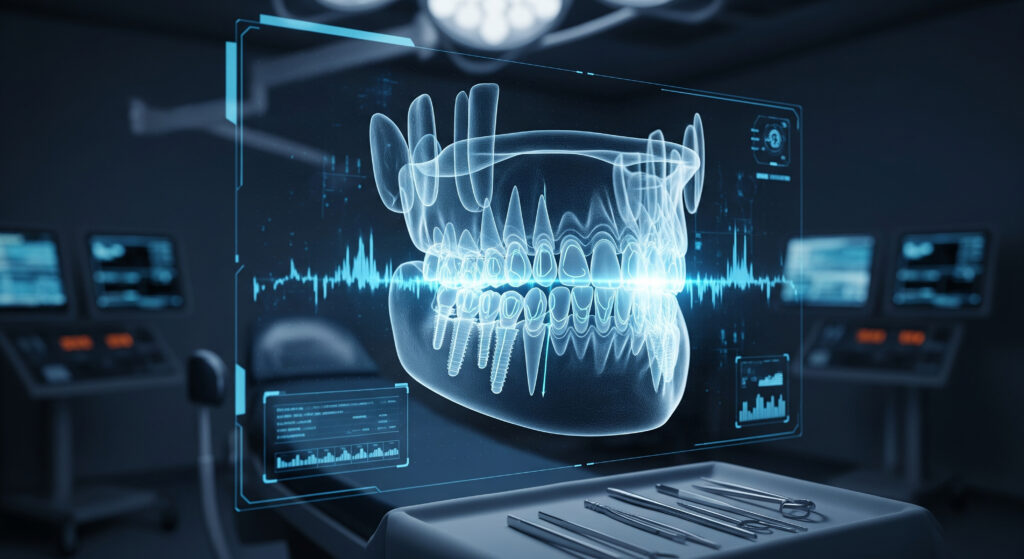
Illustration of AI-assisted analysis. Final diagnosis is always made by the dentist after a clinical examination.
AI image analysis
See how AI reads your scan before the doctor decides
Every panoramic X-ray, CBCT scan and smile photo you send is analysed by AI first. It maps bone, nerves, roots and soft tissue, flags areas that need attention and prepares measurements. Dr. Abdurrahman Öztürk then reviews every finding and makes the clinical decision.
Why keeping your natural teeth matters more than replacing them
No crown, bridge or implant behaves exactly like a healthy natural tooth. Your own tooth sits in bone through a ligament that cushions chewing forces and sends fine sensory feedback, so you feel how hard you bite. It also keeps the jawbone around it stimulated, which helps maintain the shape of the face and the position of neighbouring teeth. When a tooth is lost, bone in that area tends to shrink over time and nearby teeth may drift or tilt.
Every restoration also has a life cycle. Fillings and crowns eventually need repair or replacement, and each replacement usually removes a little more tooth. That is why preservation dentistry focuses on doing the smallest effective treatment first and on avoiding the cycle of ever-larger repairs. Saving a natural tooth is often simpler, more comfortable and, in the long run, kinder to the rest of the mouth than replacing it.
- Natural feel and bite feedback through the periodontal ligament
- Better maintenance of jawbone and gum contours
- Neighbouring teeth stay in position
- Fewer future replacement cycles when repairs are kept small
AI early detection: finding decay and cracks before they hurt
Tooth decay usually starts silently. Early lesions between back teeth or under existing fillings often cause no pain until they reach the dentine or come close to the nerve. On X-rays these early lesions appear as faint grey shadows, and their interpretation can vary between examiners. AI detection software, trained on large sets of annotated dental images, marks suspicious areas and gives the dentist a consistent second look at every surface.
The AI does not diagnose by itself. Some marked areas turn out to be harmless overlaps or old filling material, and some real problems are only visible during clinical examination. Dr. Öztürk checks each highlighted area with the X-ray, the 3D scan and a direct examination before anything is planned. The value of AI here is simple: fewer small problems are overlooked, so more teeth can be treated while the repair is still small.
Hidden decay under old fillings and crowns
Recurrent decay at the edge of an old restoration is a common reason teeth are eventually lost. AI-assisted reading helps spot these margins early so the old filling can be repaired or replaced before decay spreads deeper.
Cracked tooth signs
Fine cracks are hard to see on standard X-rays. Biting pain on release, sensitivity to cold and wear patterns on the 3D scan help us assess cracks; magnification and testing in the chair confirm what the images suggest.
Minimally invasive treatments we use to preserve tooth structure
Once a problem is confirmed, the goal is to remove only what is damaged and to keep healthy enamel and dentine. Not every early lesion needs drilling at all. Enamel that has only started to lose minerals can often be stabilised with fluoride, careful hygiene and diet changes, then monitored on later scans. Deep grooves on back teeth that trap plaque can be protected with sealants.
When a restoration is needed, modern adhesive materials let us bond directly to the tooth, so the cavity does not have to be shaped to hold a filling mechanically. For larger damage on back teeth, an inlay or onlay designed on the digital model can rebuild the weak parts while leaving strong walls intact, instead of cutting the whole tooth down for a crown.
- Fluoride varnish and remineralisation for early enamel lesions
- Fissure sealants for deep grooves on molars and premolars
- Small bonded composite fillings with minimal preparation
- Repair of a failing filling edge rather than full replacement when suitable
- CAD/CAM inlays and onlays to reinforce weakened teeth
- Night guards to protect teeth from grinding damage
Protecting the living nerve: vital pulp therapy with AI planning
When decay is deep, the question is whether the pulp, the living nerve and blood supply inside the tooth, can stay alive. If the pulp is still healthy or only mildly inflamed, vital pulp therapy may protect it instead of removing it. In indirect pulp capping, most of the decay is removed and a protective, biocompatible material is placed over the thin remaining layer near the nerve. In direct pulp capping or partial pulpotomy, a small exposed area of pulp is covered with a bioceramic material that encourages healing.
Before choosing this route, AI segmentation of the X-ray or CBCT helps estimate how close the decay is to the pulp, and your symptoms and pulp tests show how healthy the nerve is. Vital pulp therapy is not suitable for every tooth. If the nerve is already irreversibly inflamed or infected, root canal treatment is usually the more predictable option, and Dr. Öztürk will explain this honestly.
Signs the pulp may still be savable
Short, sharp sensitivity that fades quickly after cold or sweet food can suggest a reversible condition. Lingering pain, night pain or swelling usually point to a more advanced problem.
Why follow-up matters
After pulp protection, the tooth is checked again with tests and X-rays. Comparing new images with the AI baseline helps confirm that the nerve is responding well.
Save or extract? How the decision is made at AIDENT
Not every tooth can or should be kept. A tooth may be too badly broken below the gum, have a crack running down the root, or lack enough bone support. In these situations, keeping it can lead to repeated infections and wasted treatment. Our preservation approach does not mean saving teeth at any cost; it means giving every tooth a fair, evidence-based assessment before extraction is considered.
AI tools help organise the information: remaining wall thickness, the depth of decay relative to the bone level, crack patterns, root shape and the condition of the supporting bone. Dr. Öztürk combines this with clinical tests, your gum health, your bite and your own priorities. You receive a clear explanation of the options, including the likely maintenance each one needs, so the decision is shared and informed.
- Enough healthy structure to support a durable restoration
- Decay or fractures that end above the bone level
- Healthy or treatable gum and bone support
- A tooth that is useful for chewing and the overall bite plan
Preservation treatment in Istanbul for international patients
Many patients contact us from abroad because they have been told a tooth needs extraction or a crown and want a second opinion focused on keeping it. You can send your recent X-rays, photos and a description of your symptoms on WhatsApp. This preliminary review cannot replace an examination, but it helps estimate which treatments may be needed and how many days to plan in Istanbul.
Most conservative treatments, such as sealants, bonded fillings and pulp protection, can be completed in one or a few visits. Digitally designed inlays and onlays are often made within a short stay using CAD/CAM. Before you leave, you receive copies of your scans and a written summary, so your local dentist can continue monitoring the treated teeth.
Conventional vs AI-assisted
Conventional versus AI-assisted tooth preservation
Who it suits
Who benefits from AI preservation of natural teeth?
- Patients with early or hidden decay found on a check-up X-ray
- People told a tooth needs a crown who want a less invasive option assessed
- Teeth with deep decay where the nerve may still be healthy
- Patients with old, leaking fillings at risk of recurrent decay
- People who grind their teeth and show wear or fine cracks
- Anyone seeking a second opinion before agreeing to an extraction
Your treatment journey
Typical AI tooth preservation timeline
Before travel
Remote review
Send X-rays, photos and symptoms on WhatsApp for a first opinion and an estimate of visit length.
Day 1
Exam, imaging and AI analysis
Clinical exam, X-rays, intraoral scan and CBCT if needed. AI findings are reviewed with you on screen.
Day 1–2
Conservative treatment
Sealants, small bonded fillings, repairs or pulp protection are carried out by Dr. Öztürk.
Day 2–4
Inlays or onlays if planned
Digitally designed restorations are milled and bonded. Timing depends on the number of teeth involved.
Before departure
Bite check and home plan
The bite is checked, a prevention plan is explained and your scans are shared for future monitoring.
Why patients choose it
More of your own tooth kept
Finding problems early usually means smaller repairs and less removal of healthy enamel and dentine.
Chance to keep the nerve alive
Careful assessment of deep decay allows vital pulp therapy to be considered when the pulp is still healthy.
Consistent second look
AI reads every surface on every image the same way, helping reduce overlooked early lesions.
Clear visual explanation
Marked X-rays and 3D scans help you understand why a tooth needs treatment, or why it can simply be watched.
Measurable monitoring
Saved digital baselines make it easier to see whether an early lesion is stable or progressing.
Decisions by an experienced dentist
Dr. Abdurrahman Öztürk reviews every AI finding and selects the treatment with you.
Your doctor
Supervised by Dr. Abdurrahman Öztürk
Dr. Abdurrahman Öztürk holds a PhD in dentistry and oral and maxillofacial surgery and has more than 15 years of experience in dentistry and dental surgery. He graduated from a leading Istanbul university. At AIDENT Clinic, he personally reviews every AI-analysed X-ray, CBCT scan and 3D model before any tooth is treated. His surgical background is valuable in preservation work: knowing exactly when a tooth can be saved, and when it cannot, protects patients from both unnecessary extractions and unnecessary treatment. AI supports his analysis; he makes every clinical decision.
Aftercare
Aftercare to keep your natural teeth healthy
- Brush twice daily with a fluoride toothpaste and clean between teeth every day
- Limit how often you have sugary snacks and acidic drinks between meals
- Avoid very hard foods on newly restored or pulp-treated teeth for the first days
- Report lingering pain, night pain or swelling after pulp protection promptly
- Wear your night guard if one was made for grinding
- Have regular check-ups and X-rays so changes are compared with your baseline scans
Related AI treatments
Questions and answers
What patients ask about AI Preservation of Natural Teeth
Can AI find cavities that my dentist missed?
AI can highlight early shadows that are easy to overlook, but it is a support tool, not a final judge. The software flags suspicious areas on X-rays, and some of these turn out to be harmless. Dr. Öztürk checks every marked area clinically before recommending treatment, so you are not treated on the basis of software alone.
Does early decay always need a filling?
No, very early decay limited to the enamel can often be stopped without drilling. Fluoride varnish, better cleaning between teeth and fewer sugary snacks can help the enamel remineralise. We record the lesion on a digital baseline and compare it at later check-ups, and a small filling is placed only if it progresses.
Can a tooth with deep decay be saved without a root canal?
Sometimes, yes, if the nerve is still healthy. Vital pulp therapy, such as indirect or direct pulp capping, can protect the pulp under a biocompatible material. It depends on your symptoms, pulp tests and how close the decay is to the nerve on the images. If the pulp is irreversibly inflamed, root canal treatment is usually more predictable.
Is an onlay better than a crown for a damaged back tooth?
An onlay is often more conservative because it replaces only the weak parts and leaves strong walls in place. A crown covers the whole tooth and needs more reduction. Which one is better depends on how much healthy structure remains, your bite and any cracks, which Dr. Öztürk evaluates using the 3D scan and clinical exam.
Can a cracked tooth be saved?
Many cracked teeth can be saved if the crack is limited to the crown of the tooth. Bonding the crack or covering the cusps with an onlay or crown can hold the tooth together. If the crack extends deep into the root, the tooth often cannot be kept reliably, and extraction may then be the honest recommendation.
Is preservation treatment painful?
Most preservation treatments are comfortable and many need little or no drilling. Sealants and fluoride are painless, and small fillings or pulp protection are done under local anaesthesia. Some mild sensitivity for a few days afterwards is common, especially after deep fillings, and usually settles on its own.
How much time do I need to stay in Istanbul for tooth preservation treatment?
Many patients need only one to three days for examination, AI analysis and conservative fillings or pulp protection. If several inlays or onlays are planned, a few extra days may be needed. Sending your X-rays and photos on WhatsApp first helps us give you a more realistic estimate before you book travel.
Who is the best dentist for AI tooth preservation in Istanbul?
Look for a dentist who uses AI as an aid but makes decisions personally and explains them clearly. At AIDENT Clinic, Dr. Abdurrahman Öztürk, who has a PhD and more than 15 years of experience, reviews every AI-analysed scan and recommends the least invasive treatment that is likely to last.
Does AI really make conservative dentistry better?
AI mainly helps with consistency and early detection. It reads every surface of every image in the same way and makes small changes easier to compare over time. It cannot feel a tooth, test a nerve or understand your priorities, so its value depends on an experienced dentist interpreting the findings.
Can I get a second opinion before having a tooth pulled?
Yes, a second opinion is a common reason patients contact us. Send your most recent X-rays or CBCT and photos on WhatsApp, along with your symptoms. Dr. Öztürk reviews them and tells you whether saving the tooth appears possible, though a final answer always requires a clinical examination.
How do I know if my old fillings need replacing?
Old fillings need attention when they are cracked, leaking at the edges or have new decay underneath. You may notice staining, roughness or sensitivity, but often there are no symptoms. AI-assisted X-ray reading and the 3D scan help locate failing margins, and sometimes a repair is enough instead of a full replacement.
Can teeth grinding damage be stopped?
Yes, the damage can usually be slowed or stopped with a custom night guard. Grinding wears enamel, causes chips and can create fine cracks. The 3D scan shows wear patterns that serve as a baseline, and worn edges can be rebuilt conservatively with bonding once the cause is controlled.
How often should I have check-ups to keep my natural teeth?
Most adults benefit from check-ups every six to twelve months, but the right interval depends on your personal decay and gum disease risk. Patients with many fillings, dry mouth or a history of new cavities may need more frequent visits. Regular images allow early changes to be compared with your baseline.
No question matches your search. Ask us directly on WhatsApp.
Find out if your tooth can be saved
Send your X-rays, photos and symptoms on WhatsApp. Dr. Abdurrahman Öztürk will review your case with AI-assisted analysis and suggest the most conservative options before you travel to Istanbul.
Get my free AI tooth assessment on WhatsAppFree initial review of your photos and X-rays. Reply on WhatsApp.