AI-Planned Full-Arch Implantology
AI All-on-6 Implants in Istanbul: A Fixed Full Arch on Six AI-Planned Implants
AI All-on-6 implants replace a complete upper or lower arch with a fixed bridge anchored to six implants, each positioned using AI analysis of your CBCT scan and digital smile simulation. Every plan is reviewed and approved by Dr. Abdurrahman Öztürk before surgery in Istanbul.
 Medically reviewed by Dr. Abdurrahman Öztürk, PhD, oral & maxillofacial surgery
The 3D model shows six titanium implants spread along the jaw, joined by abutments to one fixed bridge. Spreading the load over six points instead of fewer is the core idea of All-on-6.
Short answer
What are AI All-on-6 implants?
AI All-on-6 is a full-arch treatment where six dental implants support a fixed bridge of teeth in one jaw. At AIDENT, AI software analyzes your CBCT scan to map bone and nerves, suggests where the six implants should go and simulates your new smile, while Dr. Abdurrahman Öztürk confirms every decision.
- Implants per arch
- Six
- Typical trips to Istanbul
- Usually two
- Teeth on surgery week
- Fixed temporary bridge when stability allows
- Supervising surgeon
- Dr. Abdurrahman Öztürk, 15+ years
AI
How AI Plans Your All-on-6 Step by Step
Placing six implants in one arch means six angles, six depths and six distances to respect. AI helps us study all of them together, so the final bridge sits on a balanced, well-spread foundation.
- 1
Photo and X-ray screening
You send smile photos and any existing X-rays on WhatsApp. AI-assisted review flags missing teeth, bone loss patterns and old restorations so the doctor can judge early whether All-on-6 is realistic.
- 2
CBCT bone segmentation
A 3D CBCT scan is processed with AI segmentation that outlines the jawbone, sinuses and the nerve canal, giving a clear picture of bone height and width across the whole arch.
- 3
Six-position implant mapping
Planning software proposes positions for all six implants, spreading them from front to back while keeping safe distances from the sinus, the nerve and each other.
- 4
Digital smile and bite simulation
Your future teeth are designed digitally on top of the implant plan, so tooth length, lip support and the bite can be previewed before anything is decided.
- 5
Doctor review and approval
Dr. Abdurrahman Öztürk checks every suggested position, changes what needs changing and approves the final plan. The AI proposes; the surgeon decides.
- 6
Guide, surgery and prosthesis
The approved plan can be turned into a 3D-printed surgical guide and a CAD/CAM temporary bridge, linking the digital design to the real procedure.
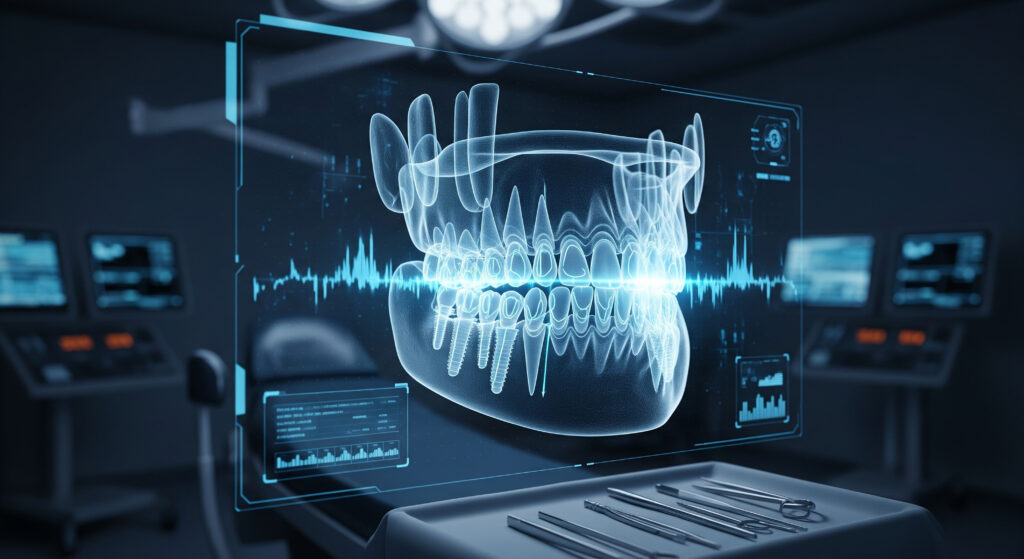
Illustration of AI-assisted analysis. Final diagnosis is always made by the dentist after a clinical examination.
AI image analysis
See how AI reads your scan before the doctor decides
Every panoramic X-ray, CBCT scan and smile photo you send is analysed by AI first. It maps bone, nerves, roots and soft tissue, flags areas that need attention and prepares measurements. Dr. Abdurrahman Öztürk then reviews every finding and makes the clinical decision.
What Makes AI All-on-6 Different From Other Full-Arch Options
All-on-6 is a fixed full-arch restoration: one continuous bridge of teeth screwed onto six implants in the same jaw. Unlike a removable denture, it does not come out at night and does not rest on the gums. The word that defines it is distribution. With six anchors, chewing forces are shared across more points of the jaw, and the bridge has support closer to the back teeth, where biting forces are strongest.
Using AI does not change what All-on-6 is; it changes how precisely we can plan it. Six implants have to fit into a curved arch alongside the sinus in the upper jaw or the nerve canal in the lower jaw. AI segmentation of the CBCT scan makes these structures visible in 3D, and planning software helps test different six-implant layouts quickly. Dr. Abdurrahman Öztürk then chooses the layout that suits your bone, bite and smile.
Why six and not fewer
Extra implants add support and a degree of redundancy. If one implant ever has a problem, a well-planned six-implant arch may still have enough support while it is assessed, although this depends on the individual case.
Why AI matters more as the implant count rises
Every additional implant adds another position to coordinate. AI tools help keep spacing, angles and the bridge design consistent across all six at once instead of planning them one by one.
Bone Requirements for AI All-on-6: What the CBCT Analysis Looks For
All-on-6 generally needs a reasonable amount of bone along a longer stretch of the jaw than a four-implant design, because some implants are placed further back. In the upper jaw this area lies below the sinus; in the lower jaw it lies above the nerve canal. That is why the 3D scan is the single most important step in deciding whether All-on-6 is suitable for you.
AI segmentation highlights bone height, width and the distance to critical structures in every region of the arch. It can show, for example, that the front of the jaw is strong while the back has shrunk after years without teeth. When the back is thin, the doctor may suggest a sinus lift or bone graft, an adjusted implant angle, or a different full-arch option. These are clinical decisions made by Dr. Öztürk, not automatic outputs of software.
- Bone height and width in front and back regions of the arch
- Distance to the maxillary sinus or the inferior alveolar nerve
- Bone quality signs visible on CBCT
- Remaining teeth that need extraction and their infection status
- Whether grafting or a sinus lift could be needed
Guided Surgery Day: How Your Six Implants Are Placed
On surgery day, any remaining failing teeth in the arch are removed, the area is cleaned, and the six implants are placed under local anaesthesia, with sedation available when appropriate. When the case allows, a 3D-printed surgical guide made from the AI-assisted plan helps transfer the planned positions to the jaw. A guide is a tool, not a guarantee; the surgeon still checks bone and stability at every step.
Once the implants are in, the doctor measures how firmly each one holds. When stability is sufficient, abutments are attached and a fixed temporary bridge can be fitted within a few days, so most patients do not leave without teeth. If stability in some positions is lower than expected, the safer choice may be to let the implants heal before loading them, and Dr. Öztürk will explain this honestly rather than rush.
Is the procedure done in one session?
For one arch, implant placement is usually completed in a single surgical appointment. Both arches may be treated in the same visit or separately, depending on your health and the plan.
What anaesthesia is used?
Local anaesthesia numbs the area fully. Sedation can be discussed for anxious patients or longer surgeries after a medical review.
Temporary and Final Teeth on Six Implants
The first bridge you receive is a temporary one, usually made from a strong acrylic-type material and designed digitally from your smile simulation. It lets you smile and eat soft foods while the implants bond with the bone, a process called osseointegration that usually takes several months. During this time it is important to follow the soft-diet instructions, because the implants are still integrating.
On the second trip, a new scan records how the gums have healed and the final bridge is produced with CAD/CAM. Common final options include monolithic or layered zirconia, or a hybrid bridge on a milled titanium framework. Each has trade-offs in appearance, weight, repairability and cost, which the doctor will explain. The AI smile design created at the start guides the final shape, but the final result is confirmed in the mouth, not only on screen.
- Temporary bridge: lighter, adjustable, used during healing
- Final zirconia bridge: very strong and stain-resistant
- Hybrid on titanium framework: easier to repair, softer bite feel
- Both are screw-retained so the dentist can remove them for checks
AI All-on-6 in Istanbul: Planning Your Trips as an International Patient
Most international patients complete All-on-6 in two visits to Istanbul. The first visit covers the CBCT scan, final planning, surgery and the fixed temporary bridge, which usually takes around a week. After a healing period of several months at home, the second visit is for the final bridge and typically takes about a week as well. Your exact schedule depends on healing, any grafting and whether one or both arches are treated.
Because AI analysis can start from photos and existing X-rays, much of the early assessment happens before you travel. You can send your images on WhatsApp, receive an initial opinion from Dr. Öztürk, and arrive in Istanbul with a clear idea of the plan. The definitive plan is always confirmed after the in-person clinical examination and new 3D scan.
Honest Risks and Limits of AI-Planned All-on-6
All-on-6 is surgery, and every surgery carries risks: swelling, bruising, infection, delayed healing, and in rare cases nerve irritation or sinus complications. An implant may fail to integrate, which can require replacement. Long term, poor cleaning, smoking and uncontrolled diabetes increase the risk of peri-implantitis, an inflammation that can damage bone around implants.
AI does not remove these risks. What it does is help the doctor see anatomy more clearly and plan more carefully, which can reduce some planning-related problems. Smile previews are simulations, not promises; your final appearance depends on healing, bone and the clinical limits of your case. Dr. Öztürk will tell you if All-on-6 is not the right choice and explain the alternatives.
- Smokers and people with uncontrolled diabetes face higher implant risk
- Heavy teeth grinding may require a protective night guard
- Not every patient has enough posterior bone without grafting
Conventional vs AI-assisted
All-on-6 Planning: Conventional vs AI-Assisted
Who it suits
Who Is a Good Candidate for AI All-on-6?
- People missing all or most teeth in the upper or lower jaw
- Patients with failing teeth that cannot be saved across an arch
- Denture wearers who want fixed teeth that do not move
- Patients with enough bone along the arch for six implants, or who can be grafted
- Adults in stable general health with controlled conditions such as diabetes
- Patients willing to keep up daily cleaning and regular check-ups
Your treatment journey
Your AI All-on-6 Timeline
Before travel
Online AI pre-assessment
Send photos and X-rays on WhatsApp. Dr. Öztürk reviews the AI-assisted findings and gives an initial opinion.
Trip 1, day 1
CBCT, scan and final plan
A 3D scan and intraoral scan are taken, AI planning is completed and the doctor approves the six positions.
Trip 1, day 2
Surgery
Extractions if needed and placement of six implants, guided by the plan.
Trip 1, days 3 to 7
Fixed temporary bridge
The digitally designed temporary bridge is fitted and adjusted, with a check before you fly home.
Several months later
Healing at home
The implants integrate with the bone while you follow a soft diet and send progress photos.
Trip 2
Final bridge
New scans, try-in and fitting of the final zirconia or hybrid bridge, with bite fine-tuning.
Why patients choose it
Wider support base
Six implants spread chewing forces across more of the jaw, including the back region.
Fixed, non-removable teeth
The bridge is screwed in place, so it does not slip like a denture and does not cover the palate.
AI-mapped anatomy
AI segmentation of the CBCT helps the doctor keep a safe distance from nerves and sinuses.
Preview before surgery
A digital smile simulation lets you see and discuss tooth shape and length in advance.
Built-in redundancy
With six anchors, a single problem implant may be managed with less disruption, depending on the case.
Fewer days in Istanbul
Online pre-assessment and digital workflows help keep your on-site visits focused and efficient.
Your doctor
Every AI All-on-6 Plan Is Approved by Dr. Abdurrahman Öztürk
Dr. Abdurrahman Öztürk holds a PhD in dentistry and oral and maxillofacial surgery and has more than 15 years of experience in dentistry and dental surgery. A graduate of a leading Istanbul university, he personally reviews every AI-analyzed scan, adjusts the suggested positions of all six implants where needed and performs or supervises the surgery. At AIDENT, artificial intelligence is a planning assistant that helps him see more and plan more carefully. It never makes a clinical decision on its own, and no plan goes ahead without his approval.
Aftercare
Caring for Your All-on-6 Bridge
- Eat only soft foods during the healing months and avoid biting hard items with the temporary bridge
- Clean under the bridge daily with a water flosser and interdental brushes
- Brush the bridge twice a day with a soft brush and low-abrasive toothpaste
- Stop or reduce smoking, which harms implant healing
- Wear a night guard if you grind your teeth
- Attend professional cleaning and checks, where the bridge may be removed for inspection
- Contact the clinic on WhatsApp if you notice bleeding, looseness or a change in your bite
Related AI treatments
Questions and answers
What patients ask about AI All-on-6 Implants
Is All-on-6 better than All-on-4?
Neither is better for everyone; the right choice depends on your bone. All-on-6 adds two implants, which spreads the load and adds support toward the back of the mouth. It usually needs more bone in the back of the jaw. AI analysis of your CBCT helps Dr. Öztürk see which design your anatomy supports best.
How does AI help with All-on-6 implants?
AI helps by mapping your bone, sinus and nerve in 3D and testing six-implant layouts before surgery. It segments the CBCT scan, supports the digital smile design and can feed a 3D-printed surgical guide. Dr. Abdurrahman Öztürk reviews and approves every suggestion, so the AI assists the plan but never makes the decision.
How long do I need to stay in Istanbul for All-on-6?
Most patients plan two trips of about a week each. The first covers scanning, surgery and a fixed temporary bridge. After several months of healing at home, the second trip is for the final bridge. Grafting, treating both arches or slower healing can change this schedule.
Will I have teeth right after All-on-6 surgery?
In many cases yes, a fixed temporary bridge is fitted within a few days. This is possible when the implants are stable enough at surgery. If stability is lower than expected, Dr. Öztürk may advise healing before loading to protect the implants, and he will explain the reason clearly.
Is All-on-6 surgery painful?
The surgery itself should not be painful because the area is fully numbed with local anaesthesia, and sedation can be discussed. Afterwards, swelling and soreness for several days are normal and are usually managed with prescribed medication, cold packs and a soft diet.
Can I get All-on-6 if I have worn dentures for years?
Often yes, but long-term denture wear can shrink the jawbone, especially at the back. A CBCT scan with AI segmentation shows how much bone remains. Some patients need grafting or a sinus lift first, and others may be better suited to a different full-arch design.
Do I need a bone graft for All-on-6?
Not always; it depends on the bone in the back of your jaw. Because All-on-6 uses implants placed further back, thin bone there may need a graft or sinus lift. The AI bone map helps the doctor judge this, and he will discuss the options before any decision.
What are All-on-6 teeth made of?
The temporary bridge is usually a strong acrylic-type material, while the final bridge is commonly zirconia or a hybrid on a titanium framework. Zirconia is very strong and stain-resistant; hybrids are easier to repair and feel slightly softer. Dr. Öztürk will help you choose based on your bite and goals.
Can AI show me what my All-on-6 smile will look like?
Yes, a digital smile simulation can show the planned tooth shape, length and lip support before surgery. It is a preview, not a guarantee. The final appearance depends on healing, bone and clinical limits, and it is confirmed at the try-in on your second visit.
How long do All-on-6 implants last?
With good cleaning and regular check-ups, implants can last many years, often decades, though no lifespan can be guaranteed. The bridge may need repair or replacement over time. Smoking, grinding and poor hygiene shorten the life of both implants and bridges.
Who is the best dentist for AI All-on-6 implants in Istanbul?
The best choice is an experienced implant surgeon who uses 3D planning and explains the risks honestly. At AIDENT, Dr. Abdurrahman Öztürk, with a PhD in oral and maxillofacial surgery and 15+ years of experience, reviews every AI-analyzed case personally and approves each All-on-6 plan.
Can I do both jaws with All-on-6 at the same time?
It is possible for some patients, but it depends on health, bone and comfort. Treating both arches in one visit means a longer surgery and more recovery. Dr. Öztürk will advise whether one session or two separate stages is safer for you.
How do I clean All-on-6 implants?
Clean them every day with a soft toothbrush, interdental brushes and a water flosser under the bridge. Food collects where the bridge meets the gums, so cleaning there is essential. Regular professional cleanings, sometimes with the bridge removed, help prevent peri-implantitis.
Can I start my All-on-6 consultation online?
Yes, you can begin on WhatsApp by sending clear smile photos and any recent X-rays. The images are reviewed with AI support and Dr. Öztürk gives an initial opinion. The final plan is confirmed only after an in-person exam and a CBCT scan in Istanbul.
No question matches your search. Ask us directly on WhatsApp.
Find Out If AI All-on-6 Is Right for You
Send your smile photos and any X-rays on WhatsApp. Our AI-assisted review and Dr. Abdurrahman Öztürk's assessment will tell you whether six implants suit your jaw and what your treatment in Istanbul could look like.
Get my free AI All-on-6 assessment on WhatsAppFree initial review of your photos and X-rays. Reply on WhatsApp.