AI-Planned Implant Bridges
AI Multiple-Tooth Implants & Implant Bridges in Istanbul
When two, three or more teeth are missing side by side, AI multiple-tooth implants let us rebuild the gap with a fixed bridge anchored in your jawbone, without cutting down healthy neighbouring teeth. Every AI-generated plan is reviewed and approved by Dr. Abdurrahman Öztürk before anything is done.
 Medically reviewed by Dr. Abdurrahman Öztürk, PhD, oral & maxillofacial surgery
This model shows a typical implant bridge, where two implant posts carry three connected crowns, with the middle tooth resting on the gum instead of needing its own implant.
Short answer
What are AI multiple-tooth implants and implant bridges?
They replace several missing teeth in a row with a fixed bridge supported by a smaller number of implants, for example three teeth on two implants. AI analyzes your CBCT scan and 3D intraoral scan to suggest where each implant should go, and Dr. Abdurrahman Öztürk confirms the final plan after a clinical exam.
- Typical use
- 2 to 5 adjacent missing teeth
- Common design
- 3-unit bridge on 2 implants
- Healing phase
- Usually a few months
- Neighbouring teeth
- Left untouched
AI
How AI plans an implant bridge for your gap
A bridge on implants only works when the posts, the bone and the final teeth are planned as one unit. Our AI-assisted workflow builds that unit digitally first, and Dr. Abdurrahman Öztürk checks every step before it moves to the next.
- 1
Photo and X-ray review
You send photos and any existing X-rays on WhatsApp, and AI helps us flag the gap length, visible bone loss and the state of the teeth on either side.
- 2
CBCT segmentation
At the clinic a 3D CBCT scan is taken and AI segments the bone, nerve canal, sinus floor and neighbouring roots so the whole gap can be measured in three dimensions.
- 3
Bridge-first design
Using your intraoral scan, the future bridge is designed digitally first, so the implants can be positioned under the teeth they must carry rather than wherever bone happens to be.
- 4
Implant count and spacing
AI tools test different layouts, such as two or three implants for a gap, while respecting safe distances between implants and from natural roots; the doctor chooses the layout.
- 5
Guided surgery template
The approved plan can be turned into a 3D-printed surgical guide that transfers the planned angle and depth of each implant to the mouth.
- 6
Outcome simulation
A visual simulation shows how the finished bridge may look and fit your bite; it is a preview, and the final result is confirmed only after healing and try-in.
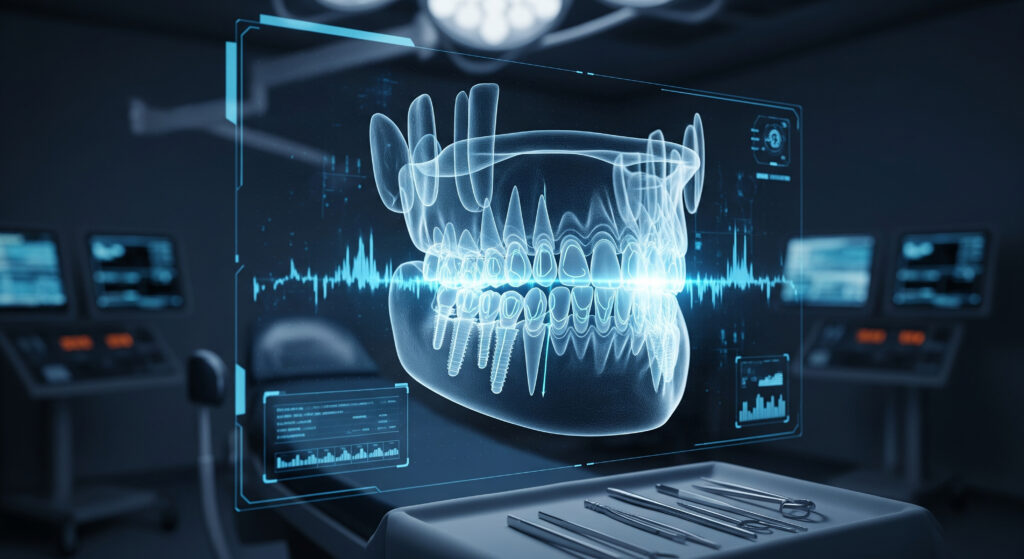
Illustration of AI-assisted analysis. Final diagnosis is always made by the dentist after a clinical examination.
AI image analysis
See how AI reads your scan before the doctor decides
Every panoramic X-ray, CBCT scan and smile photo you send is analysed by AI first. It maps bone, nerves, roots and soft tissue, flags areas that need attention and prepares measurements. Dr. Abdurrahman Öztürk then reviews every finding and makes the clinical decision.
What an implant bridge is and when several teeth can share implants
An implant bridge is a single fixed restoration made of joined crowns that rests on two or more dental implants instead of on natural teeth. The key idea is that not every missing tooth needs its own post. In a gap of three teeth, for instance, an implant is often placed at each end and the middle tooth, called a pontic, is suspended between them. With AI multiple-tooth implants, the decision about how many posts to use and where to put them is based on a precise 3D analysis of your bone and bite, then confirmed by Dr. Abdurrahman Öztürk.
This approach suits people who have lost several neighbouring teeth through decay, gum disease, failed root canals, old bridges that broke down, or injury. It is also chosen when one implant per tooth is not possible because bone is thin in part of the gap, or when a nerve or sinus sits too close. Spreading the load across a connected bridge lets us use the strongest areas of bone. The trade-off is that connected crowns must be cleaned with special tools, which we teach before you leave Istanbul.
- Two or more adjacent missing teeth in the front or back of the mouth
- Healthy teeth on either side that you want to keep untouched
- Enough bone at the planned implant sites, or a plan to rebuild it
- A wish for fixed teeth rather than a removable partial denture
Individual implants or an implant bridge? How AI helps compare the options
When several teeth are missing, there are usually two fixed choices: one implant for every tooth with separate crowns, or fewer implants carrying a bridge. Separate implants are easier to floss and allow a problem with one crown to be fixed without touching the others. A bridge needs fewer surgical sites, can avoid weak bone areas and is often the more practical option for longer gaps. Neither is automatically better; the right answer depends on your anatomy, bite force and hygiene habits.
AI makes this comparison concrete. On the segmented CBCT, we can place virtual implants for both scenarios and look at the bone available around each one, the distance to the nerve or sinus, and how the crowns would sit in your bite. Dr. Abdurrahman Öztürk reviews these scenarios with you, explains the advantages and drawbacks of each, and recommends the layout he believes is safest and most durable for your case. You see the reasoning rather than just a final recommendation.
When separate implants are usually preferred
If bone is good across the whole gap and the gap is short, such as two teeth, separate implants often give the simplest cleaning and the most flexibility for future repairs.
When a bridge on implants makes more sense
For three or more missing teeth, or when one area of the gap lacks bone or lies close to the sinus or nerve, a bridge on well-placed implants can avoid extra grafting and surgery.
AI implant positioning: spacing, angles and the floating tooth
The success of an implant bridge depends on millimetres. Widely accepted guidelines recommend keeping roughly 3 mm of bone between two implants and about 1.5 mm between an implant and a natural tooth root, so that bone and gum can stay healthy around each post. AI segmentation measures these distances on your scan automatically and warns us when a planned position becomes too tight, so Dr. Abdurrahman Öztürk can adjust it before surgery rather than discovering a problem in the mouth.
Angles matter just as much. For a bridge to be screwed or cemented in one piece, the implants need a common path of insertion, meaning their directions must be close enough that the bridge can slide onto all of them together. Digital planning lets us align the posts with the future teeth from the start. We also plan the pontic area, the gum contour under the floating tooth, so that it looks natural and can be cleaned. This is a design detail that is easy to overlook without a bridge-first plan.
- Automatic measurement of bone width and height at each planned site
- Warnings for proximity to the mandibular nerve, sinus and neighbouring roots
- Parallel alignment so the bridge can seat on all implants together
- Planned pontic contour for a natural look and easier cleaning
Missing back teeth: implant bridges near the sinus and the nerve
Many patients who need several implants have lost molars and premolars, where chewing forces are highest and anatomy is most demanding. In the upper jaw, the maxillary sinus often drops down after teeth are lost, leaving limited bone height. In the lower jaw, the inferior alveolar nerve runs through the bone and must be protected. AI segmentation of the CBCT highlights both structures in 3D, helping the doctor see how much safe bone exists in each part of the gap.
Sometimes the plan can avoid the risky area entirely by placing implants where bone is strong and bridging over the weak zone. Other times a sinus lift or bone graft is the more reliable route, which adds healing time. Dr. Abdurrahman Öztürk will explain which option he recommends and why, including the extra visits and the risks involved. AI helps reveal the anatomy clearly; it does not remove the need for careful surgical judgement, and it does not make these procedures risk-free.
Bite, materials and how your implant bridge is made
A bridge on implants feels the full force of chewing, and implants do not have the natural cushioning of a tooth ligament. That is why bite analysis is part of the plan. Digital scans of both jaws let us study how your teeth meet, how far the bridge should extend and whether a night guard is wise if you grind. Long unsupported extensions, known as cantilevers, are kept short or avoided, because they increase stress on the implants and screws.
The bridge itself is designed with CAD software and produced with CAD/CAM milling or 3D printing. Zirconia and porcelain-layered options are common for permanent bridges, and the choice depends on the location in the mouth, the space available and your aesthetic goals. Many cases receive a temporary bridge first so the gum can shape around it and you can test the bite and appearance. The permanent bridge is then fitted once the implants have integrated and the doctor is satisfied with the fit.
Screw-retained or cemented?
Screw-retained bridges can be removed by the dentist for cleaning or repair, while cemented ones may look seamless in some positions; the doctor advises based on implant angle and access.
Why a precise fit matters
A connected bridge must sit passively on all implants at once, because an ill-fitting bridge can strain the bone and loosen screws over time; digital design helps achieve that fit.
Risks, limits and what AI cannot do for multiple implants
Placing several implants is a surgical procedure, and honest expectations are part of good care. Possible issues include swelling, bruising and discomfort in the first days, infection, implants that fail to integrate with the bone, nerve irritation in the lower jaw, sinus complications in the upper jaw and, over the years, inflammation around implants if cleaning is poor. Smoking, uncontrolled diabetes and untreated gum disease raise these risks. If one implant in a bridge fails, the bridge often has to be remade.
AI improves the accuracy of planning and helps us notice anatomical risks early, but it does not operate, it does not guarantee integration, and its visual previews are simulations. Every measurement it produces is checked by Dr. Abdurrahman Öztürk, who also makes the final decision on whether you are a good candidate at all. If he believes another option, such as a conventional bridge or a removable partial denture, would serve you better, he will tell you directly.
Conventional vs AI-assisted
Implant bridge planning: conventional versus AI-assisted
Who it suits
Who is a good candidate for an AI-planned implant bridge?
- Adults missing two or more neighbouring teeth who want a fixed solution
- People with healthy adjacent teeth they do not want crowned for a traditional bridge
- Patients with a failing old bridge whose supporting teeth can no longer be saved
- Those with enough bone, or willing to have grafting or a sinus lift if needed
- Non-smokers or people prepared to stop smoking around surgery and healing
- Patients with controlled general health and treated gum disease
Your treatment journey
Typical timeline for multiple implants and a bridge in Istanbul
Before travel
Online AI pre-assessment
You share photos and any X-rays on WhatsApp, we give a preliminary opinion and outline the likely number of visits.
Visit 1, days 1 to 2
Scans, planning and approval
CBCT and intraoral scans are taken, AI-assisted planning is completed and Dr. Abdurrahman Öztürk reviews the plan with you.
Visit 1, days 2 to 5
Implant placement
The implants are placed under local anaesthesia, with sedation available, and a temporary solution is arranged where suitable.
Healing period
Osseointegration at home
Over usually a few months the implants bond with the bone; longer if grafting or a sinus lift was needed.
Visit 2, about 5 to 7 days
Final bridge
New scans are taken, the bridge is designed, tried in, adjusted for your bite and fixed in place.
Why patients choose it
Neighbouring teeth stay intact
Unlike a traditional bridge, healthy teeth next to the gap do not need to be filed down to support crowns.
Fewer implants for a long gap
Several teeth can often be replaced with fewer posts, which can mean fewer surgical sites and less grafting.
Bone stimulation where it counts
Implants transfer chewing forces into the jaw, which helps slow the bone shrinkage that follows tooth loss at those sites.
Fixed and stable chewing
The bridge is fixed in place, so there are no clasps or removable plates, and chewing on that side feels secure.
Precise, explainable planning
AI measurements and 3D models let you see why a certain number and position of implants was chosen.
Natural appearance in the gap
Digital pontic and gum contour design helps the floating tooth look like it grows from the gum.
Your doctor
Every implant bridge plan is approved by Dr. Abdurrahman Öztürk
Dr. Abdurrahman Öztürk holds a PhD in dentistry and oral and maxillofacial surgery and has more than 15 years of experience in dentistry and dental surgery, having graduated from a leading Istanbul university. At AIDENT Clinic, AI tools analyze your photos, X-rays and CBCT scans and propose implant layouts, but they never make the decision. Dr. Öztürk personally reviews each segmentation, checks the distances to nerves, sinus and roots, selects the number and position of implants for your bridge, and performs or supervises the surgery. If the data suggest that implants are not the right choice for you, he will say so honestly.
Aftercare
Caring for your implant bridge after treatment
- Clean under the bridge daily with super floss, a water flosser or interdental brushes sized by your dentist
- Eat soft food on the treated side during the first days and avoid very hard foods until the doctor approves
- Take prescribed medication exactly as instructed and keep swelling down with cold compresses on day one
- Avoid smoking and alcohol during healing, as both slow bone integration
- Wear a night guard if you clench or grind, to protect the bridge and screws
- Have professional check-ups and cleanings at the intervals your dentist sets, with X-rays when advised
- Contact us on WhatsApp quickly if you notice bleeding gums, looseness or a change in your bite
Related AI treatments
Questions and answers
What patients ask about AI Multiple Implants & Implant Bridges
How many implants do I need to replace three missing teeth?
Often two implants can support a three-tooth bridge, with the middle tooth floating between them. However, this depends on the bone available, the position in the mouth and your bite force. AI-assisted planning on your CBCT compares layouts, and Dr. Abdurrahman Öztürk decides whether two posts are enough or whether three separate implants would be safer for you.
Is an implant bridge better than a regular bridge on my own teeth?
An implant bridge is usually the better long-term choice when your neighbouring teeth are healthy, because they do not need to be filed down. It also places load into the jawbone where teeth are missing. A regular bridge can still make sense if the adjacent teeth already need crowns or if implants are not possible. The doctor explains both options for your case.
Can AI decide how many implants I need?
No, AI does not decide; it supports the decision. It measures bone, maps the nerve and sinus, and lets us test different implant layouts on your scan. Dr. Abdurrahman Öztürk then reviews these options together with your clinical exam, health history and bite, and chooses the plan he considers safest and most durable.
How long do I need to stay in Istanbul for an implant bridge?
Most patients make two trips. The first visit for scans, planning and implant placement usually takes about four to six days. After a healing period of usually a few months at home, the second visit for the final bridge takes about five to seven days. Grafting or a sinus lift can lengthen the overall timeline.
Is getting several implants at once painful?
The procedure itself should not be painful, because it is done under local anaesthesia, and sedation is available if you are anxious. Afterwards, soreness and swelling for a few days are normal and are usually managed with prescribed painkillers and cold compresses. Placing several implants may cause more swelling than a single implant, so we plan rest days.
What happens to the middle tooth that has no implant?
The middle tooth, called a pontic, is part of the bridge and rests gently on the gum between the implants. It looks like a normal tooth but has no root. We design the gum contour beneath it digitally so it looks natural and can be cleaned with floss threaders or a water flosser.
Can I get implant bridges for missing back teeth near the sinus?
Yes, in many cases. AI segmentation of your CBCT shows how much bone is left under the sinus. Sometimes implants can be placed in stronger bone with the bridge spanning the weak area; in other cases a sinus lift is recommended first. Dr. Abdurrahman Öztürk will explain which route suits your anatomy and what it adds to the timeline.
Will I have teeth while my implants are healing?
In most cases, yes. Depending on the area and stability of the implants, we may provide a temporary bridge or a removable temporary to wear during healing, especially for front teeth. For back teeth, some patients prefer to leave the gap during healing. The doctor tells you which temporary option is safe for your implants.
Can I start my AI implant bridge consultation on WhatsApp?
Yes. Send clear photos of your teeth and any recent panoramic X-ray or CBCT to +90 534 445 9444. We use AI to support a preliminary review and reply with an initial opinion and likely visit plan. The final treatment plan is only confirmed after a clinical exam and new scans in Istanbul.
What if one implant under my bridge fails?
If an implant does not integrate, it is usually removed, the area is allowed to heal and a new implant may be placed, sometimes with a bone graft. Because the bridge connects several teeth, it may need to be remade or modified. Failures are uncommon with good planning and care, but they can happen, and we explain this before treatment.
Who is the best dentist for AI implant bridges in Istanbul?
Look for a dentist with surgical training, 3D planning experience and honest explanations. At AIDENT Clinic, Dr. Abdurrahman Öztürk, who holds a PhD in oral and maxillofacial surgery and has more than 15 years of experience, personally reviews every AI-assisted plan and makes all clinical decisions for multiple-tooth implant cases.
Does AI really make implant bridges more accurate?
AI helps make planning more precise by measuring bone and distances in 3D and by aligning implants with the future bridge before surgery. Combined with a surgical guide, this helps transfer the plan to the mouth. Accuracy still depends on the surgeon, the scan quality and healing, so AI is a support tool, not a guarantee.
Can an implant bridge be repaired or removed later?
Yes, especially if it is screw-retained. Your dentist can unscrew the bridge for professional cleaning, to repair chipped porcelain or to check the implants, then fix it back in place. Cemented bridges are harder to remove. The doctor discusses which retention type suits your implant angles and your future maintenance needs.
How do I clean under an implant bridge?
You clean under it every day with super floss, floss threaders, interdental brushes or a water flosser, in addition to normal brushing. Food and plaque collect under the pontic and around the implants, and poor cleaning can lead to inflammation around implants. We show you the right tools and technique before you fly home.
No question matches your search. Ask us directly on WhatsApp.
Find out how many implants your gap really needs
Send photos and any X-rays of the missing teeth on WhatsApp. We will use AI to support a first review, and Dr. Abdurrahman Öztürk will advise whether an implant bridge, separate implants or another option suits you best.
Get my free AI implant bridge assessment on WhatsAppFree initial review of your photos and X-rays. Reply on WhatsApp.