AI-Guided Non-Surgical Periodontal Therapy
AI Scaling & Root Planing (Deep Cleaning) in Istanbul
AI scaling and root planing is a deep cleaning below the gum line, planned tooth by tooth with AI-analyzed X-rays and digital pocket charts, and carried out under the supervision of Dr. Abdurrahman Öztürk. It removes the hardened deposits that a normal cleaning cannot reach and gives inflamed gums a real chance to heal.
 Medically reviewed by Dr. Abdurrahman Öztürk, PhD, oral & maxillofacial surgery
The model shows a tooth with a periodontal pocket, where calculus has formed on the root below the gum margin. Scaling removes these deposits and root planing leaves a smooth, clean surface that the gum can tighten against.
Short answer
What is AI scaling and root planing?
AI scaling and root planing is a non-surgical deep cleaning for gum disease. AI software reads your X-rays to map bone loss and highlights deep pockets, so the dentist knows exactly which root surfaces need attention. Tartar is then removed below the gum line and the roots are smoothed, usually under local anesthesia, with every decision made by Dr. Abdurrahman Öztürk.
- Type
- Non-surgical periodontal therapy
- Comfort
- Local anesthesia where needed
- Typical plan
- 1–4 visits, by quadrant or full mouth
- Supervision
- Dr. Abdurrahman Öztürk, 15+ years of experience
AI
How AI guides your deep cleaning, step by step
A deep cleaning is only as good as the map that guides it. At AIDENT Clinic every scaling and root planing case moves through the same AI-supported workflow before an instrument touches the root surface, and every output is checked and approved by Dr. Abdurrahman Öztürk.
- 1
Photos and history
You share photos of your gums and a short medical history, often on WhatsApp, so the team can see bleeding, swelling or recession before you travel.
- 2
AI X-ray reading
Panoramic and bitewing X-rays are analyzed by AI software that outlines bone levels around each root and flags visible calculus and areas of angular bone loss.
- 3
Digital pocket charting
Probing depths, bleeding points and gum recession are recorded into a digital chart, and the software lines this up with the X-ray findings tooth by tooth.
- 4
Risk and priority map
The combined data produce a colour-coded map that shows which sites are deepest and most inflamed, helping the dentist plan the order of treatment and anesthesia.
- 5
Supervised instrumentation
Ultrasonic scalers and fine hand curettes remove tartar and biofilm from the roots, following the map site by site under Dr. Öztürk's direction.
- 6
Comparison at re-evaluation
Six to eight weeks later the pockets are measured again and the new chart is compared with the first, so healing is judged by data, not by impression.
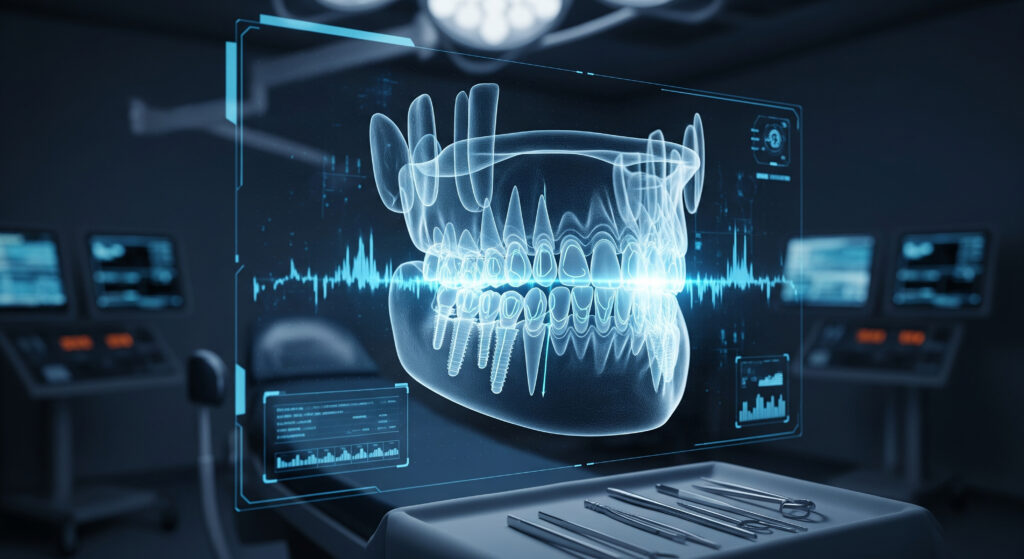
Illustration of AI-assisted analysis. Final diagnosis is always made by the dentist after a clinical examination.
AI image analysis
See how AI reads your scan before the doctor decides
Every panoramic X-ray, CBCT scan and smile photo you send is analysed by AI first. It maps bone, nerves, roots and soft tissue, flags areas that need attention and prepares measurements. Dr. Abdurrahman Öztürk then reviews every finding and makes the clinical decision.
What scaling and root planing actually does
Scaling and root planing, often called a deep cleaning, is the core non-surgical treatment for periodontitis. It is different from the routine cleaning many people have every six months. A routine cleaning works mostly above the gum line, on the visible enamel. A deep cleaning goes into the space between the gum and the root, called the periodontal pocket, where bacteria live in a sticky biofilm and minerals from saliva turn plaque into hard calculus, also known as tartar.
The treatment has two parts. Scaling is the removal of plaque and calculus from the tooth and root surfaces, including deposits that sit several millimetres below the gum margin. Root planing follows and smooths the root surface so that it is less welcoming to new bacterial build-up. A cleaner, smoother root makes it easier for the inflamed gum to shrink, firm up and sit more closely against the tooth again, which is how pockets become shallower during healing.
Deep cleaning does not regrow lost bone and it is not a cosmetic procedure. Its purpose is to stop the infection that is slowly destroying the support of your teeth, and to create conditions in which your own daily cleaning and regular maintenance can keep the disease under control.
- Removes hardened tartar from root surfaces below the gum line
- Disrupts the bacterial biofilm that drives gum inflammation
- Smooths roots so the gum can tighten and pockets can shrink
- Is usually the first step before any gum surgery is considered
How AI makes a deep cleaning more precise
The hardest part of root planing is that the dentist cannot see the deposits. They sit under the gum, on curved roots, sometimes between the roots of molars. Traditionally this work relies on touch and on a paper chart. At AIDENT Clinic, AI-supported analysis adds a second set of eyes before and after treatment, so the dentist starts with a clear picture of where the disease is worst.
AI software trained on dental radiographs can outline the bone crest around each tooth, estimate how much bone has been lost compared with the root length, and draw attention to radiopaque calculus spurs that might be missed at a quick glance. When this is combined with a digital pocket chart, the clinic can see which teeth have deep pockets, which ones bleed, and where furcation areas of molars may need extra care.
None of this replaces the clinical examination. AI can misread overlapping structures or old fillings, and probing remains the gold standard for measuring pockets. That is why Dr. Abdurrahman Öztürk reviews every AI finding against the probe and the mouth itself, and decides what is treated, in what order and with what anesthesia.
AI on X-rays
Highlights bone levels, angular defects and visible calculus on panoramic and bitewing images, giving a tooth-by-tooth overview before probing begins.
AI on pocket charts
Organizes probing depths and bleeding points into a visual map and makes it easy to compare the same site before and after treatment.
Signs that you may need a deep cleaning rather than a regular cleaning
Many people only discover they need scaling and root planing when a dentist measures their pockets. Healthy gum pockets are shallow, generally around one to three millimetres. When the probe goes deeper, bleeds easily and the X-ray shows bone loss, the problem is no longer just surface plaque but an established periodontal infection that a polish cannot reach.
Symptoms are often mild at first, which is why periodontitis is called a silent disease. Bleeding when brushing, gums that look red or puffy, a bad taste or breath that does not go away, and teeth that seem longer because the gum has receded are common warnings. Later signs include spaces opening between teeth, food packing into gaps and teeth that feel slightly loose when you bite.
- Gums that bleed when you brush, floss or eat
- Persistent bad breath or a bad taste in the mouth
- Red, swollen or tender gums
- Gums pulling away from the teeth or visible root surfaces
- Hard tartar below the gum line that returns quickly after cleanings
- Teeth that feel loose or have started to drift
What happens during your AI-guided scaling and root planing appointment
Your appointment begins with a review of the AI map and the pocket chart, so you can see on screen which areas will be treated and why. If pockets are deep or the gums are sensitive, the area is numbed with local anesthesia. You stay awake and can communicate throughout. Many patients are surprised that the main sensations are vibration, water spray and gentle pressure rather than pain.
The dentist usually starts with an ultrasonic scaler, a fine vibrating tip cooled by water that breaks up calculus and flushes the pocket. Thin hand instruments called curettes are then used to feel and clean the root surface carefully, especially in narrow pockets and around the roots of molars. The AI priority map helps ensure that the deepest and most inflamed sites receive the most attention.
Depending on how much disease is present, treatment is done in one quadrant or one half of the mouth per visit, or as a full-mouth session spread over consecutive days. In selected cases the dentist may place a local antimicrobial in specific pockets or prescribe medication; this is decided individually and is never automatic.
Quadrant approach
One quarter or one side of the mouth is treated per visit, which keeps each session shorter and limits numbness to one area at a time.
Full-mouth approach
All quadrants are treated within a short window, often over one or two days, which suits international patients with limited time in Istanbul.
Healing, re-evaluation and why the second chart matters
After a deep cleaning the gums go through a predictable healing phase. In the first days they may feel tender and teeth can be sensitive to cold, because root surfaces that were covered by tartar or swollen gum are now exposed. Bleeding usually reduces as the inflammation settles. As the swelling goes down, the gum line may sit slightly lower, and some patients notice that teeth look a little longer or that small gaps appear between them.
Real healing takes weeks, not days. This is why the pockets are measured again roughly six to eight weeks after treatment. At this re-evaluation the new digital chart is compared with the original one site by site. Pockets that have become shallow and stopped bleeding are moved to maintenance. Sites that remain deep and bleeding may need a second round of instrumentation or, in some cases, referral for periodontal surgery.
For international patients who cannot return in person, this re-evaluation can be arranged with a local dentist, who shares the chart and X-rays with AIDENT Clinic for comparison, or planned around a second visit to Istanbul.
Honest limits and possible side effects
Scaling and root planing is a well-established, low-risk treatment, but it is not without side effects. Temporary sensitivity to cold, mild soreness, and a slightly receded gum line as the swelling goes down are the most common. Sensitivity usually eases over a few weeks, and a desensitizing toothpaste helps. Rarely, a small abscess can form if a deposit is left deep in a pocket, which is one reason the re-evaluation visit is important.
Deep cleaning also has limits. It cannot rebuild bone that has already been lost, it may not fully clean very deep pockets or complex molar furcations, and the results depend heavily on your home care and on risk factors such as smoking and poorly controlled diabetes. AI analysis improves planning and follow-up, but it cannot make the disease disappear on its own and it cannot guarantee a particular pocket depth.
Periodontitis is a chronic condition. Even after successful treatment, it needs regular periodontal maintenance cleanings, often every three to four months at first, to stay stable over the long term.
Conventional vs AI-assisted
Conventional deep cleaning vs AI-assisted deep cleaning at AIDENT
Who it suits
Who is a good candidate for AI scaling and root planing?
- Adults diagnosed with periodontitis and pockets deeper than normal
- People whose gums bleed regularly despite brushing and flossing
- Patients with tartar below the gum line seen on X-rays or at probing
- Patients preparing for implants, crowns or orthodontics who need healthy gums first
- People with diabetes or a smoking history who need closely monitored gum care
- International patients who want a clear, data-based record to continue care at home
Your treatment journey
Your deep cleaning timeline in Istanbul
Before travel
Online pre-assessment
You send gum photos and any recent X-rays on WhatsApp, and the team explains whether a deep cleaning is likely.
Day 1
Examination and AI mapping
Clinical exam, X-rays, AI analysis and full digital pocket charting, followed by a clear treatment plan.
Day 1–2
Scaling and root planing
Treatment by quadrant or half-mouth under local anesthesia, with home-care instructions after each session.
Day 3
Check and home-care coaching
A short review of the treated areas and personalised training with brushes and interdental cleaners.
6–8 weeks
Re-evaluation
Pockets are measured again in Istanbul or by your local dentist, and the new chart is compared with the first.
Why patients choose it
Targeted treatment
AI mapping helps the dentist focus effort on the roots and pockets that need it most.
Non-surgical first step
Many cases of periodontitis can be stabilised without cutting the gum.
Measurable progress
Digital before-and-after charts show objectively how your pockets respond.
Fresher breath
Removing infected deposits often reduces the odour linked to gum disease.
Foundation for other work
Healthy gums are essential before implants, crowns, veneers or aligners.
Short stay in Istanbul
Most deep cleaning plans fit into a few days, with follow-up possible at home.
Your doctor
Every deep cleaning plan is approved by Dr. Abdurrahman Öztürk
Dr. Abdurrahman Öztürk holds a PhD in dentistry and oral and maxillofacial surgery and has more than 15 years of experience in dentistry and dental surgery. He graduated from a leading Istanbul university and supervises every AI-analyzed case at AIDENT Clinic. For scaling and root planing, he reviews the AI bone-level analysis, checks it against the clinical pocket chart, and decides which sites are treated, how anesthesia is used and whether any additional therapy is needed. AI organizes the data and highlights risk; Dr. Öztürk makes the clinical decisions and remains responsible for your care from the first chart to the re-evaluation.
Aftercare
Aftercare following scaling and root planing
- Wait until the numbness wears off before eating to avoid biting your cheek or tongue
- Expect mild soreness for a day or two; take pain relief only as advised by the dentist
- Use a soft toothbrush and keep brushing the treated areas gently from the first evening
- Start cleaning between your teeth with the interdental brushes sized for you at the clinic
- Use a desensitizing toothpaste if your teeth feel sensitive to cold
- Avoid smoking, which slows gum healing and worsens the long-term outcome
- Keep your re-evaluation and maintenance appointments, even if your gums feel fine
Related AI treatments
Questions and answers
What patients ask about AI Scaling & Root Planing
Is scaling and root planing painful?
Scaling and root planing is usually not painful because deep areas are numbed with local anesthesia. During treatment most people feel vibration, water and pressure rather than pain. Afterwards the gums can be tender and teeth may be sensitive to cold for a few days, which normally settles with gentle care and a desensitizing toothpaste.
How long does a deep cleaning take?
A deep cleaning usually takes about forty-five minutes to an hour per quadrant or longer for half the mouth, depending on how much tartar there is and how deep the pockets are. Full-mouth treatment is often split over one or two days. The AI map helps the dentist plan the time realistically before you sit in the chair.
Does AI really help with a deep cleaning?
Yes, AI helps mainly with planning and follow-up rather than the cleaning itself. It analyzes your X-rays to outline bone loss and visible calculus, and organizes your pocket measurements into a clear map. This helps the dentist prioritise the right sites and compare results later. The actual cleaning and every decision remain in the hands of Dr. Öztürk.
How many visits do I need for scaling and root planing?
Most people need between one and four treatment visits plus a re-evaluation. Mild cases can be finished in one or two sessions, while extensive periodontitis is often treated one quadrant at a time. For international patients the visits are usually grouped over consecutive days in Istanbul, with the re-evaluation about six to eight weeks later.
How much time do I need to stay in Istanbul for a deep cleaning?
Most patients need around two to four days in Istanbul for examination, AI mapping, treatment and a short check-up. The exact length depends on how many teeth are affected. The re-evaluation six to eight weeks later can be done on a second trip or with your local dentist, who can share the new chart with the clinic.
What is the difference between a regular cleaning and a deep cleaning?
A regular cleaning removes plaque and tartar mainly above the gum line on healthy gums. A deep cleaning treats periodontitis by cleaning inside the pockets below the gum line and smoothing the root surfaces. It is more detailed, often needs local anesthesia, and is followed by a re-evaluation to check that the pockets have healed.
Can scaling and root planing save loose teeth?
It can help, but it cannot promise to save every loose tooth. Removing the infection often lets the gums tighten and can reduce mobility when enough bone support remains. Teeth that have lost a large amount of bone may stay loose or need further treatment. The AI bone-level analysis helps Dr. Öztürk give you an honest prognosis for each tooth.
Will my gums recede after a deep cleaning?
The gum line may sit slightly lower after healing because swollen tissue shrinks as the inflammation resolves. This is a sign that the gums are becoming healthier, not that the treatment has damaged them. If recession is already significant before treatment, the team will discuss it with you in advance and explain whether any later gum procedure might be useful.
Can I go back to work after scaling and root planing?
Yes, most people return to normal activities the same day. You may feel numb for a few hours and slightly sore for a day or two. It is best to avoid very hot food until the anesthesia wears off and to keep the first evening relaxed, but there is no long recovery period after a deep cleaning.
Do I need antibiotics with a deep cleaning?
Most patients do not need antibiotics with scaling and root planing, because the main treatment is the mechanical removal of deposits. In certain situations, such as aggressive disease or specific medical conditions, the dentist may recommend a local antimicrobial in some pockets or a prescription. This is decided case by case by Dr. Öztürk, never routinely.
How often should I have a deep cleaning?
Scaling and root planing is not usually repeated on a fixed schedule. After the initial treatment, you move to periodontal maintenance cleanings, often every three to four months at first. A repeat deep cleaning is only needed on sites that become deep and inflamed again, which the digital charts help detect early.
Can I send my X-rays on WhatsApp for an AI deep cleaning assessment?
Yes, you can send recent X-rays and clear photos of your gums on WhatsApp to +90 534 445 9444. The team can give an initial opinion on whether a deep cleaning is likely and how long to plan in Istanbul. A final plan always requires a clinical examination and pocket charting at the clinic.
Who is the best dentist for AI scaling and root planing in Istanbul?
The best choice is a clinic that combines careful periodontal examination with clear records and honest follow-up. At AIDENT Clinic, AI-supported X-ray analysis and digital pocket charting are reviewed by Dr. Abdurrahman Öztürk, who has a PhD and more than 15 years of experience, and who personally supervises each deep cleaning plan.
Is deep cleaning safe if I have diabetes or heart problems?
Deep cleaning is generally safe for people with diabetes or heart conditions, and treating gum disease is often especially important for them. You must share your full medical history and medications beforehand. The dentist may coordinate with your physician, adjust timing or take precautions, such as checking blood sugar control or bleeding risk, before treatment.
No question matches your search. Ask us directly on WhatsApp.
Find out if you need an AI-guided deep cleaning
Send photos of your gums and any recent X-rays on WhatsApp. The AIDENT team will review them, explain whether scaling and root planing is likely to help, and suggest how many days to plan in Istanbul, with every plan confirmed by Dr. Abdurrahman Öztürk after examination.
Get my free AI gum assessment on WhatsAppFree initial review of your photos and X-rays. Reply on WhatsApp.