AI-Mapped Primary Endodontics
AI Root Canal Therapy in Istanbul: Every Canal Found, Cleaned and Sealed
AI root canal therapy removes inflamed or dead pulp from inside a tooth that has never been treated before, using AI analysis of your X-rays and CBCT scan to locate every canal before the first instrument touches the tooth. Dr. Abdurrahman Öztürk reviews each AI finding and performs the treatment himself.
 Medically reviewed by Dr. Abdurrahman Öztürk, PhD, oral & maxillofacial surgery
This 3D model shows a lower molar cut open to reveal the pulp chamber and the canals running down each root. AI segmentation of a CBCT scan produces a similar view of your own tooth before treatment begins.
Short answer
What is AI root canal therapy?
AI root canal therapy is a first-time root canal where AI software helps read your X-rays and CBCT scan to count the canals, measure their length and curvature, and flag infection at the root tip. Dr. Abdurrahman Öztürk confirms the findings, then removes the pulp, disinfects the canals and seals them so the tooth can be kept.
- Treats
- Never-treated teeth with damaged pulp
- Anesthesia
- Local, tooth fully numbed
- Visits
- Usually 1–2 sessions
- After treatment
- Filling, onlay or crown
AI
How AI Guides Your Root Canal Therapy, Step by Step
A root canal succeeds when no canal is missed and every canal is cleaned to its full length. AI helps us see the inside of the root more clearly, and Dr. Öztürk turns that information into clinical decisions.
- 1
Symptom and image review
You describe your pain and send any X-ray you have on WhatsApp. AI-assisted image review highlights deep decay, widened ligament space or a dark area at the root tip for the doctor to assess.
- 2
Clinical pulp testing
In Istanbul the tooth is tested with cold, tapping and gum probing. These tests tell us whether the pulp is inflamed, dying or already dead, which no software can judge alone.
- 3
AI reading of the CBCT
When a 3D scan is justified, AI segmentation separates enamel, dentin, pulp space and bone so the number, shape and curvature of every canal can be studied slice by slice.
- 4
Canal map and length estimate
The software produces a canal map with estimated lengths and the position of hidden canals, such as an extra canal in upper molars. Dr. Öztürk checks every measurement against the images.
- 5
Guided cleaning and sealing
During treatment an electronic apex locator and check X-rays confirm the working length in the mouth, while the canal map helps the doctor choose access shape and instrument sequence.
- 6
Final image comparison
A final X-ray is compared with the pre-treatment images to confirm the canals are filled densely to the correct length. It becomes the baseline for future healing checks.
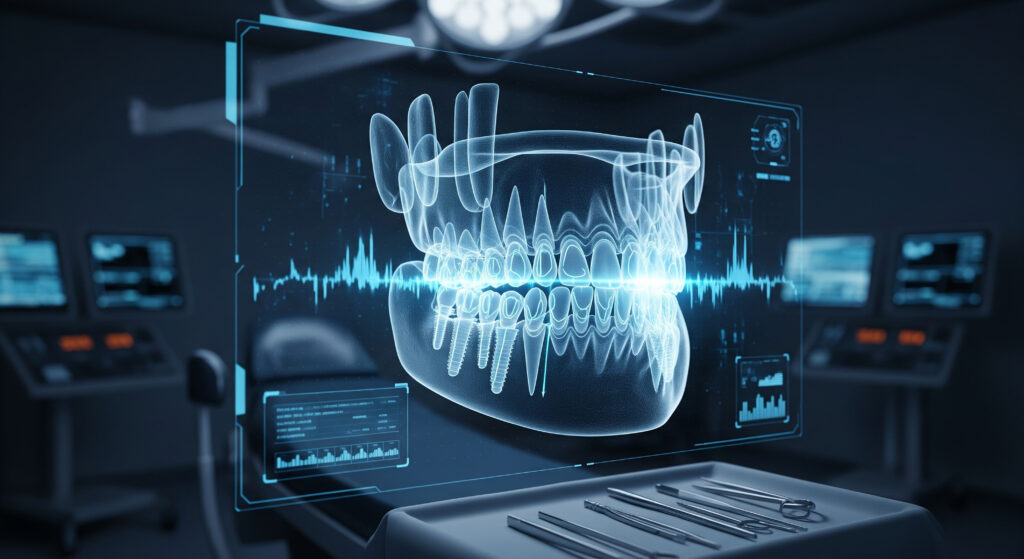
Illustration of AI-assisted analysis. Final diagnosis is always made by the dentist after a clinical examination.
AI image analysis
See how AI reads your scan before the doctor decides
Every panoramic X-ray, CBCT scan and smile photo you send is analysed by AI first. It maps bone, nerves, roots and soft tissue, flags areas that need attention and prepares measurements. Dr. Abdurrahman Öztürk then reviews every finding and makes the clinical decision.
What AI root canal therapy is, and which teeth it is for
Root canal therapy is the treatment for a tooth whose inner pulp, the soft tissue of nerves and blood vessels, has become irreversibly inflamed or has died. This page is about primary treatment: a tooth that has never had a root canal before. Deep decay, a crack, a large old filling or repeated dental work can let bacteria reach the pulp. Once the pulp cannot recover, removing it and sealing the empty canals is the way to keep the tooth instead of extracting it.
With AI root canal therapy at AIDENT, the diagnosis and the planning are supported by software that analyzes your X-rays and, when needed, your CBCT scan. The aim is practical: to know before the appointment how many canals the tooth has, how long and curved they are, and whether infection has already reached the bone. Dr. Abdurrahman Öztürk uses that map, together with his clinical tests, to decide whether the tooth truly needs a root canal and how to treat it.
- Toothache that lingers after cold or hot drinks
- Spontaneous throbbing pain, often worse at night
- Pain when biting on one specific tooth
- A tooth that has darkened after decay or an old injury
- A dark area at the root tip seen on an X-ray
Why canal anatomy matters, and how AI CBCT analysis helps
Teeth are not simple tubes. A front tooth often has one canal, but premolars can have two or three, and molars commonly have three or four, with narrow side branches, sharp curves and canals that split or join. One of the main reasons first root canals fail is a canal that was never found, so bacteria remain inside the root. Upper first molars, for example, frequently have a second canal in their front-cheek root that is easy to miss on a flat X-ray.
A CBCT scan shows the tooth in three dimensions, and AI segmentation makes that information faster to use. The software outlines the pulp space in every slice, suggests where canal openings should be on the chamber floor, and estimates canal length and curvature. It cannot see everything: very fine canals may sit below the scan's resolution, and metal fillings can create artifacts. That is why Dr. Öztürk always confirms the anatomy under magnification and with an electronic apex locator during treatment.
Does every patient need a CBCT scan?
No. For many front teeth and straightforward premolars a good periapical X-ray is enough. A CBCT scan is considered for molars, suspected extra canals, unusual curvature or unclear symptoms, keeping radiation as low as reasonably possible.
What the AI report shows the doctor
The report gives a suggested canal count, estimated lengths, curvature notes, and any dark area at the root tip. These are suggestions to be verified, not a diagnosis.
Step by step: what happens in the treatment chair
The treatment starts with local anesthesia, and we wait until the tooth is fully numb before beginning. A thin rubber sheet called a dental dam is placed around the tooth to keep saliva and bacteria out and to protect your throat from small instruments and rinsing solutions. Dr. Öztürk then removes the decay and opens a small access cavity through the top of the tooth into the pulp chamber, shaped according to the canal map prepared from your images.
Each canal is located, measured with an electronic apex locator and confirmed with an X-ray. Flexible nickel-titanium rotary files shape the canals, while disinfecting irrigation solutions dissolve tissue remnants and kill bacteria in areas the files cannot touch. When the canals are clean and dry, they are filled with a rubber-like material called gutta-percha and a sealer, then the access cavity is closed with a temporary or permanent filling.
- Local anesthesia and a dental dam for a clean field
- Access cavity planned from the AI canal map
- Length measured electronically and on X-ray
- Rotary shaping with antibacterial irrigation
- Dense three-dimensional sealing of each canal
- Final X-ray to confirm the result
One visit or two? How Dr. Öztürk decides
Many root canals can be finished in a single appointment, especially when the pulp is inflamed but not yet dead and the canals can be cleaned and dried properly. A single session also suits international patients with limited time in Istanbul. A long or complex molar may take a longer appointment, and Dr. Öztürk will tell you in advance how much chair time to expect.
A second visit is sometimes the safer choice. If the pulp is necrotic with an active infection, if there is persistent drainage from the canal, or if the tooth anatomy is very complicated, an antibacterial dressing such as calcium hydroxide may be left inside the canals for a period before final sealing. AI analysis can show the size of the dark area at the root tip and the complexity of the canals, but the decision depends on what the doctor sees and feels inside the tooth on the day.
Signs a two-visit approach may be advised
Swelling or a gum boil, a canal that keeps weeping fluid, a large lesion at the root tip, or a tooth that needs its walls rebuilt before it can be isolated with the dam.
How we plan trips around it
When two visits are likely, we schedule them a few days apart within the same stay whenever it is clinically appropriate, so you do not need an extra flight.
Protecting the tooth after root canal therapy
A root canal removes the infection, but it does not rebuild the tooth. A tooth that needed a root canal has usually already lost structure to decay or large fillings, and back teeth take heavy chewing forces. For that reason, molars and premolars usually need cuspal coverage, meaning an onlay or crown that wraps over the biting surface, to reduce the risk of fracture. Front teeth with little structure lost may only need a bonded filling.
Digital planning continues here. An intraoral scan of the treated tooth can be used to design an onlay or crown with CAD/CAM, and the software helps check the remaining wall thickness so the restoration protects weak areas. If a post is needed to hold the core, the CBCT canal map helps judge how much root can be used safely. Dr. Öztürk recommends the simplest restoration that protects the tooth properly, and he explains the options before you decide.
- Front teeth: often a bonded composite filling
- Premolars and molars: usually an onlay or crown
- Posts only when there is too little tooth to hold a core
- Restoration planned from an intraoral scan
Honest limits: when root canal therapy may not be the answer
Root canal therapy has a good record of saving teeth, but it is not always possible or wise. A tooth with a crack running down into the root, very little remaining structure, severe gum and bone loss, or a root that cannot be restored above the gum may have a poor long-term outlook even with a perfect root canal. In those cases an honest discussion about extraction and replacement is part of good care.
AI analysis can help spot warning signs, such as a bone defect pattern that suggests a vertical crack, but it cannot prove a crack exists or guarantee healing. Some treated teeth stay sensitive to biting for a short time, and a small number of root canals do not heal and later need retreatment or surgery. Instruments can very rarely separate inside a narrow canal. Dr. Öztürk explains these risks openly, and every final decision is his, not the software's.
What AI cannot do
It cannot test whether the pulp is alive, feel a crack, or decide whether a tooth is worth saving for you. Those judgments need a clinical exam and the dentist's experience.
Conventional vs AI-assisted
Conventional vs AI-Assisted Root Canal Therapy
Who it suits
Who Is a Good Candidate for AI Root Canal Therapy?
- Adults with a never-treated tooth that has lingering or night-time pain
- Patients whose X-ray shows deep decay reaching the pulp
- Teeth with a dead, darkened pulp but a restorable crown
- Molars with complex or curved canals that benefit from 3D mapping
- International patients who want treatment and a crown in one Istanbul stay
- Patients who prefer to keep their natural tooth rather than extract it
Your treatment journey
Your AI Root Canal Therapy Timeline
Before travel
WhatsApp review
Send your symptoms and any X-rays. AI-assisted review helps Dr. Öztürk give a preliminary opinion and suggest how long to stay.
Day 1
Exam and imaging
Pulp tests, X-rays and, where indicated, a CBCT scan with AI canal mapping. The plan is explained before any treatment.
Day 1–2
Root canal session
The tooth is numbed, cleaned, shaped and sealed, usually in one session, or dressed for a second visit if infection needs time.
Day 3–5
Scan for the restoration
Once comfortable, the tooth is scanned for an onlay or crown, which can often be made and fitted during the same stay.
Months later
Healing check
A follow-up X-ray, taken in Istanbul or by your local dentist, is compared with the baseline to confirm healing at the root tip.
Why patients choose it
Fewer missed canals
AI-read 3D images help reveal extra or hidden canals that are a common cause of root canal failure.
Planned, not improvised
Access shape, canal length and instrument choice are considered before treatment, which helps the session run smoothly.
You keep your own tooth
A sealed and restored natural tooth keeps its root, bone support and natural feel when you chew.
Clear explanations
You see the 3D canal map of your own tooth and understand exactly what will be done and why.
Efficient for travelers
Remote review and digital restorations help many patients finish treatment and a crown in one trip.
Doctor-made decisions
Every AI suggestion is checked by Dr. Abdurrahman Öztürk, who performs the treatment personally.
Your doctor
Every Root Canal Is Planned and Performed by Dr. Abdurrahman Öztürk
Dr. Abdurrahman Öztürk holds a PhD in dentistry and oral and maxillofacial surgery and has more than 15 years of experience in dentistry and dental surgery, having graduated from a leading Istanbul university. At AIDENT, AI analysis of X-rays and CBCT scans prepares the canal map, but Dr. Öztürk confirms the diagnosis with his own clinical tests, judges whether the tooth is worth saving, and carries out the root canal therapy himself. If the software and his clinical findings disagree, his judgment decides. That combination of careful technology and personal responsibility is what we offer every patient.
Aftercare
Aftercare Following AI Root Canal Therapy
- Wait until the numbness wears off before eating to avoid biting your cheek or tongue
- Expect mild tenderness when biting for a few days; take pain relief as advised
- Avoid chewing hard food on the treated tooth until the final onlay or crown is placed
- Brush and floss normally, including gently around the treated tooth
- Contact us on WhatsApp if swelling increases, pain worsens after the third day, or a temporary filling comes out
- Do not postpone the final restoration; an unprotected back tooth can crack
- Keep your final X-ray so any future dentist can compare healing
Related AI treatments
Questions and answers
What patients ask about AI Root Canal Therapy
What does an AI root canal actually feel like?
With proper local anesthesia it usually feels like a long filling: pressure and vibration, but not sharp pain. Dr. Öztürk tests that the tooth is numb before starting and can add more anesthetic if needed. A very inflamed tooth can be harder to numb, so extra techniques may be used. AI planning does not change the sensation, but it can make the session more efficient.
How does AI find canals that a normal X-ray misses?
AI does it by analyzing a 3D CBCT scan instead of a flat image. The software outlines the pulp space in each slice and points out canal openings that overlap or hide on a 2D X-ray, such as the extra canal often found in upper molars. Dr. Öztürk then confirms each canal inside the tooth during treatment.
Can a root canal be done in one visit in Istanbul?
Yes, many first-time root canals are completed in a single session. This is common when the pulp is inflamed but not severely infected and the canals can be fully cleaned and dried. If there is active infection or difficult anatomy, Dr. Öztürk may place a medicated dressing and finish a few days later during the same stay.
How many days should I plan in Istanbul for a molar root canal and crown?
Many patients plan around five to seven days for a molar root canal followed by a digitally made crown or onlay. The exact time depends on whether one or two root canal sessions are needed and on how quickly the tooth settles. After reviewing your X-ray on WhatsApp, Dr. Öztürk can give you a more personal estimate before you book flights.
Why does my tooth hurt more at night?
Night-time throbbing often means the pulp is inflamed under pressure, which is a common reason for root canal therapy. Lying down increases blood flow to the head, and the swollen pulp has no room to expand inside the tooth. Pain that wakes you or lingers long after cold usually suggests the pulp may not recover on its own.
Is root canal therapy safe if the nerve is already dead?
Yes, a dead pulp is one of the main reasons to have a root canal. Even if the tooth no longer hurts, bacteria in the dead tissue can spread to the bone at the root tip. AI analysis of your images can highlight such an area, and cleaning and sealing the canals helps the bone heal.
Can I fly home right after root canal therapy?
Usually yes, flying after a completed root canal is generally fine. Cabin pressure rarely affects a properly sealed tooth. We still recommend staying at least a day after treatment so any early tenderness can be checked, and leaving extra days if a crown or onlay is being made. Swelling or fever before a flight should be reported to us immediately.
Will the treated tooth look or feel different?
A treated tooth looks and feels like a normal tooth once it is restored. It no longer senses hot or cold because the pulp has been removed, but you still feel pressure through the surrounding ligament. Some teeth can darken slightly over years, which is one reason a well-made onlay or crown is often recommended for back teeth.
What are rotary files and why are they used?
Rotary files are thin, flexible nickel-titanium instruments that shape the canal with a motor. Their flexibility lets them follow curved roots more safely than stiff hand files, and they help create a smooth, tapered canal that can be cleaned and filled well. The AI canal map helps Dr. Öztürk choose file sequences for curved roots.
Can I take antibiotics instead of having a root canal?
No, antibiotics alone cannot cure an inflamed or dead pulp. The bacteria live inside the tooth where the bloodstream, and therefore the medicine, cannot reach them properly. Antibiotics may be added when infection spreads with swelling or fever, but the source has to be removed by cleaning the canals or, if the tooth cannot be saved, by extraction.
Is AI root canal therapy suitable for pregnant patients?
Necessary root canal therapy can often be done during pregnancy, ideally in the second trimester, after discussing it with your doctor. Local anesthetics used in dentistry are generally considered acceptable, and X-rays are kept to the minimum needed with protection. A CBCT scan is usually postponed unless it is essential. Dr. Öztürk will plan the safest timing for you.
Who checks the AI results for my root canal in Istanbul?
Dr. Abdurrahman Öztürk checks every AI result personally. He compares the software's canal count, lengths and lesion highlights with your clinical tests and the images themselves, and he performs the treatment. The AI is a measuring and reading aid; it never decides whether a tooth needs treatment or how it should be treated.
What happens if a canal is too narrow or calcified?
A narrow or calcified canal can usually still be treated, but it needs more time and care. The CBCT canal map shows where the canal runs, which helps the doctor search in the right direction under magnification. In rare cases a canal cannot be fully opened, and Dr. Öztürk will explain the options, which may include monitoring or a surgical approach.
No question matches your search. Ask us directly on WhatsApp.
Find Out Whether Your Tooth Needs AI Root Canal Therapy
Send a short description of your pain and any recent X-ray on WhatsApp. Dr. Abdurrahman Öztürk will review it with AI support and tell you honestly whether root canal therapy is likely, what it involves and how long to plan in Istanbul.
Send my X-ray on WhatsAppFree initial review of your photos and X-rays. Reply on WhatsApp.