AI-Assisted Diagnosis
AI Dental Diagnostics & Treatment Planning in Istanbul
At AIDENT Clinic, AI dental diagnostics means every X-ray, scan and photo of your mouth is read by AI software and then by Dr. Abdurrahman Öztürk, so nothing small is overlooked and your treatment plan is built in the right order.
 Medically reviewed by Dr. Abdurrahman Öztürk, PhD, oral & maxillofacial surgery
The 3D model shows how AI findings are mapped onto individual teeth, so you and the dentist can discuss each highlighted area together before any treatment starts.
Short answer
What is AI dental diagnostics and treatment planning?
AI dental diagnostics uses trained software to scan your X-rays, CBCT and intraoral photos for signs of decay, infection, bone loss, cracks and failing fillings, then marks each finding on a digital chart. Your dentist reviews every mark, confirms or rejects it after examining you, and turns the verified findings into a prioritized, phased treatment plan.
- What AI reads
- Panoramic, bitewing, periapical X-rays, CBCT, photos
- Who decides
- Dr. Abdurrahman Öztürk, 15+ years
- Remote start
- Send existing X-rays via WhatsApp
- Output
- Tooth-by-tooth chart and phased plan
AI
How an AI dental diagnosis is built, step by step
AI diagnostics is not a single button. It is a sequence where software does the tireless pattern-searching and the dentist does the clinical judgment. Here is the path your case follows at AIDENT.
- 1
Collect the images and history
We gather your X-rays, any CBCT scan, intraoral photos, medical history and your main complaint. Older X-rays are valuable because they let us compare change over time.
- 2
AI image screening
The software scans each image and flags areas that resemble decay, periapical lesions, bone loss, calculus, overhanging fillings or root fractures, each with a highlighted region.
- 3
Automatic tooth numbering and charting
AI identifies and numbers every tooth, existing crowns, fillings, root canals and implants, producing a draft digital chart in minutes instead of a manual count.
- 4
Clinical verification
Dr. Öztürk compares each AI flag with a hands-on examination, probing and cold or bite tests where needed. False alarms are removed and missed details are added.
- 5
Problem list and priorities
Verified findings are grouped by urgency: pain and infection first, then active disease such as decay and gum inflammation, then function and aesthetics.
- 6
Phased plan and alternatives
You receive a written plan with treatment options for each problem, the order of visits, what can wait, and what happens if a problem is left untreated.
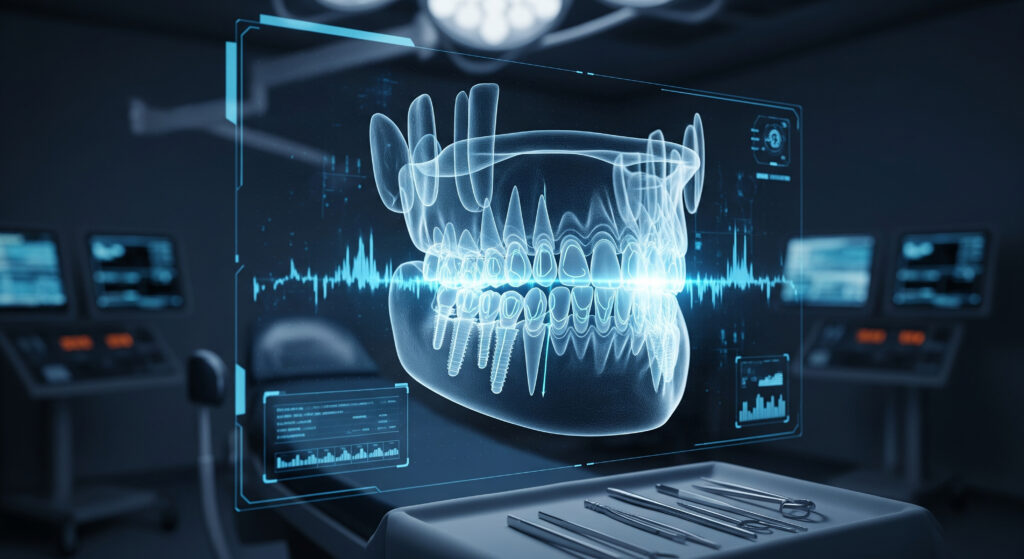
Illustration of AI-assisted analysis. Final diagnosis is always made by the dentist after a clinical examination.
AI image analysis
See how AI reads your scan before the doctor decides
Every panoramic X-ray, CBCT scan and smile photo you send is analysed by AI first. It maps bone, nerves, roots and soft tissue, flags areas that need attention and prepares measurements. Dr. Abdurrahman Öztürk then reviews every finding and makes the clinical decision.
What AI dental diagnostics actually looks for
Dental X-rays contain far more information than a quick glance can capture. An AI diagnostic model has been trained on large numbers of labelled radiographs, so it learns the grey-scale patterns that usually accompany specific problems. When it reads your images, it does not get tired at the end of a long day and it checks every tooth surface with the same attention. That consistency is its main value. At AIDENT, the AI acts as a second pair of eyes that raises questions, while Dr. Abdurrahman Öztürk answers them with a clinical examination.
The findings an AI system typically highlights fall into a few groups. Some relate to the hard tissue of the teeth, some to the bone and gums, and some to work that a previous dentist has already done. Each flag is a suggestion with a location, not a diagnosis on its own.
- Caries between teeth and under old fillings, including early lesions that are easy to miss
- Dark areas at root tips that may indicate infection or a periapical lesion
- Horizontal and vertical bone loss linked to gum disease
- Calculus deposits, overhanging fillings and open crown margins
- Incomplete or short root canal fillings and possible root fractures
- Impacted or missing teeth, retained roots and unusual anatomy
From AI findings to a treatment plan: how priorities are set
A list of findings is not yet a plan. The real skill in treatment planning is deciding what to do first, what to combine and what can safely wait. AI treatment planning tools help by organizing the verified findings into a clear problem list and checking for conflicts, for example a tooth planned for a crown that actually has a questionable root. The dentist then applies clinical logic that software cannot replace: your pain, your medical conditions, your budget, your time in Istanbul and your own priorities.
At AIDENT we usually structure a comprehensive plan in phases. This keeps treatment logical and prevents expensive work being placed on an unstable foundation.
Phase 1: urgent and infection control
Relief of pain, drainage or treatment of infection, extraction of hopeless teeth and temporary sealing of deep cavities. Nothing cosmetic is done while active infection is present.
Phase 2: stabilizing disease
Fillings for decay, deep cleaning for gum disease and root canal treatment where a tooth can be saved. This phase creates a healthy base.
Phase 3: rebuilding and replacing
Crowns, bridges and implants for missing or heavily damaged teeth, planned once the gums and remaining teeth are stable.
Phase 4: aesthetics and maintenance
Whitening, veneers or smile refinements, followed by a recall schedule. AI comparison of future X-rays with today's images helps detect early changes.
Why AI catches what is easy to overlook
Human vision is excellent at recognizing obvious problems but less reliable with faint contrast differences, especially in overlapping areas between back teeth. Early decay between molars, slight widening of the ligament space around a root, or a thin line of bone loss can all look like normal shadow. AI image analysis can enhance contrast, measure distances and draw the dentist's attention to a specific region that deserves a closer look.
This matters because small problems are cheaper and simpler to treat. A cavity found while it is still in enamel may need only a small filling or simply monitoring, while the same cavity found a year later may need a root canal. A gum pocket recognized early can often be managed with cleaning instead of surgery. The aim of AI dental diagnosis at AIDENT is not to find more treatment, but to find the right treatment at the right time.
The honest limits of AI dental diagnostics
AI is a support tool, and it has real weaknesses that every patient should understand. It only sees what is in the image. If an X-ray is blurred, angled badly or too dark, the software may miss a lesion or flag something that is just an artefact. It cannot feel a tooth's mobility, test whether a nerve is alive, or notice that a sore area is actually caused by grinding. It can also produce false positives, marking healthy tooth structure as suspicious.
For these reasons, at AIDENT no AI finding becomes part of your plan until Dr. Öztürk has confirmed it clinically. Some findings are deliberately recorded as 'monitor' rather than 'treat'. A preview created online from your photos is always preliminary, and the final plan is confirmed only after an in-person examination in Istanbul.
- AI suggests, the dentist confirms or rejects every flag
- Image quality limits what software can detect
- Vitality tests, probing and bite checks remain essential
- Online assessments are preliminary until you are examined
AI second opinions: when your plan from home feels uncertain
Many international patients contact us with a plan from another dentist and a simple question: is all of this really necessary? An AI-supported second opinion is a structured way to answer it. We read your existing X-rays with AI, compare the flagged areas with the treatment proposed, and Dr. Öztürk explains where he agrees, where he sees a more conservative option, and where more information is needed before anyone can decide.
Sometimes a second opinion confirms the original plan, and that is useful too because you can proceed with confidence. Sometimes it shows that a tooth marked for extraction could be saved with root canal treatment, or that several crowns could be replaced by smaller fillings. We will always tell you honestly when images from home are not good enough and a new X-ray is required.
Preparing for an AI dental assessment from abroad
You can begin AI dental diagnostics before you book a flight to Istanbul. The more complete your information, the more useful the preliminary plan. Send your images on WhatsApp in their original quality; screenshots of screenshots lose detail that AI and the dentist both need. Add a short description of symptoms, which teeth hurt, any medication you take and what result you hope to achieve.
After review, you receive a preliminary outline of likely problems and options, an estimate of how many visits are typically involved and which parts depend on the in-clinic examination. This helps you plan your stay realistically rather than guessing.
- A recent panoramic X-ray, ideally less than 12 months old
- Bitewing or periapical X-rays of any painful area
- Clear daylight photos of your smile, upper and lower teeth
- Any previous CBCT files in their original format
- A list of medications and medical conditions
Conventional vs AI-assisted
Conventional diagnosis vs AI-assisted diagnosis at AIDENT
Who it suits
Who benefits most from AI diagnostics and planning?
- Patients planning extensive work such as a full-mouth rehabilitation
- Anyone who wants a second opinion on a plan from another dentist
- International patients who need a reliable plan before travelling
- People with many old fillings, crowns or root canals to review
- Patients with symptoms but no clear cause found so far
- Anyone who has not had a thorough check-up for several years
Your treatment journey
Typical timeline of an AI diagnostic and planning visit
Before travel
Remote AI pre-assessment
You send X-rays and photos; AI screening and doctor review produce a preliminary problem list.
Day 1, morning
Examination and new images
Clinical exam, any missing X-rays or a CBCT if indicated, and intraoral photos.
Day 1, afternoon
AI analysis and verification
The images are analyzed and Dr. Öztürk verifies each finding against the clinical exam.
Day 1 or 2
Plan consultation
You review the annotated images, discuss options and agree a phased plan with the doctor.
Following days
Treatment begins
Urgent and stabilizing phases start, following the order agreed in your plan.
Why patients choose it
Consistent reading
Every tooth and surface is screened with the same level of attention, regardless of how busy the day is.
Earlier detection
Subtle changes are flagged sooner, which often means smaller and simpler treatment.
Clear explanations
Annotated images make it easier to understand why a treatment is recommended.
Logical sequencing
A phased plan avoids placing new crowns or implants on an unhealthy foundation.
Better remote planning
A preliminary plan before travel helps you estimate the time you need in Istanbul.
Human judgment kept central
Dr. Öztürk confirms every finding, so software never decides your treatment alone.
Your doctor
Every AI diagnosis is reviewed by Dr. Abdurrahman Öztürk
Dr. Abdurrahman Öztürk holds a PhD in dentistry and oral and maxillofacial surgery and has more than 15 years of experience in dentistry and dental surgery. A graduate of a leading Istanbul university, he personally reviews each AI-analyzed X-ray, scan and photo at AIDENT Clinic. He treats the software's flags as questions, not answers, and checks them against a careful examination before anything enters your plan. His surgical background is especially valuable when a diagnosis touches bone, infection or complex extractions, and he explains every finding in plain language so you understand your options before choosing.
Aftercare
After your AI diagnostic visit
- Keep the annotated images and written plan to share with your dentist at home
- Follow the phase order, treating infection and decay before cosmetic work
- Report any new pain, swelling or sensitivity on WhatsApp promptly
- Book regular check-ups so new X-rays can be compared with today's
- Maintain daily brushing and interdental cleaning to protect monitored areas
- Ask for an updated plan if your health, medication or goals change
Related AI treatments
Questions and answers
What patients ask about AI Diagnostics & Planning
Can AI really find cavities on my dental X-rays?
Yes, AI can highlight areas on X-rays that look like decay, including early cavities between teeth. However, it can also mark shadows that are not decay, so every flag must be checked by a dentist. At AIDENT, Dr. Öztürk confirms each suspected cavity with a clinical examination before recommending a filling or deciding to monitor it.
How accurate is AI dental diagnosis compared with a dentist?
AI works best together with a dentist, not instead of one. Software is very consistent at screening images, while a dentist adds examination, symptoms and medical history. Accuracy also depends heavily on image quality. That is why we never present AI output as a final diagnosis; the verified result is always the dentist's clinical judgment.
Can I get an AI diagnosis from X-rays taken in my home country?
Yes, in most cases you can. Send your X-rays on WhatsApp in the best quality available, ideally the original digital file. We analyze them with AI and Dr. Öztürk reviews them to give you a preliminary plan. If the images are old, blurred or incomplete, we will tell you which new X-rays are needed in Istanbul.
Is an AI dental check-up painful?
No, the AI part of the check-up is completely painless because the software only analyzes images. The examination itself involves the same gentle steps as any thorough dental check-up: looking, light probing of the gums, and sometimes a cold or bite test on a suspicious tooth to confirm what the images suggest.
How long does AI treatment planning take at AIDENT?
For most patients the diagnosis and plan are ready within the first one or two days in Istanbul. The AI analysis itself takes minutes, but verification, discussion and agreeing the order of treatment take longer because we want you to understand each option. Complex full-mouth cases may need an extra planning session.
Does AI decide which treatment I get?
No, AI never decides your treatment. It flags possible problems and helps organize them, but Dr. Abdurrahman Öztürk makes every clinical decision. You are then part of the decision too: we explain the options for each problem, including conservative ones, and you choose the plan that fits your health, goals and time.
What kinds of problems can AI detect on a panoramic X-ray?
On a panoramic X-ray, AI can typically help flag missing or impacted teeth, larger cavities, bone loss around teeth, dark areas at root tips, existing restorations and retained roots. Fine detail between back teeth is better seen on bitewing X-rays, so we may request those for a complete diagnosis.
Can AI tell if I need a root canal or an extraction?
AI can show signs that suggest a tooth may need a root canal, such as a dark area at the root tip or decay close to the nerve, but it cannot make that decision. Whether a tooth can be saved depends on vitality tests, remaining structure, gum support and your symptoms, which the dentist assesses in person.
Will AI find more problems and make my treatment more expensive?
Not necessarily. AI sometimes finds small issues early, which are often cheaper to fix than if left to grow. Equally, a careful review can show that some planned work is not needed. At AIDENT many findings are recorded as 'monitor' rather than 'treat', and we explain clearly what is urgent and what can wait.
How much time do I need to stay in Istanbul for an AI diagnosis and plan?
The diagnosis and planning visit alone usually fits into one to two days. How long you stay overall depends on the treatment you choose afterwards. A preliminary plan made from your X-rays before travel helps us estimate the number of visits, so you can book a realistic stay.
Who is the best dentist for AI dental diagnostics in Istanbul?
The best choice is a dentist who uses AI as a tool but personally verifies every finding. At AIDENT Clinic, Dr. Abdurrahman Öztürk, with a PhD in oral and maxillofacial surgery and over 15 years of experience, reviews each AI-analyzed case and explains the reasoning behind every recommendation.
Is my X-ray data safe when it is analyzed by AI?
We treat your images as confidential medical records. They are used only for your diagnosis and treatment planning, and we share them only with you or with professionals you ask us to send them to. If you have questions about how your data is stored, ask us directly before sending files.
Can AI compare my old and new X-rays to see if something is getting worse?
Yes, comparing images over time is one of the most useful parts of AI-supported diagnostics. Placing older and newer X-rays side by side helps show whether a dark area, a bone level or a small cavity is stable or progressing, which helps the dentist decide between monitoring and treatment.
No question matches your search. Ask us directly on WhatsApp.
Get your X-rays read with AI and checked by a specialist
Send your X-rays and smile photos on WhatsApp. AI screens them and Dr. Abdurrahman Öztürk reviews the findings to give you a preliminary, honest treatment outline before you travel to Istanbul.
Send my X-rays for an AI assessmentFree initial review of your photos and X-rays. Reply on WhatsApp.