AI-Assisted Endodontic Retreatment
AI Root Canal Retreatment in Istanbul: Giving a Previously Treated Tooth a Second Chance
When a tooth that already had a root canal starts hurting, swells or shows a dark shadow on the X-ray, AI root canal retreatment at AIDENT Clinic looks for the reason first. Your CBCT and X-rays are analyzed with AI, and Dr. Abdurrahman Öztürk decides whether the tooth can be cleaned, resealed and kept.
 Medically reviewed by Dr. Abdurrahman Öztürk, PhD, oral & maxillofacial surgery
The model shows a molar with its crown opened, the old root filling being removed, a previously missed canal highlighted and the area of bone inflammation at the root tip.
Short answer
What is AI root canal retreatment?
AI root canal retreatment is a second endodontic treatment on a tooth whose first root canal has failed. AI software analyzes CBCT scans and X-rays to highlight missed canals, short or leaking fillings and bone changes, then the dentist reopens the tooth, removes the old material, disinfects the canals again and reseals them.
- Treats
- Failed or reinfected root canals
- Key imaging
- CBCT read with AI support
- Visits
- Usually 1–3 appointments
- Decision
- Dr. Abdurrahman Öztürk, 15+ years
AI
How AI Studies a Failed Root Canal Before Retreatment
Retreatment is more demanding than a first root canal because the dentist has to undo previous work without seeing inside the root. AI helps map that hidden anatomy so the plan is made with more information, while every finding is checked by Dr. Öztürk.
- 1
History and old records
We collect the date of your first root canal, your symptoms and any previous X-rays you have, so the AI analysis can compare then and now.
- 2
CBCT and periapical imaging
A small-field CBCT scan shows the treated tooth in three dimensions, including root curves and the bone around each root tip.
- 3
AI canal and filling segmentation
AI software outlines each canal, the existing root filling, posts and the bone, making gaps, short fillings and untreated canals easier to spot.
- 4
Lesion and fracture screening
The software flags dark areas around the root tips and suspicious lines that may indicate a crack, which the dentist then verifies clinically.
- 5
Retreatment strategy
Dr. Öztürk weighs the AI findings to choose between non-surgical retreatment, apicoectomy or, if the tooth cannot be saved, extraction.
- 6
Control imaging
After resealing, a control X-ray is compared with the original scan, and later follow-up images track how the bone heals.
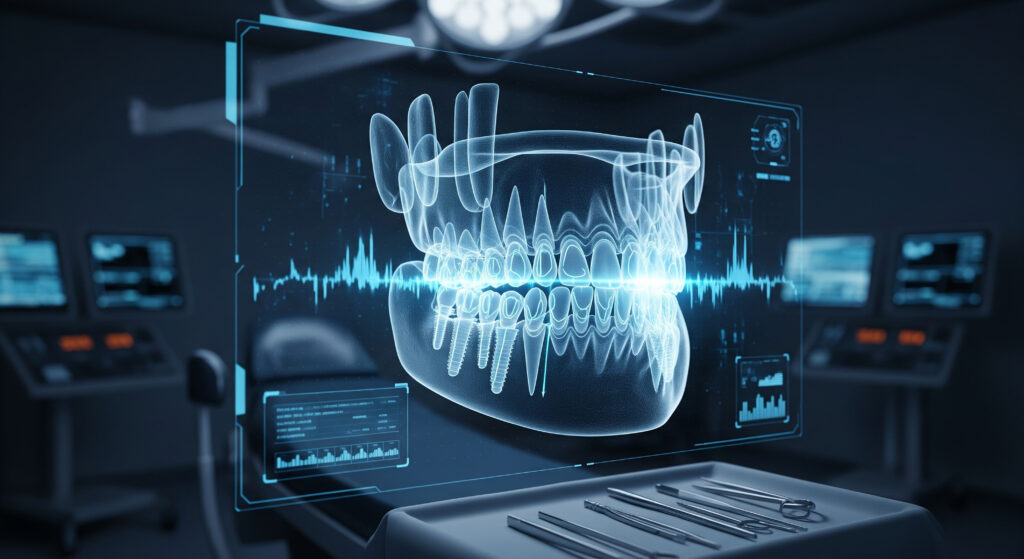
Illustration of AI-assisted analysis. Final diagnosis is always made by the dentist after a clinical examination.
AI image analysis
See how AI reads your scan before the doctor decides
Every panoramic X-ray, CBCT scan and smile photo you send is analysed by AI first. It maps bone, nerves, roots and soft tissue, flags areas that need attention and prepares measurements. Dr. Abdurrahman Öztürk then reviews every finding and makes the clinical decision.
Why a root canal can fail and when AI root canal retreatment is needed
A root canal treatment removes infected or inflamed pulp, cleans the canals and seals them. Most treated teeth stay comfortable for many years, but some do not. Bacteria can survive in a canal that was never found, in a curved section that was not fully cleaned, or in tiny side branches. In other cases the tooth was treated well, yet saliva leaked in later through a broken filling, a loose crown or new decay. The result is the same: the bone around the root tip becomes inflamed again.
Signs that a previously treated tooth may need retreatment include pain when biting, tenderness when pressing the gum, a small pimple-like bump that releases pus, swelling, or a dark area at the root tip on an X-ray. Sometimes there are no symptoms at all and the problem is found during a routine scan. Because these signs can also come from a cracked root or a gum problem, AI root canal retreatment at AIDENT always begins with an accurate diagnosis rather than an automatic decision to redo the treatment.
- Missed or untreated canals, common in molars with complex anatomy
- Root fillings that are too short, poorly condensed or have voids
- Leakage through a failed crown, temporary filling or new decay
- Persistent bacteria in curved canals or lateral branches
- Broken instruments or blockages left from the first treatment
What AI sees on your CBCT that a flat X-ray may miss
A traditional periapical X-ray is a two-dimensional shadow. Roots overlap, and a second canal hidden behind the first one can be invisible. CBCT adds depth, but the scan contains hundreds of image slices, and reading them carefully takes time. AI segmentation tools help by outlining the canals, the existing filling material and the surrounding bone in each slice, then presenting them as a clear 3D view that Dr. Öztürk can rotate and measure.
For retreatment this is especially valuable. The AI-assisted view can show a canal running beside a filled one, a gap between the filling and the canal wall, a filling that stops several millimetres before the root tip, or a lesion that is larger than it looks on a flat film. It can also help estimate root wall thickness around posts. None of this replaces the dentist: AI outputs are suggestions that the doctor confirms, adjusts or rejects after reviewing the images and examining your tooth.
Finding the missed canal
Upper molars often have an extra canal in one root that is easy to overlook. AI highlighting directs attention to where it is likely to be, and the dentist then locates it under magnification.
Screening for root cracks
A vertical root fracture usually means a tooth cannot be saved by retreatment. AI may flag suspicious patterns, but cracks are confirmed clinically, sometimes only once the tooth is opened.
The AI root canal retreatment procedure, step by step
Retreatment starts with local anaesthesia so the area is numb. A rubber dam is placed to isolate the tooth from saliva, which is essential to avoid reintroducing bacteria. If the tooth has a crown, the dentist either works through it or removes it, depending on its condition. Any post inside the root is carefully loosened and removed. Then the old root filling, usually gutta-percha with sealer, is taken out using rotary or ultrasonic instruments and, where needed, a solvent.
With the canals empty, the dentist searches for any canal that was missed, guided by the AI-assisted CBCT map. Each canal is measured, shaped and disinfected with irrigating solutions. If infection is significant, a medicated dressing may be left inside for some days before the final seal. Finally, the canals are filled and the access is closed with a tight restoration. Because a strong coronal seal protects the result, most back teeth will need a new crown afterwards.
- Local anaesthesia and rubber dam isolation
- Removal of crown, post and old root filling when needed
- Locating missed canals with magnification and the AI map
- Cleaning, shaping and disinfection of every canal
- New root filling and a sealed core, then a crown if indicated
Retreatment, apicoectomy or extraction: how the decision is made
Not every failed root canal should be retreated the same way. Non-surgical retreatment through the crown is usually the first choice because it lets the dentist clean the entire canal system again. When it is not practical, for example when a long post cannot be removed safely or the crown is a new, well-fitting bridge, a surgical approach at the root tip may be considered. That procedure is explained on our separate apicoectomy page.
Sometimes the honest answer is that the tooth cannot be kept. A vertical root fracture, very thin root walls, deep decay below the gum or poor bone support can make retreatment unpredictable. In that case Dr. Öztürk will explain why and discuss options such as an implant or a bridge. AI outcome prediction can show how the bone and tooth look in each scenario, but it is a planning aid, not a promise. The final recommendation always comes from the clinical examination.
Factors that favour retreatment
Enough healthy tooth structure, a canal that can be accessed, no fracture, and a gum and bone condition that supports the tooth long term.
Factors against it
Confirmed root cracks, perforations that cannot be repaired, roots too weak to hold a crown, or a tooth that has little value in the overall treatment plan.
Risks and limits of root canal retreatment
Retreatment is a well-established procedure, but it is technically harder than the first treatment and its prognosis depends on what is found inside the tooth. Possible complications include an instrument that cannot be bypassed, a canal blocked by hardened material, a perforation of the root wall, or a crack that was not visible beforehand. Removing a post or crown always carries some risk to the remaining tooth. After treatment, tenderness for several days is common and usually settles with simple painkillers.
Even a technically excellent retreatment cannot guarantee that the lesion will heal, because the biological response varies between people. Bone healing is assessed on follow-up X-rays over months, not days. If healing does not progress, an apicoectomy or extraction may still be needed. We explain these possibilities before you begin so you can make an informed choice. AI improves the information available for planning, yet it does not remove these biological limits.
AI root canal retreatment in Istanbul for patients travelling from abroad
Many international patients come to Istanbul with a tooth that was treated years ago in their home country and has started to cause problems. Before you book a flight, you can send recent X-rays, any CBCT you already have and a short description of your symptoms on WhatsApp. Dr. Öztürk reviews them with AI-assisted analysis and tells you whether retreatment looks feasible, whether a new scan is required and how many days you should plan to stay.
Retreatment can often be completed in one or two visits a few days apart. If a medicated dressing is needed, or a new crown is planned, your stay may be longer, and digital scanning with CAD/CAM manufacturing can help keep it efficient. You leave with copies of your images and a written summary so your dentist at home can follow the healing. Planned follow-up X-rays can be sent to us remotely for comparison with your original scans.
- Online review of your existing X-rays on WhatsApp
- Clear estimate of visits and days needed in Istanbul
- Copies of CBCT and control images to take home
- Remote follow-up by sending new X-rays later
Conventional vs AI-assisted
Root Canal Retreatment: Conventional vs AI-Assisted at AIDENT
Who it suits
Who Is a Good Candidate for AI Root Canal Retreatment?
- Patients with pain or tenderness in a tooth that already had a root canal
- People with a dark area at a root tip found on a routine X-ray
- Teeth with a gum bump or recurring swelling near a treated root
- Teeth whose first root canal looks short, incomplete or missing a canal
- Treated teeth that need a new crown and have a doubtful old root filling
- Patients who prefer to keep their natural tooth when it can be saved
Your treatment journey
Typical Timeline for AI Root Canal Retreatment
Before travel
Remote image review
Send your X-rays and symptoms on WhatsApp for an AI-assisted preliminary assessment by Dr. Öztürk.
Day 1
Exam and CBCT
Clinical tests, a CBCT scan and AI analysis of the failed treatment; the plan is discussed with you.
Day 1–2
Retreatment visit
Old filling removed, canals cleaned and disinfected, and either sealed or dressed with medication.
Day 3–7
Final seal if needed
If a dressing was placed, the canals are filled and the tooth is sealed with a core restoration.
Before leaving
Crown and control X-ray
A crown is prepared or placed when indicated and a control image is taken.
6–12 months
Healing check
A follow-up X-ray, taken in Istanbul or at home, shows how the bone around the root is healing.
Why patients choose it
Keeps your natural tooth
A successful retreatment preserves your own root, bite feel and surrounding bone, avoiding an implant or bridge.
Diagnosis before drilling
AI-assisted CBCT analysis helps identify why the first treatment failed, so the correct problem is treated.
Better canal detection
Highlighted 3D anatomy helps the dentist look for extra or curved canals that may have been missed before.
Honest prognosis
If a crack or weak root makes retreatment unpredictable, you are told before treatment, not after.
Efficient for travellers
Remote review and digital workflows help plan the shortest realistic stay in Istanbul.
Measurable follow-up
Baseline and control images allow bone healing to be tracked over time, even from abroad.
Your doctor
Retreatment Planned and Performed Under Dr. Abdurrahman Öztürk
Every AI root canal retreatment at AIDENT Clinic is supervised by Dr. Abdurrahman Öztürk, who holds a PhD in dentistry and oral and maxillofacial surgery and has more than 15 years of experience in dentistry and dental surgery after graduating from a leading Istanbul university. He personally reviews each AI-analyzed CBCT, decides whether a failed root canal can be retreated, should be approached surgically or cannot be saved, and explains the reasons clearly. AI makes the hidden anatomy easier to study; the clinical judgement and the responsibility remain his.
Aftercare
Aftercare Following Root Canal Retreatment
- Expect some tenderness when biting for a few days; use the painkillers recommended by your dentist.
- Avoid chewing hard food on the treated tooth until the final crown or restoration is in place.
- Keep the temporary filling intact; contact us if it feels loose or falls out.
- Brush and floss normally, keeping the area clean to protect the new seal.
- Complete any antibiotics only if they were prescribed for a specific reason.
- Have the planned crown made without long delay, as leakage can cause failure again.
- Attend or send follow-up X-rays so healing of the bone can be confirmed.
Related AI treatments
Questions and answers
What patients ask about AI Root Canal Retreatment
Can a failed root canal be fixed without pulling the tooth?
Yes, in many cases it can. If the root is not cracked and enough tooth structure remains, the old filling can be removed, the canals cleaned and disinfected again and resealed. Dr. Öztürk uses AI-assisted CBCT analysis to judge whether your tooth is a good candidate before recommending retreatment over extraction.
Why does my tooth hurt again years after a root canal?
Usually because bacteria have returned to or survived inside the root. Common reasons are a canal that was never treated, a filling that did not reach the root tip, or leakage through a broken crown or new decay. A crack in the root can cause similar pain, which is why imaging and examination come first.
Does AI really help with root canal retreatment?
It helps with the diagnosis and planning stage. AI tools segment the canals, old filling and bone on a CBCT scan, making missed canals, gaps and lesions easier to see. The dentist still verifies every finding and performs the treatment by hand, so AI improves the information, not the skill.
Is root canal retreatment more painful than the first root canal?
Not usually during the procedure, because the tooth is fully numbed with local anaesthesia. Afterwards it is common to feel tenderness when biting for a few days, sometimes a little more than after the first treatment, since the inflamed tissue around the root needs time to settle.
How long does an AI root canal retreatment appointment take?
A retreatment visit often takes longer than a first root canal, commonly around one to two hours, because the old filling, and sometimes a post, must be removed first. Complex molars or heavily infected teeth may need a second appointment a few days later to complete the seal.
How many days should I stay in Istanbul for root canal retreatment?
Many patients need a few days, enough for the examination, CBCT and one or two treatment visits. If a medicated dressing or a new crown is planned, allow around a week. After reviewing your X-rays on WhatsApp, Dr. Öztürk gives you a realistic estimate for your specific tooth.
Will my crown have to be removed for retreatment?
Not always. Sometimes the dentist can work through a small opening in the crown and then seal it. If the crown is leaking, poorly fitting or blocking access to the canals, removing it gives better access and a new crown is made afterwards. The CBCT and examination guide this choice.
What happens if there is a broken instrument in my old root canal?
The dentist will try to remove or bypass it using ultrasonic tools and magnification. This is not always possible, depending on its position and the curvature of the root. AI-assisted 3D imaging helps show where the fragment sits, and if it cannot be managed, an apicoectomy may be considered.
Can AI detect a cracked root before treatment?
AI can flag suspicious patterns, but it cannot reliably confirm every crack. Fine vertical fractures are often too small to see clearly even on CBCT. Dr. Öztürk combines the AI findings with clinical tests, gum probing and, if needed, direct inspection once the tooth is opened before giving a final verdict.
Is it better to redo a root canal or get a dental implant?
When the tooth has a good prognosis, keeping it with retreatment is generally preferable because a natural root preserves bone and bite feel. If the root is cracked, very weak or has poor bone support, an implant may be more predictable. Your scans and examination determine which option suits your case.
Can I send my old root canal X-rays from abroad for a second opinion?
Yes. Send clear photos or files of your X-rays and any CBCT on WhatsApp to +90 534 445 9444, with a description of your symptoms. Dr. Öztürk reviews them with AI-assisted analysis and replies with a preliminary opinion, which is confirmed after a clinical examination in Istanbul.
How will I know whether the retreatment worked?
Symptoms usually improve within days to weeks, but real confirmation comes from follow-up X-rays showing the bone around the root tip filling in. This is normally checked after about six to twelve months. You can have the image taken at home and send it to us for comparison with your original scan.
Who is the best dentist for AI root canal retreatment in Istanbul?
Look for a dentist who uses CBCT for diagnosis, explains clearly why the first treatment failed and is honest when a tooth cannot be saved. At AIDENT Clinic every case is analyzed with AI and decided by Dr. Abdurrahman Öztürk, who has a PhD in oral and maxillofacial surgery and 15+ years of experience.
Do I need a new crown after root canal retreatment?
Usually yes for back teeth. Molars and premolars that have had a root canal, and especially a second one, have lost tooth structure and are prone to fracture. A well-fitting crown protects the tooth and seals the canals from saliva. Front teeth with small openings may sometimes only need a filling.
No question matches your search. Ask us directly on WhatsApp.
Find Out If Your Previously Treated Tooth Can Be Saved
Send your X-rays or CBCT and a short description of your symptoms on WhatsApp. Dr. Abdurrahman Öztürk will review them with AI-assisted analysis and tell you whether AI root canal retreatment in Istanbul is a realistic option for you.
Get my free AI retreatment assessment on WhatsAppFree initial review of your photos and X-rays. Reply on WhatsApp.