AI-Designed Implant Restorations
AI Implant-Supported Prostheses: Teeth Designed Digitally for Your Implants
An implant is only the root; the prosthesis is the part you see, chew with and smile with. At AIDENT Clinic in Istanbul, AI implant-supported prostheses are designed on your own 3D scans, with the bite, shape and material reviewed and approved by Dr. Abdurrahman Öztürk.
 Medically reviewed by Dr. Abdurrahman Öztürk, PhD, oral & maxillofacial surgery
The model shows how a prosthesis connects to implants through abutments or a framework. Rotate it to see where the screw channel, the connector and the visible teeth sit above the bone.
Short answer
What is an AI implant-supported prosthesis?
It is a crown, bridge or full set of teeth that is fixed to, or clips onto, dental implants and is designed with AI-assisted digital software. Your scans, bite and facial photos are analyzed to propose tooth shape, position and material, and Dr. Abdurrahman Öztürk reviews and approves the final design before it is milled.
- Prosthesis types
- Fixed or removable
- Design
- AI-assisted CAD on 3D scans
- Approval
- Dr. Abdurrahman Öztürk, 15+ years
- First step
- Free online review on WhatsApp
AI
How AI Helps Design Your Implant Prosthesis
The prosthesis is planned backwards from the final teeth: we decide how the teeth should look and bite first, then make sure the implants and connectors support that design. AI tools speed up the analysis, and every step is checked by the doctor.
- 1
Facial and smile photos
AI landmarks your face, lips and smile line so that the tooth length, width and midline of the new prosthesis can be proposed in harmony with your features.
- 2
Intraoral and implant scans
An intraoral scanner and scan bodies record the exact position of each implant, replacing traditional impression trays in most cases.
- 3
AI bite analysis
Software analyzes how your jaws meet and suggests a balanced bite, which the doctor refines to protect the implants from overload.
- 4
Digital tooth design
AI-assisted CAD proposes tooth shapes from digital libraries; the doctor and technician adjust contours, gum display and cleaning access.
- 5
Try-in and preview
A printed or milled trial version lets you see and feel the design before the final material is produced, so changes are still easy.
- 6
Milling and final fit
The approved design is milled or printed with CAD/CAM, then the fit, bite and screw access are verified in the mouth by Dr. Öztürk.
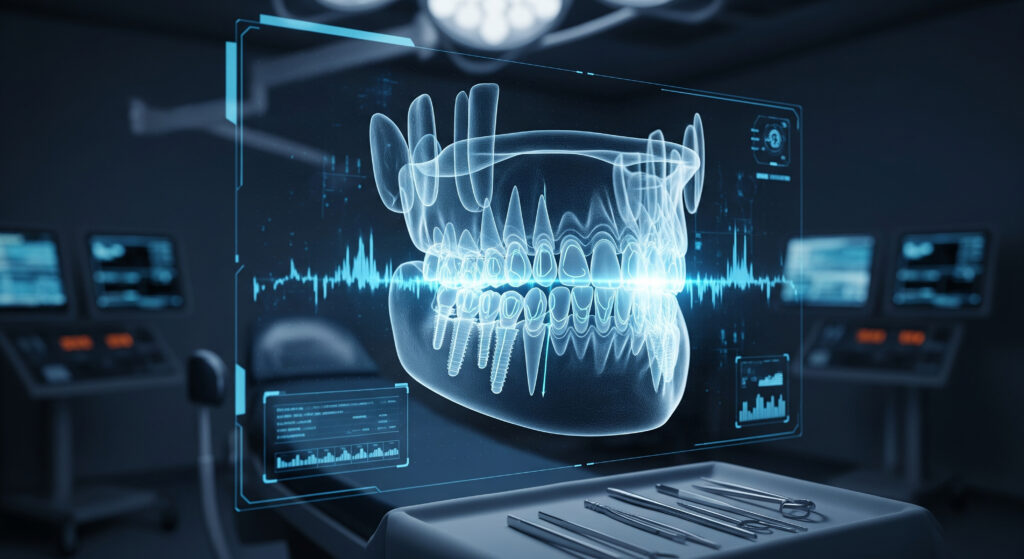
Illustration of AI-assisted analysis. Final diagnosis is always made by the dentist after a clinical examination.
AI image analysis
See how AI reads your scan before the doctor decides
Every panoramic X-ray, CBCT scan and smile photo you send is analysed by AI first. It maps bone, nerves, roots and soft tissue, flags areas that need attention and prepares measurements. Dr. Abdurrahman Öztürk then reviews every finding and makes the clinical decision.
What an Implant-Supported Prosthesis Is, and Why the Design Matters
An implant-supported prosthesis is any artificial tooth or set of teeth that takes its support from dental implants rather than from natural teeth or the gums alone. The implant acts as an artificial root in the jawbone; above it sits a connector, called an abutment, and on top of that the prosthesis itself. Patients often focus on the implant brand or the surgery, yet most of what they experience every day, the appearance, the bite, the way food feels and how easy it is to clean, depends on how well the prosthesis is designed.
With AI implant-supported prostheses, that design work moves into a digital environment. Instead of shaping wax by eye on a plaster model, the team works on precise 3D scans of your mouth, your implants and your face. AI software suggests tooth forms, analyzes the bite and highlights areas that might be difficult to clean. Dr. Abdurrahman Öztürk then makes the clinical decisions: how many teeth the prosthesis carries, which material is used, and whether it is fixed or removable.
- The implant replaces the root; the prosthesis replaces the visible tooth or teeth.
- A good prosthesis spreads chewing forces evenly across the implants.
- AI proposes a design; the dentist approves, edits or rejects it.
Fixed or Removable: Choosing the Right AI-Planned Prosthesis
The first big decision is whether your new teeth will be fixed in place or removable by you. Fixed implant prostheses, such as screw-retained bridges or full-arch hybrid bridges, can only be taken off by the dentist. They feel closest to natural teeth and do not cover the palate. Removable implant overdentures clip onto implants or a bar; you take them out each day for cleaning, which some patients find easier, especially if hand dexterity is limited.
AI analysis helps make this choice more objective. On your CBCT scan and digital model, the software can show how much bone and soft tissue has been lost, how much lip support the prosthesis must provide and how much space is available between the jaws. When a lot of tissue is missing, a removable design with a flange may give better facial support. Dr. Öztürk discusses these simulations with you, because comfort, budget, cleaning habits and personal preference matter as much as the scan.
Fixed implant prostheses
Single crowns, implant bridges and full-arch fixed bridges. They stay in the mouth permanently, are cleaned with brushes, floss and water flossers, and are removed only by the clinic for professional maintenance.
Removable implant overdentures
A denture that snaps onto two or more implants using attachments such as locators, balls or a milled bar. It is far more stable than a conventional denture and is taken out at night for cleaning.
Screw-Retained or Cement-Retained: How Teeth Attach to Implants
Fixed prostheses are held onto implants in one of two main ways. A screw-retained prosthesis is attached with a small screw that passes through the tooth into the implant or abutment; the access hole is then sealed with a tooth-coloured filling. A cement-retained prosthesis is glued onto an abutment, much like a crown on a natural tooth. Both are well established, and each has advantages depending on the situation.
Screw retention makes the prosthesis retrievable, so the dentist can remove it for cleaning, repair or checks without cutting it off, and it avoids the risk of leftover cement under the gum, which is one known cause of inflammation around implants. Cement retention can be preferred when the implant angle would place the screw hole in a visible area. In AI-assisted planning, the software displays the exact path of each screw channel on your 3D model, allowing Dr. Öztürk to decide in advance whether a screw-retained design is possible and, if needed, to use angled screw channels or custom abutments.
- Screw-retained: retrievable, no cement under the gums, needs a suitable screw position.
- Cement-retained: no visible access hole, but excess cement must be carefully controlled.
- The screw path is visualised in 3D before the prosthesis is designed.
Prosthesis Materials: Zirconia, Ceramic, PMMA and Hybrid Options
The material of an implant prosthesis affects its strength, appearance, weight, repairability and cost. Monolithic zirconia is very strong and resistant to chipping, which makes it popular for full-arch fixed bridges and back teeth. Layered ceramics on zirconia or metal frameworks can achieve very natural translucency for front teeth, although the porcelain layer can chip under heavy forces. Acrylic or composite teeth on a titanium framework, often called hybrid prostheses, are lighter and easier to repair, but they wear and stain faster over the years.
PMMA and other high-performance resins are commonly used for temporary teeth and trial versions, because they can be milled quickly and adjusted easily. AI-assisted design does not change the physics of these materials, but it helps match material to situation: the software reports the available vertical space, the thickness each material needs and where the strongest forces will fall. Dr. Öztürk explains the trade-offs honestly, including that no material is unbreakable and that grinding habits may require a protective night guard.
When zirconia is usually suggested
For patients with strong bites, enough vertical space and a wish for a durable, stain-resistant full-arch bridge.
When a hybrid or acrylic design may fit better
When a lighter prosthesis, simpler repairs or a lower initial cost is the priority, accepting more frequent maintenance.
Temporary Teeth, Trial Versions and the Final AI-Designed Prosthesis
Most implant prostheses are made in stages. Immediately after surgery, or once the implants are stable, you may receive temporary teeth, usually in PMMA resin. These protect the area, let you eat soft foods and give you a chance to live with a shape before committing to it. While the implants integrate with the bone, which commonly takes a few months, the soft tissues also settle, so the final prosthesis is designed afterwards on fresh scans.
Because your temporary design is stored digitally, the final version does not start from zero. Feedback such as "the front teeth feel too long" or "I bite my cheek on the left" can be applied directly to the digital file. A trial version may be tried in before the final zirconia or ceramic is milled. This step is where the AI preview becomes real: you see the actual shape in your mouth, and Dr. Öztürk confirms the bite, speech and appearance before approval.
Bite, Fit and Hygiene: What AI Checks That Your Eyes Cannot
Implants do not have the cushioning ligament that natural teeth have, so they cannot sense overload in the same way. An uneven bite can loosen screws, chip ceramics or stress the bone around implants. AI-assisted bite analysis uses the digital models of both jaws to highlight contacts that are too heavy and movements that strike the prosthesis at an angle. The doctor refines these contacts digitally and then confirms them in the mouth with articulating paper.
Fit is equally important. A full-arch framework should seat passively on all implants without forcing them. Digital scanning with scan bodies and CAD/CAM milling help achieve a precise fit, and the dentist checks it clinically and, when needed, with X-rays. The design software can also show where the underside of a bridge touches the gum, so that cleaning spaces are created for floss or water flossers. These checks support the doctor's judgement; they do not replace careful clinical examination.
- Heavy contacts and side-to-side interferences are flagged digitally.
- Passive fit of the framework is checked clinically and radiographically.
- Cleaning access under bridges is planned into the design.
Upgrading an Existing Denture or Bridge to an Implant Prosthesis in Istanbul
Many international patients who contact AIDENT already wear a loose denture or have an old bridge that has failed. In some cases, a well-made existing denture can be converted into an implant overdenture by adding attachments, though often a new prosthesis gives a better long-term result. Patients who already have implants placed elsewhere can also ask whether a new prosthesis can be made on them; this depends on identifying the implant system and checking the health of the bone and gums around it.
You can start online: send clear photos of your smile, your current prosthesis and any recent X-rays or CBCT scans via WhatsApp. These images are analyzed with AI tools and reviewed by Dr. Öztürk, who gives a preliminary opinion on what may be possible. A final plan is only confirmed after a clinical examination in Istanbul, and the number and length of visits depend on whether new implants are needed or only a new prosthesis.
Conventional vs AI-assisted
Conventional vs AI-Assisted Prosthesis Design at AIDENT
Who it suits
Who Is a Good Candidate for an AI Implant-Supported Prosthesis?
- People missing one or more teeth who have, or can receive, healthy integrated implants
- Denture wearers whose dentures move when eating or speaking
- Patients with a failing tooth-supported bridge who want a solution not relying on neighbouring teeth
- People with existing implants whose old crowns or bridges need replacing
- Patients willing to keep up daily cleaning and regular professional check-ups
- Adults whose general health, gum condition and smoking habits allow stable implant support, as confirmed by the dentist
Your treatment journey
From Scan to Final Teeth: A Typical Prosthesis Timeline
Before travel
Online AI review
Photos, X-rays and details of your current teeth or prosthesis are sent on WhatsApp for an AI-assisted preliminary assessment by Dr. Öztürk.
First visit
Scans and design start
Clinical exam, CBCT, intraoral and facial scans. The prosthesis design and implant plan are discussed together on screen.
Surgery phase
Implants and temporaries
If implants are needed, they are placed and temporary teeth may be fitted when stability allows; otherwise healing caps are placed.
Healing period
Integration
The implants integrate with the bone, commonly over several months. Many patients return home during this time.
Second visit
Final design and try-in
New scans, a trial version and adjustments to shape and bite are made before the final material is produced.
Delivery
Final prosthesis
The milled prosthesis is fitted, screws are tightened to specification and the bite is confirmed, followed by care instructions.
Why patients choose it
Stable chewing
Implant support stops the prosthesis from slipping, so many patients can chew a wider range of foods than with conventional dentures.
Design you can preview
AI-assisted digital design and trial versions let you see the shape of your teeth before the final material is made.
Protected implants
Digital bite analysis helps reduce overload on the implants and the prosthesis, supporting longer service.
Easier maintenance
Screw-retained designs can be removed by the clinic for cleaning or repair, and cleaning spaces are planned in advance.
Reusable digital records
Your design is stored, so future repairs or replacements can start from an accurate file instead of new impressions.
Bone-preserving support
Implants transmit chewing forces to the jawbone, which can help limit the bone loss that occurs under conventional dentures.
Your doctor
Dr. Abdurrahman Öztürk Approves Every AI-Designed Prosthesis
Dr. Abdurrahman Öztürk holds a PhD in dentistry and oral and maxillofacial surgery, graduated from a leading Istanbul university and has more than 15 years of experience in dentistry and dental surgery. At AIDENT Clinic, AI tools analyze scans, propose tooth designs and highlight bite problems, but none of that becomes treatment until Dr. Öztürk has reviewed it. He decides whether your prosthesis should be fixed or removable, chooses the attachment method and material, and personally checks fit and bite at delivery. AI supports the work; the doctor makes every clinical decision.
Aftercare
Caring for Your Implant-Supported Prosthesis
- Brush the prosthesis and the gum line around each implant twice a day with a soft brush.
- Use interdental brushes, implant floss or a water flosser under bridges every day.
- For overdentures, remove and clean the denture and attachments daily, and leave it out overnight if advised.
- Wear a night guard if you grind or clench your teeth.
- Report loose teeth, a clicking sound or a change in your bite promptly, as screws may need retightening.
- Attend professional check-ups, where fixed prostheses may be removed for deep cleaning when indicated.
- Expect overdenture attachment inserts to wear over time and need periodic replacement.
Related AI treatments
Questions and answers
What patients ask about AI Implant-Supported Prostheses
What is the best type of prosthesis on dental implants?
There is no single best type; the right prosthesis depends on how many teeth are missing, how much bone and gum tissue remains and your cleaning habits. Fixed bridges feel most like natural teeth, while removable overdentures can offer more lip support and easier cleaning. AI analysis of your scans helps Dr. Öztürk show you the options, and he recommends the one that suits your mouth.
Can my existing denture be attached to implants?
Sometimes, yes. If your current denture fits well and is in good condition, attachments can occasionally be added so it clips onto implants. Often, however, a new denture designed digitally for the implants gives a more stable and durable result. Dr. Öztürk can give a preliminary opinion from photos and X-rays sent on WhatsApp, then confirm after examination.
How are teeth attached to dental implants?
Teeth are attached either with a small screw through the prosthesis into the implant or abutment, or by cementing the prosthesis onto an abutment. Removable overdentures instead snap onto attachments or a bar. In AI-assisted planning, the screw path is shown on your 3D model in advance, so the attachment method can be chosen before the teeth are designed.
Is a screw-retained or cement-retained implant crown better?
Many dentists prefer screw-retained prostheses when the implant position allows it, because they can be removed for maintenance and avoid leftover cement under the gum. Cement retention is still useful when a screw hole would be visible or the angle is unfavourable. Dr. Öztürk decides case by case after viewing the screw channels on your digital plan.
Does AI really design my new teeth?
AI helps design them, but it does not decide on its own. The software analyzes your face, smile and bite and proposes tooth shapes and positions from digital libraries. A dental technician and Dr. Öztürk then edit the design, check it against clinical findings and approve it. You also see a trial version before the final prosthesis is milled.
What material is best for implant teeth, zirconia or acrylic?
Zirconia is generally stronger, more stain-resistant and less prone to wear, which makes it a common choice for fixed full-arch bridges. Acrylic or composite hybrid prostheses are lighter, cheaper initially and easier to repair, but wear and discolour faster. The best option depends on your bite strength, available space and budget, which are assessed during planning.
How long does an implant-supported prosthesis last?
Lifespan varies widely with the material, your bite, grinding habits and hygiene, so no exact figure can be promised. Implants themselves can serve for many years when healthy, while the prosthesis on top may need repairs, new attachment inserts or eventual replacement. Regular check-ups and a stored digital design make maintenance and remakes simpler.
Can I take my implant prosthesis out myself?
It depends on the type. Removable overdentures are designed to be taken out by you every day for cleaning. Fixed implant bridges and crowns can only be removed by the dentist, usually by unscrewing them during a professional maintenance visit. Your preference for fixed or removable teeth is one of the first things discussed in planning.
How much time do I need to stay in Istanbul for an implant-supported prosthesis?
It depends on whether you need new implants or only a new prosthesis on existing healthy implants. When implants are placed, treatment is usually split into two trips separated by a healing period of several months. A prosthesis on already-integrated implants generally needs a shorter stay. Dr. Öztürk estimates your schedule after the online AI review.
Is getting the final prosthesis fitted painful?
Fitting the final prosthesis is usually not painful, because the surgery has already healed. You may feel pressure while the teeth are seated and screws are tightened, and gums can feel tender for a short time. If adjustments are needed, they are typically quick. Local anaesthetic can be used if a particular step is uncomfortable.
Can a new prosthesis be made on implants placed at another clinic?
Often it can, provided the implant system can be identified and the compatible components are available. The bone and gum around the implants must also be healthy. Send any implant records, X-rays and photos you have on WhatsApp; the images are analyzed with AI and reviewed by Dr. Öztürk before a clinical check in Istanbul.
Who is the best dentist for AI implant-supported prostheses in Istanbul?
Look for a dentist who combines surgical and prosthetic experience with digital planning and explains every option clearly. At AIDENT Clinic, Dr. Abdurrahman Öztürk, who holds a PhD in dentistry and oral and maxillofacial surgery and has 15+ years of experience, supervises every AI-analyzed case and approves each prosthesis design personally.
What happens if my implant teeth chip or break?
Contact the clinic as soon as possible and avoid chewing hard foods on that side. Small chips in ceramic or resin can often be polished or repaired, while larger fractures may need a replacement. Because your prosthesis design is stored digitally, a new one can usually be produced from the existing file after the cause, such as grinding, is assessed.
Will my implant prosthesis look exactly like the AI preview?
The AI preview is a simulation that shows the planned shape and proportions, not a guaranteed final appearance. Colour, translucency and gum display can differ slightly once real materials are in your mouth. That is why a trial version is used: you and Dr. Öztürk can adjust the design before the final prosthesis is produced.
No question matches your search. Ask us directly on WhatsApp.
Find Out Which AI-Designed Implant Prosthesis Suits You
Send photos of your smile, your current teeth or denture, and any X-rays to our WhatsApp at +90 534 445 9444. Your images are analyzed with AI and reviewed by Dr. Abdurrahman Öztürk, who will explain your fixed or removable options before you travel to Istanbul.
Get my free AI prosthesis review on WhatsAppFree initial review of your photos and X-rays. Reply on WhatsApp.