AI-Designed Fixed Bridges
AI Dental Bridges in Istanbul: Fixed Replacement Teeth Planned Around Your Bite
An AI dental bridge at AIDENT starts with AI analysis of your X-rays, photos and 3D scan to test whether the neighbouring teeth can carry a bridge, then a digital design you can preview before anything is prepared. Dr. Abdurrahman Öztürk reviews every step and makes every clinical decision.
 Medically reviewed by Dr. Abdurrahman Öztürk, PhD, oral & maxillofacial surgery
The 3D model shows a classic three-unit bridge: two crowns on prepared neighbouring teeth hold a false tooth that fills the gap. The connectors between them are the thinnest part of the bridge and are designed carefully for strength.
Short answer
What is an AI dental bridge?
An AI dental bridge is a fixed bridge that replaces one or more missing teeth, planned with AI tools that analyse X-rays, CBCT and 3D scans of the support teeth, gum and bite. Software helps design the shape and simulate the result, and the dentist confirms the plan after a clinical exam before the bridge is made and cemented.
- Replaces
- 1 to several missing teeth in a row
- Support
- Natural teeth or dental implants
- Tooth-supported bridge
- Usually about 1 week in Istanbul
- Removable?
- No, fixed and cemented or screwed
AI
How AI Plans Your Dental Bridge
A bridge only lasts if the teeth or implants holding it are strong enough and the bite is balanced. Our AI-assisted workflow collects that evidence before any tooth is touched, and Dr. Öztürk checks each result.
- 1
Photo and X-ray screening
Your smile photos and panoramic X-ray are analysed with AI to flag decay, old fillings, bone loss and root problems around the gap and the possible support teeth.
- 2
CBCT and root assessment
When needed, a CBCT scan is segmented by AI so the doctor can see root length, root shape and bone levels of each candidate abutment tooth in three dimensions.
- 3
Intraoral 3D scan
An intraoral scanner records your teeth, gums and bite digitally, replacing most messy impression trays and giving the design software precise data.
- 4
Bridge type selection
Using the data, the doctor compares a traditional, cantilever, resin-bonded or implant-supported bridge and explains which is suitable and why.
- 5
Digital design and preview
CAD software proposes tooth shapes for the pontic and abutment crowns, and an outcome simulation shows how the bridge may look in your smile before preparation.
- 6
Bite simulation and milling
The design is checked against your recorded bite movements, adjusted by the doctor, then milled or printed with CAD/CAM and tried in before final cementation.
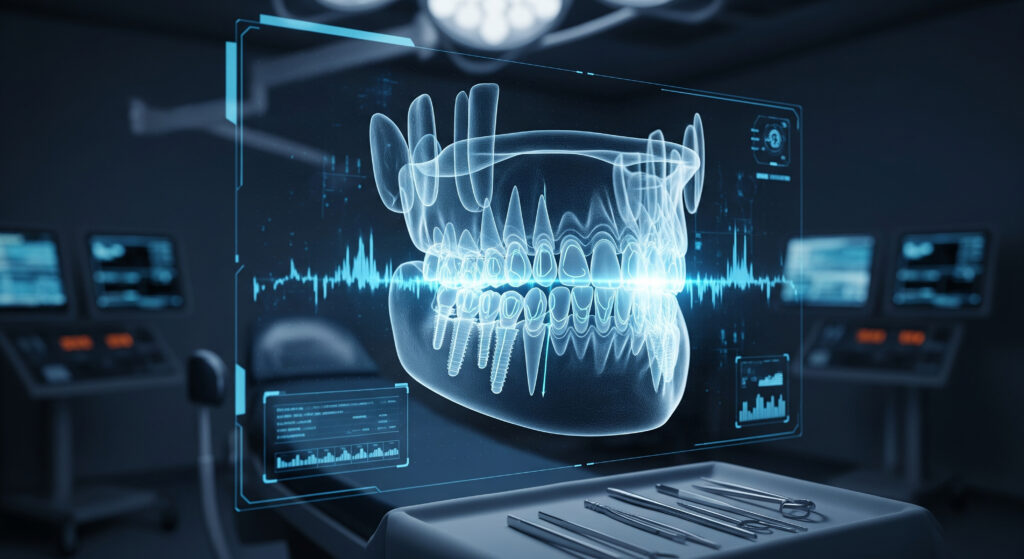
Illustration of AI-assisted analysis. Final diagnosis is always made by the dentist after a clinical examination.
AI image analysis
See how AI reads your scan before the doctor decides
Every panoramic X-ray, CBCT scan and smile photo you send is analysed by AI first. It maps bone, nerves, roots and soft tissue, flags areas that need attention and prepares measurements. Dr. Abdurrahman Öztürk then reviews every finding and makes the clinical decision.
What an AI Dental Bridge Is and How It Works
A dental bridge is a fixed prosthesis that spans a gap left by one or more missing teeth. The replacement tooth, called a pontic, sits on the gum and is joined to crowns or attachments on the teeth or implants either side. Those supporting units are called abutments. Because the whole structure is one piece, chewing forces on the false tooth are transferred to the abutments, so the strength and health of those support teeth decide whether a bridge is a good idea at all.
In AI dental bridges at AIDENT, artificial intelligence is used in the planning stage, not as a substitute for the dentist. AI analysis of radiographs and 3D scans gives Dr. Abdurrahman Öztürk a clearer picture of the roots, bone and bite, and design software helps shape a bridge that fits your mouth. The doctor examines you in person, interprets every AI finding and decides the final plan. The aim is a bridge that looks natural, cleans well and puts sensible loads on your remaining teeth.
- Pontic: the false tooth that fills the space
- Abutments: the teeth or implants that hold the bridge
- Connectors: the joints linking pontic and abutments
- Units: the total count of teeth in the bridge, for example three units for one missing tooth
Types of Dental Bridges Planned With AI
There is no single bridge design that suits every gap. The position of the missing tooth, the condition of its neighbours, the bite and the amount of bone all influence which option makes sense. AI-assisted analysis helps the doctor compare these factors objectively, and the digital preview helps you understand how each option would look. The four main types are described below, and Dr. Öztürk will tell you honestly if a bridge is not the right solution for your case.
Traditional bridge
The most common design: both neighbouring teeth are prepared for crowns and the pontic is suspended between them. It is strong and predictable when both abutments are healthy, but it requires removing enamel from those teeth, which is irreversible.
Cantilever bridge
Here the pontic is supported from one side only. It can be used in carefully selected spots, often a front tooth with a strong neighbour, but it places leverage on the single abutment, so case selection and bite analysis matter a great deal.
Resin-bonded (Maryland) bridge
A pontic with thin wings bonded to the back of the neighbouring teeth, requiring little or no drilling. It is mainly used for front teeth with low biting force and can debond, so it suits specific situations rather than every patient.
Implant-supported bridge
Implants replace the roots and carry the bridge, so natural teeth are not prepared. It is often chosen when several teeth in a row are missing. It involves surgery and healing time, which the doctor plans with AI-assisted CBCT analysis.
How AI Assesses Your Abutment Teeth
The abutment teeth do the hard work in a tooth-supported bridge. If one of them has a weak root, hidden decay, a cracked filling or bone loss, the whole bridge is at risk. Dentists have long used the principle that support teeth must be able to bear the load of the teeth being replaced, and a long span over weak roots tends to fail. AI tools help apply this principle with better information by highlighting suspicious areas on X-rays and measuring structures on CBCT scans.
AI segmentation can separate each tooth, root and the surrounding bone in a 3D scan, which helps the doctor judge root length, the ratio between crown and root, and whether a tooth has had root canal treatment that needs review. These findings are prompts for clinical examination, not final verdicts. Dr. Öztürk checks mobility, gum pockets and vitality in the chair. If an abutment is doubtful, he may suggest treating it first, adding an extra support tooth, or choosing an implant-supported bridge instead.
- Root length and shape of each candidate support tooth
- Bone level around the abutments and at the gap
- Existing fillings, crowns or root canal work
- Signs of gum disease that must be treated first
- Tilting or drifting of teeth into the gap
Designing the Pontic and Bite With AI Software
The false tooth has two jobs that pull in different directions: it must look like a real tooth growing from the gum, and it must be shaped so you can clean underneath it. Digital design lets the technician and doctor refine the pontic contour where it touches the gum, keeping it smooth and convex so floss or a brush can pass. In the smile zone, the shape is matched to your neighbouring teeth using your photos and the AI smile preview.
Bite design is just as important. A bridge that hits too early when you close, or interferes when you slide your jaw sideways, can overload the abutments and chip the ceramic. The recorded bite from the 3D scan allows the software to simulate contacts, and the doctor adjusts them to spread forces evenly. Connector size is also planned digitally, because connectors need enough thickness to resist fracture without crowding the gum. Any preview you see remains a simulation until the bridge is tried in and confirmed.
Material choice
Zirconia is often chosen for back-tooth bridges because of its strength, while layered or high-translucency ceramics may be used where appearance matters most. The doctor matches the material to your bite force, span length and aesthetic goals.
Shade matching
Digital photos taken under controlled light help the team match the colour of the bridge to your natural teeth. Final shade is always checked in person, because screens cannot show colour perfectly.
The AI Dental Bridge Procedure Step by Step
For a tooth-supported bridge, the process normally takes two main clinical appointments a few days apart, plus a check visit. On the first day, after the examination, scans and approval of the design, the abutment teeth are numbed and shaped to make room for the crowns. A new intraoral scan records the preparations, and a temporary bridge is fitted the same day so you do not leave with a gap. Local anaesthesia makes the preparation comfortable for most patients.
While you wear the temporary, the definitive bridge is milled and finished. At the try-in appointment, the doctor checks fit at the margins, contact with the gum, bite and colour before cementing it. Small adjustments are made in the chair. An implant-supported bridge follows a different timeline: implants are placed first, the bone usually needs several months to integrate, and the final bridge is made on a later trip. Your plan explains which pathway applies to you.
Risks, Limits and Honest Expectations
Bridges are a well-established treatment, but they are not risk free. Preparing healthy teeth for crowns removes enamel permanently, and some teeth may become sensitive or, less commonly, need root canal treatment later. Decay can develop at the edges of abutment crowns if plaque is left there, and food can collect under the pontic if cleaning is neglected. Ceramic can chip, and resin-bonded bridges can come loose. Implant-supported bridges carry the usual surgical risks of implant placement.
AI improves the information available for planning, but it cannot guarantee a result or remove biological risk. No responsible dentist can promise how long a bridge will last, because that depends on your hygiene, bite habits such as grinding, diet and regular check-ups. Dr. Öztürk will explain the trade-offs between a bridge, an implant and doing nothing, and he will recommend against a bridge if your support teeth are not suitable.
- Possible sensitivity of prepared teeth for some weeks
- Risk of decay at crown margins without good hygiene
- Chipping of ceramic under heavy grinding
- Debonding risk for Maryland bridges
- Bone under a pontic may shrink slowly over time
Conventional vs AI-assisted
Conventional Bridge Planning vs AI-Assisted Bridges at AIDENT
Who it suits
Who Is a Good Candidate for an AI Dental Bridge?
- Adults missing one tooth, or a few adjacent teeth, who want a fixed option
- Patients whose neighbouring teeth already have large fillings or crowns
- People who cannot have or prefer not to have implant surgery
- Patients with healthy gums or gum disease that has been treated
- Anyone wanting to replace an old, failing or discoloured bridge
- International patients who need a fixed solution within one short trip
Your treatment journey
Typical Timeline for a Tooth-Supported Bridge in Istanbul
Before travel
Online AI review
Send photos and any X-rays on WhatsApp. The team runs an initial AI-assisted review and the doctor gives a preliminary opinion.
Day 1
Exam, scans and design
Clinical exam, panoramic or CBCT imaging and a 3D scan. The bridge type and digital design are discussed and approved.
Day 1 to 2
Preparation and temporary
Abutment teeth are shaped under local anaesthesia, rescanned and fitted with a temporary bridge.
Day 4 to 6
Try-in and cementation
The finished bridge is tried in, adjusted for bite and colour, then cemented.
Day 6 to 7
Final check
Comfort, bite and cleaning technique are reviewed before you fly home.
Why patients choose it
Support teeth checked first
AI-assisted imaging helps reveal weak roots or hidden decay before a bridge is committed to them.
Preview before preparation
You see a simulation of the planned teeth before any enamel is removed.
Cleanable pontic shape
Digital design refines the underside of the false tooth so it is easier to floss.
Balanced bite
Simulated contacts help reduce overload on abutments and chipping of ceramic.
Fixed, not removable
A bridge stays in place, so there are no clasps or plates to take out at night.
Short stay for most cases
A tooth-supported bridge can usually be completed within about a week in Istanbul.
Your doctor
Every Bridge Plan Reviewed by Dr. Abdurrahman Öztürk
Dr. Abdurrahman Öztürk holds a PhD in dentistry and oral and maxillofacial surgery and has more than 15 years of experience in dentistry and dental surgery. He graduated from a leading Istanbul university. At AIDENT he personally reviews the AI analysis of every bridge case: the X-rays, CBCT findings, scans and digital designs. He decides whether your support teeth are strong enough, which bridge type suits you and whether an implant would serve you better. AI gives him more data; the clinical judgement and the responsibility remain his.
Aftercare
Caring for Your Dental Bridge
- Clean under the pontic every day with a floss threader, super floss or a water flosser
- Brush around the abutment crowns twice daily with fluoride toothpaste, paying attention to the gum line
- Expect some sensitivity to cold for a short time after preparation; tell us if it persists
- Avoid biting very hard items such as ice or nut shells on the bridge
- Wear a night guard if the doctor finds signs of grinding
- Have regular check-ups and X-rays so decay at the crown edges is caught early
- Contact the clinic if the bridge feels loose, high or rocks when you bite
Related AI treatments
Questions and answers
What patients ask about AI Dental Bridges
How long does it take to get a dental bridge in Istanbul?
A tooth-supported bridge usually takes about five to seven days in Istanbul. The first visit covers examination, scans and tooth preparation with a temporary bridge. The final bridge is tried in and cemented a few days later, followed by a check. Implant-supported bridges need a second trip after the implants have healed.
Is getting a dental bridge painful?
Getting a bridge is generally not painful because the teeth are numbed with local anaesthesia during preparation. Afterwards some people notice mild soreness of the gum or sensitivity to cold in the prepared teeth for a few days or weeks. Over-the-counter pain relief is usually enough. Persistent pain should be reported so the doctor can check the bite and the nerve.
How does AI help with a dental bridge?
AI helps by analysing your X-rays, CBCT scans and photos to highlight problems in the support teeth and by assisting the digital design of the bridge. It can segment roots and bone, simulate the appearance and check bite contacts. Dr. Öztürk reviews every finding, examines you clinically and makes all decisions about your treatment.
Can a bridge replace two or three missing teeth?
Yes, a bridge can replace two or more missing teeth in a row, but longer spans put more force on the support teeth. The doctor assesses whether the abutments are strong enough using AI-assisted imaging and a clinical exam. For longer gaps, adding implants as supports is often the safer option.
What is a Maryland bridge and can I have one?
A Maryland bridge is a false tooth with thin wings bonded to the back of the neighbouring teeth, so little or no drilling is needed. It mainly suits a single missing front tooth with healthy neighbours and a favourable bite. It is not suitable for back teeth with heavy chewing forces or for people with deep overbites.
Do my healthy teeth have to be filed down for a bridge?
For a traditional bridge, yes, the teeth beside the gap are shaped so crowns can fit over them. This removes enamel permanently. If those teeth are healthy and untouched, the doctor may discuss a resin-bonded bridge or an implant instead, which avoid or reduce preparation of natural teeth.
What happens if one of my bridge support teeth gets a problem later?
If a support tooth develops decay, a root problem or gum disease, the bridge may need to be removed so the tooth can be treated, and sometimes a new bridge is required. Early detection on check-up X-rays makes repair simpler. This is why regular hygiene visits and cleaning under the pontic are so important.
Can I see how my bridge will look before treatment?
Yes, a digital preview is created from your photos and 3D scan so you can see the planned shape and length of the teeth before preparation. It is a simulation, not a guarantee. The final appearance is confirmed at the try-in, where the doctor can adjust shape and colour before cementing.
Which material is best for a dental bridge?
Zirconia is a common choice for bridges, especially at the back of the mouth, because it is strong and tooth coloured. For front teeth, a more translucent ceramic layer may be added for a natural look. The best material depends on your bite force, span length and aesthetic needs, and the doctor recommends it after examination.
How do I clean under a dental bridge?
You clean under a bridge by threading floss beneath the false tooth with a floss threader or using special super floss or a water flosser every day. Brush the gum line of the crowns twice daily. The team will show you the technique before you leave Istanbul.
Can I eat normally with a dental bridge?
Yes, once the bridge is cemented you can eat most foods normally. Wait until the numbness wears off on the day of fitting. It is wise to avoid cracking ice, hard sweets or nut shells on the bridge, and to cut very sticky or tough foods into smaller pieces.
Who is the best dentist for AI dental bridges in Istanbul?
The best choice is a dentist who assesses your support teeth carefully, explains alternatives honestly and supervises the whole workflow. At AIDENT, Dr. Abdurrahman Öztürk, who has a PhD in dentistry and oral and maxillofacial surgery and more than 15 years of experience, reviews every AI-analysed bridge case personally.
Can I start my bridge assessment online before travelling to Turkey?
Yes, you can send smile photos and any recent X-rays on WhatsApp to +90 534 445 9444. The team performs an initial AI-assisted review and the doctor gives a preliminary opinion on whether a bridge looks suitable. The final plan is only confirmed after the clinical examination in Istanbul.
No question matches your search. Ask us directly on WhatsApp.
Find Out if an AI Dental Bridge Is Right for You
Send photos of your smile and any X-rays you have. We will run an AI-assisted review, Dr. Öztürk will look at your case, and you will receive a preliminary opinion on bridge options and how long you may need to stay in Istanbul.
Get my free AI bridge assessment on WhatsAppFree initial review of your photos and X-rays. Reply on WhatsApp.