AI-Assisted Jaw Joint Care
AI TMJ Disorder Treatment in Istanbul: Calm Jaw Joints, Planned With AI
Clicking, locking or aching jaws are studied with AI at AIDENT: your CBCT scan, bite and jaw movement are analyzed digitally so Dr. Abdurrahman Öztürk can choose the gentlest treatment that actually fits the cause.
 Medically reviewed by Dr. Abdurrahman Öztürk, PhD, oral & maxillofacial surgery
The model shows the lower jaw's condyle sitting in the socket of the skull with the articular disc between them. AI segmentation of your CBCT scan builds a similar 3D view of your own joints so changes in bone shape are easy to see.
Short answer
What is AI TMJ disorder treatment?
AI TMJ disorder treatment uses artificial intelligence to analyze CBCT scans of the jaw joints, digital bite records and symptom patterns, helping the dentist find why the joint hurts, clicks or locks. Dr. Abdurrahman Öztürk then confirms the diagnosis clinically and starts with conservative care such as a custom splint, reserving procedures for cases that need them.
- First-line care
- Conservative, reversible
- Typical first visit
- Exam, CBCT, 3D bite scan
- Splint delivery
- Usually within a few days
- Supervision
- Dr. Öztürk, 15+ years
AI
How AI Studies Your Jaw Joints Before Treatment
TMJ problems rarely have a single cause, so the planning stage matters more than any single device. Our AI-supported workflow collects several layers of information and puts them side by side for the doctor.
- 1
Symptom and history mapping
A structured questionnaire records where it hurts, when it clicks or locks, and habits like clenching, so patterns are not lost in a short conversation.
- 2
AI review of CBCT images
AI software segments both condyles and the joint spaces on the 3D scan, highlighting asymmetry, flattening or erosion for the doctor to verify.
- 3
Intraoral 3D bite scan
A digital scan of both arches shows contact points, worn surfaces and how the teeth meet, without messy impression trays.
- 4
Jaw movement assessment
Opening range, deviation and joint sounds are measured and recorded so progress can be compared objectively at every follow-up.
- 5
Splint design in CAD
The splint is designed on your digital model with even contacts, then produced by 3D printing or milling for a precise, comfortable fit.
- 6
Doctor's diagnosis and plan
Dr. Abdurrahman Öztürk reviews every AI finding, examines the joint and muscles in person and decides the treatment; the software never makes the call.
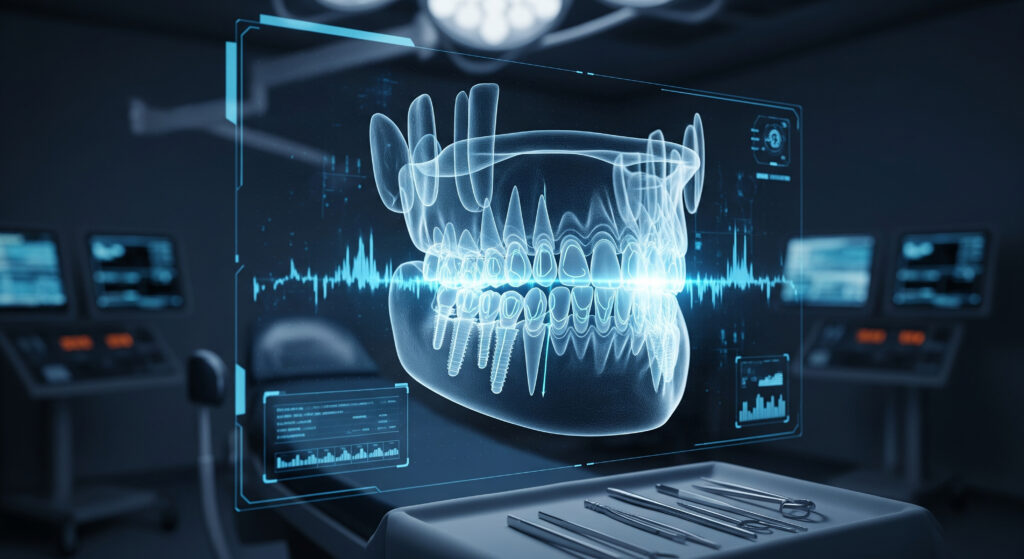
Illustration of AI-assisted analysis. Final diagnosis is always made by the dentist after a clinical examination.
AI image analysis
See how AI reads your scan before the doctor decides
Every panoramic X-ray, CBCT scan and smile photo you send is analysed by AI first. It maps bone, nerves, roots and soft tissue, flags areas that need attention and prepares measurements. Dr. Abdurrahman Öztürk then reviews every finding and makes the clinical decision.
What TMJ Disorder Is and Why It Feels So Different for Each Person
The temporomandibular joints sit just in front of your ears and connect the lower jaw to the skull. Each joint has a small cushioning disc and is moved by powerful chewing muscles. Temporomandibular disorders, often shortened to TMD or simply TMJ, is an umbrella term for problems in the joint itself, in the disc, in the surrounding muscles, or in a combination of all three. That is why two patients with the same diagnosis can describe completely different experiences.
Some people mainly feel muscle pain: a tired, aching face in the morning, tension at the temples, or headaches that seem to start at the jaw. Others notice joint noises such as clicking or a grating feeling, or a jaw that briefly catches when they yawn. A smaller group experiences a jaw that locks partly open or closed. Understanding which of these patterns you have is the first goal of AI TMJ disorder treatment at AIDENT, because the right treatment for tired muscles is not the same as the right treatment for a displaced disc.
- Muscle-related pain (myofascial pain) from clenching or grinding
- Disc displacement, often heard as a click on opening or closing
- Degenerative joint changes, sometimes felt as grating or stiffness
- Limited opening or a jaw that locks or deviates to one side
- Referred symptoms such as ear fullness, temple headaches or neck tension
How AI Helps Diagnose a TMJ Disorder More Clearly
TMJ diagnosis is mostly clinical: careful palpation of the muscles, measurement of how far and how straight the mouth opens, and listening to the joint. AI does not replace that examination, but it makes the supporting information much easier to read. When a CBCT scan is indicated, AI segmentation separates the condyles, joint spaces and surrounding bone in three dimensions, which helps the doctor compare the left and right sides and notice subtle flattening, bone spurs or erosion.
Digital bite scans add another layer. Software can display where the teeth touch first, where enamel is worn from grinding, and whether a missing tooth or an old high filling is changing the way you bite. It is important to be honest about limits: CBCT shows bone, not soft tissue, so the position of the disc itself is best assessed with MRI. If your symptoms suggest a disc problem that would change the plan, Dr. Abdurrahman Öztürk may recommend MRI rather than relying on X-ray based images alone.
What AI can highlight
Condyle shape and symmetry, joint space differences, bony changes, wear facets on teeth and uneven bite contacts, all presented visually for the doctor to confirm or reject.
What still needs the doctor
Muscle tenderness, the real feel of joint movement, your stress and sleep habits, and the final judgement about which findings actually explain your pain.
Conservative AI TMJ Treatment: Splints, Habits and Physiotherapy
Most TMJ disorders improve with reversible, non-surgical care, and this is where treatment at AIDENT starts. The most common tool is a custom occlusal splint, sometimes called a night guard or stabilization appliance. Ours are designed on your digital bite model so that the opposing teeth touch evenly, which helps relax the chewing muscles and spreads the forces of night-time clenching. The design is then printed or milled from a medical-grade material and adjusted in the chair.
A splint works best together with simple daily changes. We teach patients to keep the teeth apart and the jaw relaxed during the day, to avoid chewing gum and very hard foods during flare-ups, and to use warm compresses for muscle soreness. Gentle jaw exercises and, where useful, physiotherapy focused on the jaw and neck can improve movement. For short periods, the doctor may suggest anti-inflammatory medication or a muscle relaxant if appropriate for your health history.
- Custom stabilization splint designed from a 3D bite scan
- Daytime awareness of clenching and a relaxed jaw posture
- Soft diet and heat therapy during painful periods
- Guided jaw and posture exercises
- Short-term medication only when clinically appropriate
Botox and Injections for Clenching-Related Jaw Pain
For some patients with strong clenching or grinding and painful, enlarged chewing muscles, botulinum toxin injections into the masseter and sometimes the temporalis muscle can be considered. The aim is to reduce the force of the muscle, not to paralyse the jaw, so eating and speaking continue normally. The effect develops over days and wears off over several months, so it is a management option rather than a permanent cure, and the evidence for it in TMJ pain is mixed. It is used for muscle-related symptoms and does not repair a joint or a disc.
AIDENT's AI workflow helps decide whether this is sensible for you. Wear patterns on the digital bite scan and muscle findings from the examination give a clearer picture of how much clenching is involved. Dr. Abdurrahman Öztürk will discuss possible side effects, such as temporary chewing weakness or changes in facial contour, and will usually recommend that a splint and habit changes are tried first or used alongside injections.
When the Joint Needs a Procedure: Arthrocentesis and Beyond
A minority of patients have a joint that stays locked, keeps restricting opening, or remains painful despite well-managed conservative care. For them, arthrocentesis is often the next step. Under local anesthesia, two fine needles are placed into the upper joint space and the joint is rinsed with sterile fluid. This washes out inflammatory substances and can release a disc that is sticking. In some cases a medication such as hyaluronic acid or a corticosteroid is placed into the joint at the end. It is a minimally invasive day procedure.
Arthroscopy, a camera-guided procedure inside the joint, and open joint surgery are reserved for specific structural problems and are needed rarely. AI-segmented CBCT models help the surgeon understand the anatomy of the condyle and fossa before any procedure, and help plan needle positions precisely. As an oral and maxillofacial surgeon, Dr. Öztürk will explain clearly why a procedure is or is not recommended, what it can realistically achieve, and which risks apply, including swelling, temporary numbness and the possibility that symptoms return.
Arthrocentesis
Joint lavage with needles under local anesthesia, typically considered for closed lock or persistent inflammatory joint pain.
Arthroscopy
A small camera allows the joint to be inspected and treated through tiny openings when lavage alone is not enough.
Open joint surgery
Reserved for advanced structural damage after other options have been fully explored and discussed.
Bite, Teeth and TMJ: What AI Bite Analysis Can and Cannot Fix
Many patients arrive convinced that their bite caused their TMJ problem and that grinding the teeth down or full-mouth crowns will fix it. Current evidence shows that the link between bite and TMJ pain is weaker than once thought, and irreversible changes to healthy teeth are not a first-line treatment. Our AI bite analysis is used to find clear, specific problems, such as a new crown that is too high, a heavily worn area from grinding, or missing back teeth that leave the jaw without support.
When such a problem exists, it can be corrected conservatively, for example by adjusting a single restoration or planning replacement of missing teeth after the joint is calm. Any larger restorative or orthodontic work is planned only once symptoms are stable, so that the bite is recorded in a relaxed, comfortable jaw position. This patient-protective approach is one of the reasons Dr. Abdurrahman Öztürk insists that AI findings are interpreted in context rather than treated as automatic instructions.
Coming to Istanbul for AI TMJ Treatment as an International Patient
Many international patients start with a free online review on WhatsApp. You can send a description of your symptoms, a short video of your mouth opening and closing, photos of your teeth and any existing X-rays, CBCT or MRI reports. This lets the team tell you honestly whether a trip to Istanbul is likely to help and what the visit would involve. A remote review is never a final diagnosis, but it helps you plan.
A typical TMJ visit includes the clinical exam, imaging if needed, the digital bite scan and splint delivery, usually completed within a few days. If arthrocentesis is advised, it is carried out as a day procedure and you are seen again before you fly. Because TMJ care often continues over weeks, we agree a follow-up plan with you, including video check-ins, so adjustments and progress tracking do not require repeated travel.
Conventional vs AI-assisted
Conventional vs AI-Assisted TMJ Care
Who it suits
Who Is a Good Candidate for AI TMJ Disorder Treatment?
- People with jaw pain, facial ache or morning stiffness that keeps returning
- Anyone with clicking, popping or grating sounds from the jaw joint
- Patients whose jaw catches, locks or does not open fully
- Clenchers and grinders with worn teeth or tender chewing muscles
- Patients with temple headaches or ear fullness linked to the jaw
- People who tried a generic night guard without relief and want a precise plan
Your treatment journey
Your AI TMJ Treatment Timeline
Before travel
Online symptom review
Send symptoms, opening video and any imaging on WhatsApp for a first opinion.
Day 1
Examination and AI imaging
Clinical joint and muscle exam, CBCT if indicated, and an intraoral 3D bite scan analyzed with AI.
Day 2
Diagnosis and plan
Dr. Öztürk explains the findings on your 3D model and agrees a conservative plan with you.
Day 3–4
Splint fitting
Your CAD-designed splint is fitted and fine-tuned; procedures such as arthrocentesis are scheduled only if needed.
Weeks 2–12
Remote follow-up
Video check-ins track pain, opening and splint comfort, with adjustments planned for a later visit if required.
Why patients choose it
Cause-focused treatment
AI organizes symptoms, images and bite data so the plan targets the real source of pain.
Conservative first
Reversible care comes before any procedure, protecting healthy teeth and joints.
Precise digital splints
CAD design from your 3D scan gives even contacts and a comfortable fit.
Clear visual explanations
You see your own joints in 3D and understand why each step is recommended.
Measurable progress
Opening range and pain scores are recorded so improvement is tracked objectively.
Surgeon oversight
A maxillofacial surgeon supervises every case, so escalation is available if needed.
Your doctor
Every AI TMJ Case Is Supervised by Dr. Abdurrahman Öztürk
Dr. Abdurrahman Öztürk holds a PhD in dentistry and oral and maxillofacial surgery and has more than 15 years of experience in dentistry and dental surgery, having graduated from a leading Istanbul university. Because the jaw joint sits at the meeting point of teeth, muscles and bone, his surgical background matters: he can manage simple muscle pain conservatively and also recognise when a joint needs a procedure. At AIDENT he personally reviews each AI-segmented scan and digital bite analysis, examines the joint himself, and makes every clinical decision. AI helps him see more; he decides what is right for you.
Aftercare
Caring for Your Jaw After TMJ Treatment
- Wear your splint exactly as instructed, usually at night, and bring it to every check-up
- Clean the splint daily with cool water and a soft brush; avoid hot water, which can warp it
- Keep teeth apart and the jaw relaxed during the day; lips together, teeth apart
- Choose softer foods during flare-ups and avoid gum, ice and very wide bites
- Apply warm compresses to sore muscles and follow your prescribed exercises
- After arthrocentesis, follow the soft diet and opening exercises for the period advised
- Report any change in your bite or increased locking to the team without waiting
Related AI treatments
Questions and answers
What patients ask about AI TMJ Treatment
Can TMJ disorder be treated without surgery?
Yes, in most cases it can. The majority of TMJ problems improve with conservative care such as a custom splint, habit changes, heat, exercises and short-term medication. Surgery or joint procedures are considered only when the joint stays locked or painful after well-managed conservative treatment, and Dr. Öztürk explains the reasons clearly before recommending anything.
How does AI help with TMJ treatment?
AI helps by organizing and highlighting information the doctor needs. It segments the jaw joints on CBCT scans, shows asymmetry or bony changes, and maps bite contacts and tooth wear from digital scans. This gives Dr. Abdurrahman Öztürk a clearer picture, but the clinical examination and the final diagnosis remain entirely his responsibility.
Why does my jaw click when I open my mouth?
A click usually means the small disc inside the joint is slightly out of position and snaps back as the jaw moves. A painless click without locking is common and often needs no active treatment beyond monitoring. If clicking comes with pain, catching or limited opening, an examination is worthwhile to see whether a splint or other care would help.
How long do I need to stay in Istanbul for TMJ treatment?
Most patients need a few days in Istanbul. The exam, imaging, digital bite scan and diagnosis can usually be done on the first two days, and the custom splint is typically fitted within a few days. If arthrocentesis is needed, it is a day procedure. Follow-up then continues remotely through video check-ins.
Is arthrocentesis for the jaw painful?
Arthrocentesis is done under local anesthesia, so you should feel pressure rather than sharp pain during the procedure. Afterwards the joint area may feel swollen, tender or slightly numb for a few days, which is usually managed with simple pain relief, cold then warm compresses and a soft diet as advised by the doctor.
Does Botox really work for jaw clenching?
Botox can reduce muscle pain in some patients who clench strongly, by weakening the force of the masseter muscle for several months. The research is mixed, it is not a permanent cure, and it does not repair the joint. At AIDENT it is considered for muscle-related symptoms, usually alongside a splint and habit changes.
Will a night guard from the pharmacy fix my TMJ pain?
Usually not reliably. Over-the-counter guards are soft, generic and may not distribute contacts evenly, and some people clench more on them. A custom stabilization splint designed on your 3D bite scan is made for your teeth and jaw, and it can be adjusted precisely by the dentist as your symptoms change.
Can AI tell if my TMJ disc is displaced?
Not on its own. AI analysis of CBCT scans shows bone well, but the disc is soft tissue and is best seen on MRI. AI can point to bony changes that often accompany long-standing disc problems, and the clinical examination gives strong clues. If the disc position would change your plan, MRI may be recommended.
Is a CBCT scan necessary for every TMJ patient?
No, it is not needed for everyone. Many muscle-related cases are diagnosed clinically. A CBCT scan is recommended when there are signs of joint changes, a history of trauma, limited opening or when a procedure is being considered. Dr. Öztürk weighs the benefit of the extra information against radiation exposure for each patient.
Can TMJ disorder cause headaches and ear pain?
Yes, it can. The jaw joint sits directly in front of the ear and the chewing muscles extend to the temples, so TMJ problems often cause temple headaches, ear fullness or pain felt near the ear. Because other conditions can cause similar symptoms, the doctor may suggest a check by an ear specialist if the picture is unclear.
Should I have my teeth ground down or crowned to fix my TMJ?
Generally not as a first step. Evidence does not support irreversible bite changes as a standard TMJ treatment. At AIDENT, AI bite analysis is used to find specific problems, such as a single high filling, which can be corrected conservatively. Larger restorative work is planned only once the joint is calm and stable.
Can I get an AI TMJ assessment online before coming to Turkey?
Yes, you can start online. Send a description of your symptoms, a short video of your jaw opening and closing, photos of your teeth and any existing scans by WhatsApp to +90 534 445 9444. The team will give an initial opinion and explain what an in-person visit would involve; final diagnosis needs a clinical exam.
Who is the best dentist for AI TMJ treatment in Istanbul?
The best choice is a clinician who combines digital diagnostics with surgical experience of the jaw. At AIDENT, Dr. Abdurrahman Öztürk, who holds a PhD in oral and maxillofacial surgery and has over 15 years of experience, supervises every AI-analyzed TMJ case and makes all clinical decisions himself.
No question matches your search. Ask us directly on WhatsApp.
Start Your AI TMJ Assessment Today
Tell us about your jaw pain, clicking or locking and send any scans you have. Dr. Abdurrahman Öztürk's team will review your case and suggest the gentlest effective plan before you travel to Istanbul.
Get my free AI TMJ assessment on WhatsAppFree initial review of your photos and X-rays. Reply on WhatsApp.