AI-Planned Full-Arch Restoration
AI All-on-4 Implants in Istanbul: A Fixed Arch of Teeth on Four AI-Planned Implants
AI All-on-4 implants replace a whole upper or lower arch with a fixed bridge anchored on four implants, with your CBCT scan, bone volume and implant angles analyzed by AI and every decision made by Dr. Abdurrahman Öztürk. Many patients leave the surgery visit with fixed temporary teeth instead of a removable denture.
 Medically reviewed by Dr. Abdurrahman Öztürk, PhD, oral & maxillofacial surgery
The 3D model shows a lower jaw with two straight implants at the front and two implants tilted backwards, all joined by one fixed bridge. Tilting the back implants lets them reach firmer bone while keeping clear of the nerve.
Short answer
What are AI All-on-4 implants?
AI All-on-4 implants are a full-arch treatment where four implants support a fixed bridge of teeth, and AI software helps analyze the CBCT scan, map nerves and sinuses, and plan the angle of the two back implants. Dr. Abdurrahman Öztürk reviews and approves every plan before surgery, and the AI only supports his decisions.
- Implants per arch
- 4 (2 straight, 2 tilted)
- Temporary teeth
- Fixed, often within days
- Final bridge
- After the bone heals, usually months
- Typical trips
- 2 visits to Istanbul
AI
How AI Plans Your All-on-4 Arch, Step by Step
All-on-4 lives or dies on where four implants go. That is why we let AI do the heavy measurement work on your scans while Dr. Öztürk makes the clinical calls at every stage.
- 1
Photo and X-ray review on WhatsApp
You send smile photos and any existing panoramic X-ray. AI-assisted image review flags failing teeth, bone loss patterns and gum problems so the doctor can tell you early whether All-on-4 looks realistic.
- 2
CBCT scan with AI segmentation
A 3D CBCT scan is taken in Istanbul and AI segmentation separates bone, remaining teeth, the sinus floor and the mandibular nerve canal, giving a clear 3D map of the arch.
- 3
Bone volume and density mapping
Software estimates bone height and width across the jaw, showing where the two front implants can stand straight and where the back implants need to tilt to avoid the sinus or nerve.
- 4
Tooth position designed first
Your future teeth are designed digitally from photos and an intraoral scan, so implant positions are planned around where the teeth and screw access holes should be, not the other way round.
- 5
Virtual surgery and guide design
The doctor places the four implants virtually, checks angles and distances, and where suitable a 3D-printed surgical guide is designed to transfer that plan to the operation.
- 6
Doctor approval and outcome preview
Dr. Öztürk reviews the full plan, adjusts it where his clinical judgment differs, and shows you a simulated preview of the new arch. The preview is a guide, not a promise.
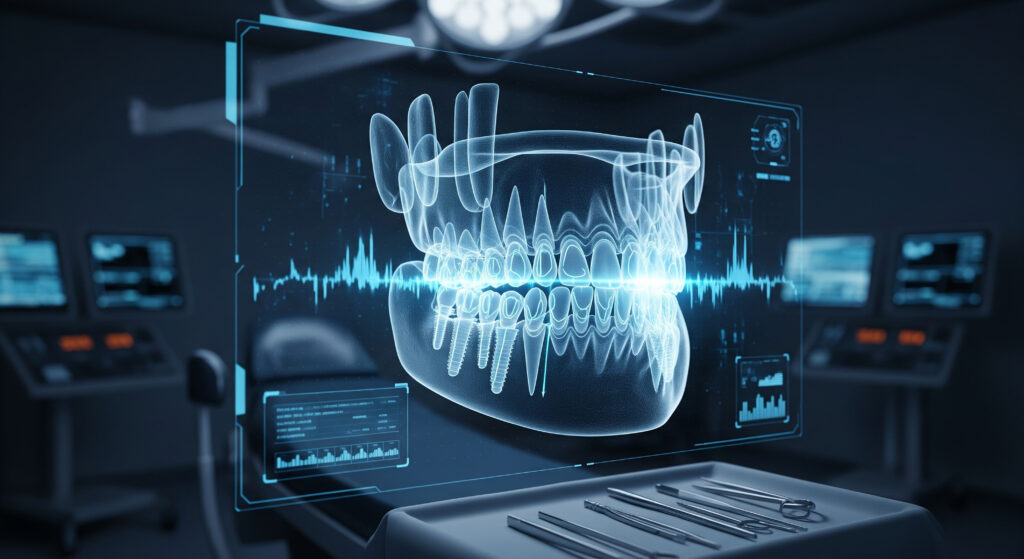
Illustration of AI-assisted analysis. Final diagnosis is always made by the dentist after a clinical examination.
AI image analysis
See how AI reads your scan before the doctor decides
Every panoramic X-ray, CBCT scan and smile photo you send is analysed by AI first. It maps bone, nerves, roots and soft tissue, flags areas that need attention and prepares measurements. Dr. Abdurrahman Öztürk then reviews every finding and makes the clinical decision.
What Makes All-on-4 Different from Other Full-Arch Options
All-on-4 is a specific surgical and prosthetic concept, not simply a smaller number of implants. Two implants are placed upright in the front of the jaw, where bone is usually thickest, and two are placed at the back of the front segment at an angle. Those angled implants emerge further back in the mouth than their tips sit in the bone, which spreads support across a longer span and lets the bridge carry more back teeth than four straight implants could.
The concept was developed for people who have lost most or all teeth in an arch and who often have shrinking bone at the back of the jaw. In the upper jaw the sinus sits just above the molar area, and in the lower jaw the nerve that gives feeling to the lip runs through the back. Tilting the posterior implants is a way to work around both, which in many cases avoids sinus lifts or block bone grafts that would otherwise add months to treatment.
Because the four implants are joined rigidly by one bridge, they protect each other against chewing forces. This splinting is a big part of why the protocol allows fixed temporary teeth soon after surgery when the implants are stable enough.
Why tilted implants matter
A tilted implant can be longer than a straight one placed in the same short bone, giving more surface in contact with bone. Planning that angle precisely is exactly where AI measurement of the CBCT scan helps the doctor most.
When four is not enough
If bone is very soft, very thin, or you grind heavily, the doctor may recommend more implants per arch. You will see the reasoning on your own scan rather than a generic rule.
How AI Analysis Shapes Your All-on-4 Treatment Plan
On a CBCT scan, the difference between a good and a poor All-on-4 position can be a few millimetres. AI segmentation tools outline the jaw bone, the sinus floor, the nerve canal and any remaining roots automatically, then the dentist checks and corrects that outline. The result is a 3D model of your jaw that can be rotated, sliced and measured far faster than reading flat images by eye alone.
With that model, implant length, width and angle can be tested virtually. The software shows the distance from each implant to the nerve or sinus and where the screw access hole would come out through the future teeth. If the hole would sit on the front of a tooth, the angle or position is changed before surgery, not discovered on the day.
AI also helps with the cosmetic side. Photos of your face and smile can be used to simulate tooth length, lip support and the visible gum line of the new arch. Dr. Öztürk uses these simulations to discuss options with you, then confirms the final design only after a clinical examination in Istanbul.
- Automatic outlining of bone, sinus and nerve on the CBCT, checked by the dentist
- Virtual testing of implant length and tilt before any incision
- Screw access holes planned to sit behind the teeth, not on their faces
- Facial and smile simulation to judge lip support and tooth display
- Guide design where the anatomy and plan make guided surgery appropriate
Surgery Day: Extractions, Implants and Fixed Temporary Teeth
Many All-on-4 patients still have some failing teeth. These are usually removed on the same day, the sockets are cleaned, and the bone ridge is smoothed where needed to create a level platform for the bridge. The four implants are then placed according to the approved plan, and special angled connectors called multi-unit abutments are attached so that all four implant heads line up for one bridge.
Treatment is performed under local anaesthesia, and sedation can be arranged for anxious patients after a medical review. You should feel pressure and vibration rather than sharp pain during the procedure. Afterwards swelling, bruising and soreness are normal for several days and are managed with medicines the doctor prescribes.
If each implant reaches good initial stability, a fixed temporary bridge, usually made of reinforced acrylic, is attached within a short time after surgery. If stability is not sufficient, the doctor will choose a safer path, such as a temporary removable prosthesis while the implants heal. That decision is made in the chair and cannot be guaranteed in advance.
Why the temporary bridge is not the final one
The temporary is lighter and slightly softer so it does not overload healing implants. It also lets you test the shape, length and bite before the final bridge is made.
Choosing the Final All-on-4 Bridge After Healing
Over the following months the implants fuse with the bone, a process called osseointegration, and the gums settle into their new shape. Once the doctor confirms healing on examination and X-ray, a new digital scan is taken and the definitive bridge is designed, often adjusting details you noticed while living with the temporary teeth.
Common final options include a bridge of acrylic or composite teeth on a titanium frame, and a bridge made largely of zirconia, sometimes over a metal bar. Each has trade-offs in weight, strength, ease of repair and appearance. Zirconia resists wear and staining well but is harder to repair if it chips, while acrylic-based bridges are easier to adjust but can wear faster.
The bridge is screwed onto the implants rather than glued, which means the dentist can remove it at check-ups for cleaning or repair. You cannot remove it yourself, and in daily life it feels like a fixed set of teeth.
- Titanium-reinforced acrylic or composite: lighter, repairable, more prone to wear
- Zirconia: strong and stain-resistant, more complex to repair
- Material choice discussed with you based on bite force, budget and aesthetics
Honest Limits and Risks of All-on-4
All-on-4 is well established, but it is still surgery and it is not suitable for everyone. Possible problems include infection, an implant that fails to integrate, numbness if a nerve is irritated, sinus complications in the upper jaw, loose screws and chipped or worn bridge teeth. Because the whole arch depends on four implants, losing one may mean placing a new implant or modifying the bridge.
Over the long term the main threat is peri-implantitis, an inflammation of gum and bone around implants that is closely linked to plaque and smoking. A full-arch bridge has spaces underneath it that need daily cleaning with tools like a water flosser and special brushes. Patients who cannot manage that cleaning should know this before choosing the treatment.
AI reduces planning uncertainty, but it does not remove biological risk. Healing depends on your health, habits and bone quality. Dr. Öztürk will tell you openly if your scan suggests another approach is safer for you.
Planning AI All-on-4 Treatment in Istanbul from Abroad
Most international patients start with a free online review. You send photos of your teeth and smile, and any recent X-rays, by WhatsApp. Using AI-assisted image review and his own assessment, the doctor tells you whether All-on-4 appears suitable and what further information is needed, while making clear that only a CBCT scan and examination can confirm it.
Treatment is usually planned in two stages. The first trip covers the CBCT scan, final planning, surgery and fitting of the temporary bridge, followed by early checks before you fly. After the healing period, the second trip is for scanning, try-ins and fitting the final bridge. The exact number of days depends on your case and is confirmed after your scan.
Between trips you can send photos and questions on WhatsApp, and the team will advise you about soft diet, cleaning and any warning signs that need attention.
Flying after surgery
Most patients can fly once the early check is done and the doctor is satisfied with healing, but upper-jaw cases near the sinus may receive specific advice about pressure and nose-blowing.
Conventional vs AI-assisted
All-on-4: Conventional Planning vs AI-Assisted Planning at AIDENT
Who it suits
Who May Be a Good Candidate for AI All-on-4
- Adults missing most or all teeth in the upper or lower jaw
- People with many failing teeth from decay or gum disease that cannot be saved
- Denture wearers tired of loose, removable plates
- Patients with reduced back-jaw bone who want to avoid major grafting where possible
- Non-smokers or people willing to stop smoking around surgery
- Patients with controlled general health who can commit to daily cleaning and check-ups
Your treatment journey
A Typical AI All-on-4 Timeline
Before travel
Online AI pre-assessment
Photos and X-rays reviewed on WhatsApp, with an honest first opinion from the doctor.
Day 1
CBCT scan and planning
3D scan, AI segmentation, digital tooth design and the doctor's final surgical plan.
Day 2
Surgery
Extractions if needed, placement of four implants and multi-unit abutments.
Following days
Fixed temporary bridge
Temporary teeth fitted when stability allows, then bite checks before you fly home.
After healing
Final bridge visit
New scans, try-in and fitting of the definitive screw-retained bridge.
Why patients choose it
Fixed, not removable
The bridge stays in your mouth, so there is no adhesive and no plate slipping when you talk or eat.
Fewer implants, planned precisely
Four well-positioned implants can support a full arch when the anatomy allows, which AI analysis helps confirm.
Often avoids major grafting
Tilted back implants can use existing bone and may avoid sinus lifts or block grafts in suitable cases.
Teeth soon after surgery
When implants are stable, a fixed temporary bridge is attached shortly after the operation.
Better palate freedom
Upper All-on-4 bridges do not cover the palate like a full denture, which many people find more comfortable for taste and speech.
A plan you can see
You review the 3D plan and the simulated result with the doctor before agreeing to surgery.
Your doctor
Every All-on-4 Plan Is Signed Off by Dr. Abdurrahman Öztürk
Dr. Abdurrahman Öztürk holds a PhD in dentistry and oral and maxillofacial surgery and has more than 15 years of experience in dentistry and dental surgery, having graduated from a leading Istanbul university. Full-arch cases such as All-on-4 combine surgery, bone anatomy and prosthetic design, which is why he personally reviews each AI-segmented CBCT, checks the planned implant tilt against the nerve and sinus, and approves the tooth design. The AI tools speed up measurement and visualisation, but it is the doctor who decides whether All-on-4 is right for you and who performs or supervises your treatment.
Aftercare
Caring for Your All-on-4 Arch
- Follow a soft, no-chew diet during the early healing weeks as instructed
- Do not bite into hard foods with the temporary bridge, even if it feels strong
- Clean under the bridge daily with a water flosser and interdental or super-floss brushes
- Avoid smoking, as it raises the risk of implant failure and peri-implantitis
- Wear a night guard if the doctor finds signs of grinding or clenching
- Attend professional check-ups where the bridge can be removed and cleaned
- Report any loose feeling, bleeding or swelling around implants promptly on WhatsApp
Related AI treatments
Questions and answers
What patients ask about AI All-on-4 Implants
Does AI decide where my All-on-4 implants go?
No, the doctor decides. AI software measures your CBCT scan, outlines the nerve and sinus and lets Dr. Öztürk test implant angles virtually, but he chooses the final position of every implant. Think of AI as a very fast measuring assistant that helps him see your anatomy in more detail.
Can I really get fixed teeth the same week as my All-on-4 surgery?
Often yes, but not always. A fixed temporary bridge is attached only if the implants reach enough stability during surgery. If they do not, the doctor will protect them with another temporary solution while they heal. This is a safety decision made on the day, so it cannot be promised in advance.
How many trips to Istanbul does All-on-4 take?
Most patients need two trips. The first is for the scan, surgery and temporary teeth, and the second, after healing, is for the final bridge. The doctor gives you the expected number of days for each trip after reviewing your CBCT, because extractions, bone quality and healing speed vary from person to person.
Will I be awake during All-on-4 surgery?
You can be awake with local anaesthesia, or sedation can be arranged after a medical check. Local anaesthesia numbs the area so you feel pressure rather than pain. Patients who are nervous about long dental procedures often prefer sedation, and the team will explain what is suitable for your health.
Can All-on-4 work if I have been told I do not have enough bone?
Sometimes yes, and that is one reason All-on-4 exists. Tilting the back implants lets them reach bone in front of the sinus or nerve, so some people refused for standard implants are still candidates. AI analysis of your CBCT shows whether this is realistic or whether another solution is safer.
Is All-on-4 better for the upper or the lower jaw?
It can be used in either jaw, but the planning differs. In the upper jaw the main concern is the sinus and softer bone, while in the lower jaw it is the nerve. The doctor uses the AI-segmented scan to judge whether four implants are enough for your jaw or whether more support is wiser.
What happens if one All-on-4 implant fails?
It can usually be managed, but it needs prompt attention. Depending on timing and bone, the doctor may place a replacement implant and adjust or remake the bridge. Regular check-ups help catch early warning signs, which is why reporting any movement, pain or bleeding on WhatsApp quickly is important.
Can I switch from my old denture to All-on-4?
Yes, many All-on-4 patients are long-term denture wearers. Years of wearing a denture can shrink the bone, so the CBCT and AI bone mapping are especially important to check whether four implants can be placed safely. You stop relying on adhesives, and the upper bridge usually leaves the palate uncovered.
Does the AI preview show exactly how my All-on-4 teeth will look?
No, it is a realistic simulation, not a guarantee. The preview helps you and the doctor agree on tooth length, shape and lip support. Final details are refined with the temporary bridge, which you live with before the definitive bridge is designed and made.
How do I clean under an All-on-4 bridge?
You clean it daily with a water flosser plus special brushes or floss that slide under the bridge. Brushing the teeth alone is not enough, because plaque collects where the bridge meets the gums. At professional check-ups the dentist can unscrew the bridge for a deeper clean.
Can smokers have All-on-4 implants?
Sometimes, but smoking clearly increases risk. It slows healing and raises the chance of implant failure and gum inflammation around implants. The doctor will usually ask you to stop smoking before and after surgery and will be honest if your risk looks too high.
Who is the best dentist for AI All-on-4 in Istanbul?
Look for a dentist with surgical training, real full-arch experience and transparent planning. At AIDENT Clinic, Dr. Abdurrahman Öztürk, who holds a PhD in oral and maxillofacial surgery and has more than 15 years of experience, personally reviews every AI-analyzed All-on-4 plan and shows you the 3D plan before surgery.
How long does an All-on-4 bridge last?
There is no fixed lifespan, because it depends on hygiene, bite forces, habits and check-ups. The implants themselves can serve for many years when bone and gums stay healthy, while bridge teeth may wear and need repair or replacement over time. Regular maintenance is the best way to protect your result.
No question matches your search. Ask us directly on WhatsApp.
Find Out If AI All-on-4 Is Right for You
Send your smile photos and any X-rays on WhatsApp. Dr. Abdurrahman Öztürk will review them with our AI-assisted analysis and give you an honest first opinion on All-on-4, with no obligation.
Get my free AI All-on-4 assessment on WhatsAppFree initial review of your photos and X-rays. Reply on WhatsApp.