AI-Planned Oral & Maxillofacial Surgery
AI Oral & Maxillofacial Surgery in Istanbul, Led by a PhD Surgeon
At AIDENT Clinic, every oral and jaw surgery case is studied with AI on your X-rays and CBCT scans, then planned and performed under Dr. Abdurrahman Öztürk, who holds a PhD in oral and maxillofacial surgery. AI maps the anatomy; the surgeon makes every decision.
 Medically reviewed by Dr. Abdurrahman Öztürk, PhD, oral & maxillofacial surgery
The model shows how AI segmentation separates the jaw bone, teeth, nerve canal and joint so the surgeon can study their exact relationship. It is a planning aid, not a prediction of your final result.
Short answer
What is AI oral and maxillofacial surgery?
AI oral and maxillofacial surgery is surgery of the teeth, jaws and jaw joints where artificial intelligence analyzes your CBCT scans and X-rays to map nerves, sinuses and bone in 3D before the operation. At AIDENT in Istanbul, a PhD surgeon, Dr. Abdurrahman Öztürk, reviews every AI finding and decides the final plan.
- Lead surgeon
- Dr. Abdurrahman Öztürk, PhD
- Experience
- 15+ years in dental surgery
- Core imaging
- AI-analyzed CBCT and panoramic X-ray
- First step
- Free online review via WhatsApp
AI
How AI Supports Every Oral Surgery Case at AIDENT
Whether you need a single difficult extraction or a full jaw correction, your case follows the same AI-assisted planning path, and each step is checked by Dr. Abdurrahman Öztürk before anything is decided.
- 1
Photos and records online
You send photos, existing X-rays and a short description of your symptoms on WhatsApp. AI helps sort the images so the surgeon can give a first opinion quickly.
- 2
AI reading of panoramic X-ray and CBCT
AI software highlights impacted teeth, bone loss, cysts, sinus position and joint shape on your scans, flagging areas the surgeon should examine closely.
- 3
3D segmentation of nerves and bone
The scan is separated into teeth, jaw bone, the inferior alveolar nerve canal and the maxillary sinus, producing a 3D model of your own anatomy.
- 4
Surgical simulation
The planned procedure is rehearsed digitally, from the angle of a wisdom tooth removal to the movement of a jaw segment, so risks can be discussed before surgery day.
- 5
Surgeon decision and consent
Dr. Öztürk examines you in person, compares the AI findings with the clinical picture and confirms, modifies or rejects the plan. You receive a clear explanation of options and risks.
- 6
Guided treatment and follow-up
Where useful, 3D-printed guides or splints carry the plan into the operating room, and healing is followed up with photos and imaging after you return home.
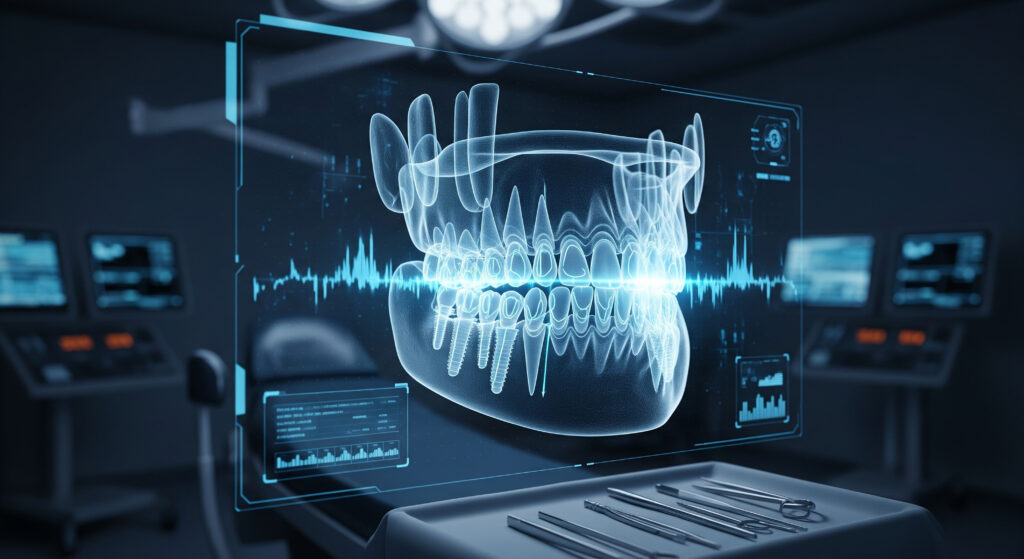
Illustration of AI-assisted analysis. Final diagnosis is always made by the dentist after a clinical examination.
AI image analysis
See how AI reads your scan before the doctor decides
Every panoramic X-ray, CBCT scan and smile photo you send is analysed by AI first. It maps bone, nerves, roots and soft tissue, flags areas that need attention and prepares measurements. Dr. Abdurrahman Öztürk then reviews every finding and makes the clinical decision.
What AI Oral and Maxillofacial Surgery Means at AIDENT
Oral and maxillofacial surgery is the dental specialty that treats problems of the teeth, jaw bones, jaw joints and surrounding facial structures with surgical methods. It covers everything from removing a wisdom tooth trapped in the bone to repositioning an entire jaw. Because these operations take place close to nerves, blood vessels and the sinuses, precise knowledge of each patient's anatomy is the foundation of a safe result.
AI oral surgery at AIDENT means that this knowledge is built with artificial intelligence. Our software reads your CBCT scan slice by slice, outlines the structures that matter, and turns them into a 3D map the surgeon can rotate and measure. It does not operate and it does not make choices. It gives Dr. Abdurrahman Öztürk a clearer, faster and more complete view of your case, so his surgical judgment is applied to better information.
- AI analysis of panoramic X-rays and CBCT for every surgical patient
- 3D segmentation of teeth, bone, nerve canals and sinuses
- Digital simulation of the planned procedure before surgery day
- Final diagnosis, plan and operation by a PhD oral and maxillofacial surgeon
How AI Changes Surgical Planning for the Mouth and Jaw
Traditional planning often relied on a flat panoramic X-ray, where structures overlap and distances can be misjudged. A CBCT scan solves part of this by giving a three-dimensional image, but reading hundreds of slices by hand takes time and attention. AI-assisted analysis speeds up this reading and makes it more systematic, so small details such as a thin bone wall or a nerve lying very close to a root are less likely to be overlooked.
For you as a patient, the practical difference is a plan you can actually see. Instead of hearing that a tooth is close to a nerve, you can look at the 3D model, understand why a particular technique was chosen and ask informed questions. This transparency is one of the main reasons international patients choose AI-assisted oral surgery in Istanbul.
Nerve and sinus mapping with AI
The lower jaw contains the inferior alveolar nerve, which gives feeling to the lip and chin, and the upper back teeth sit near the maxillary sinus. AI segmentation traces both on your scan, helping the surgeon choose an approach that keeps a safe distance where anatomy allows.
Simulation and 3D-printed guides
Once the plan is agreed, it can be rehearsed on screen and, for selected cases, transferred into surgery with 3D-printed guides or splints. In jaw surgery this helps move bone segments to the planned position; in implant-related surgery it helps control angle and depth.
Outcome previews with honest limits
For jaw correction, AI can simulate how a change in bone position may alter the facial profile. These previews are simulations to support discussion. Soft tissues heal differently in every person, so the dentist confirms the final plan only after a full clinical exam.
AI Oral Surgery Treatments: Choosing the Right Procedure
This page is the overview of our oral and maxillofacial surgery services. The three most requested procedures each have their own detailed page, which explains the technique, recovery and costs of that operation in depth. Use the short guide below to see which one matches your situation, and remember that a single online assessment can answer the question for your own case.
AI Impacted Wisdom Teeth Removal
For wisdom teeth that are trapped in bone or gum, growing at an angle, causing repeated infection or pushing on the neighboring molar. AI CBCT analysis shows the root shape and how close the roots lie to the nerve, which guides the choice between a standard removal and a more conservative technique.
AI Corrective Jaw Surgery (Orthognathic)
For adults whose upper or lower jaw is too far forward, too far back or asymmetric, affecting the bite, chewing, breathing or facial balance. It is usually combined with orthodontic treatment, and AI is used to simulate bone movements and the expected profile change.
AI TMJ Disorder Treatment
For pain, clicking, locking or limited opening of the jaw joint. Most TMJ problems improve with non-surgical care such as splints, physiotherapy and habit changes. AI helps analyze joint images and bite patterns, and surgery is considered only when conservative care is not enough.
Other Procedures Within Our Oral and Maxillofacial Surgery Service
Beyond these three main treatments, Dr. Öztürk performs a broad range of surgical procedures that rely on the same AI-supported imaging. Complex extractions of broken, ankylosed or deeply decayed teeth benefit from a clear view of root shape and surrounding bone. Patients preparing for dental implants may need bone grafting or a sinus lift, which are planned with AI measurements of bone height and width.
The specialty also includes the treatment of jaw cysts and benign lesions found on X-rays, the repair of jaw and facial fractures after accidents, and reconstruction of bone and soft tissue after injury or disease. Some of these conditions require hospital-based care or collaboration with other specialists. When this is the case, we tell you clearly and help you understand the next step rather than offering a treatment that is not appropriate.
- Surgical extraction of broken, impacted or fused teeth
- Bone grafting and sinus lift before implants, including All-on-4 and All-on-6 cases
- Removal of jaw cysts and benign lesions, with tissue sent for examination
- Management of jaw and facial fractures
- Bone and soft tissue reconstruction after trauma or disease
Which Oral Surgery Do I Need? Symptoms That Point the Way
Many patients contact us with a symptom rather than a diagnosis. Pain at the back of the mouth, a swollen gum behind the last molar, a jaw that clicks, or a bite that never felt right are all common reasons to seek a surgical opinion. The list below is a general orientation only. A diagnosis is made after your images have been analyzed with AI and Dr. Öztürk has examined you.
If you are unsure, send us photos of your teeth and any X-ray or CBCT you already have. Even an older panoramic image is often enough to tell whether you are likely to need wisdom tooth surgery, a jaw-joint evaluation or an orthodontic and surgical consultation.
- Swelling, bad taste or recurring pain behind the last molar: often linked to a partially erupted wisdom tooth
- Crowding or pressure at the back of the jaw with a tooth that never came through: possible impaction
- Upper and lower front teeth that do not meet, or a strongly protruding or retruded chin: possible skeletal jaw discrepancy
- Clicking, locking, ear-area pain or morning jaw tension: possible TMJ disorder
- A painless shadow noticed on a routine X-ray: may need further imaging to rule out a cyst
Safety, Anesthesia and the Honest Limits of AI
Every surgical procedure carries risks, and good planning reduces them without removing them completely. Depending on the operation, possible effects include swelling, bruising, bleeding, infection, dry socket after an extraction, temporary or, rarely, lasting numbness of the lip or tongue, and limited mouth opening while healing. Jaw surgery and joint surgery have additional specific risks that are explained in detail on their own pages and during your consultation.
Most minor oral surgery is performed under local anesthesia, and sedation can be discussed for anxious patients. Larger operations such as corrective jaw surgery are carried out under general anesthesia in a hospital setting. AI does not change these medical rules. It cannot guarantee an outcome, it can misread unusual anatomy, and its output is always verified by the surgeon. That is why we describe AI as a tool for planning and communication, never as a replacement for clinical experience.
What AI does well
It reads scans consistently, highlights structures that deserve attention, measures distances in 3D and makes the plan easier for you to understand.
What remains the surgeon's job
Taking your medical history, examining tissues, weighing risks against benefits, choosing the technique and anesthesia, and performing and following up the operation.
Planning AI Oral Surgery in Istanbul as an International Patient
Many of our surgical patients travel to Istanbul from abroad, so we organize the process to keep your time in Turkey efficient. The first assessment happens online: you share photos and imaging on WhatsApp, and Dr. Öztürk tells you which procedure is likely, whether a new CBCT is needed and how long you should plan to stay. If you have no recent scan, it can be taken at the clinic on your first day.
The length of stay depends on the operation. A wisdom tooth removal usually needs only a few days in the city for the procedure and a check-up, while corrective jaw surgery requires a longer stay and a period of close monitoring before flying. After you return home, we follow your recovery through photos and messages and coordinate with your local dentist when needed.
Conventional vs AI-assisted
Conventional Oral Surgery Planning vs AI-Assisted Planning at AIDENT
Who it suits
Who Is a Good Candidate for AI-Assisted Oral Surgery?
- Patients with impacted, partially erupted or repeatedly infected wisdom teeth
- Adults with a skeletal bite problem that braces alone cannot correct
- People with jaw joint pain, clicking or locking that has not improved with simple measures
- Implant patients who need bone grafting, a sinus lift or a complex extraction first
- Patients with a cyst or unusual finding on an X-ray that needs surgical evaluation
- International patients who want a clear 3D plan before traveling to Istanbul
Your treatment journey
Your AI Oral Surgery Journey, Step by Step
Before travel
Online assessment
Send photos and any X-ray or CBCT on WhatsApp. You receive a first opinion on the likely procedure and the recommended length of stay.
Day 1
Examination and AI imaging
Clinical exam, new CBCT if needed and AI analysis of your scan. Dr. Öztürk explains the 3D plan, options and risks.
Day 1 to 3
Surgery
Minor procedures are often done the same or next day under local anesthesia; major jaw surgery is scheduled in a hospital setting.
First week
Early healing check
Control visit to check the wound, remove sutures when needed and confirm you are fit to travel.
After you return home
Remote follow-up
Healing is monitored through photos and messages, with control imaging planned at the right time for your procedure.
Why patients choose it
PhD-level surgical leadership
Your case is planned and operated by a surgeon with doctoral training in oral and maxillofacial surgery, not delegated to an algorithm.
Clearer view of risky anatomy
AI segmentation of nerves, sinuses and bone helps the surgeon plan around sensitive structures with more confidence.
A plan you can see
The 3D model of your own jaw makes the operation, its options and its risks easier to understand before you agree.
Efficient time in Istanbul
Online AI-supported pre-assessment lets us prepare before you arrive, so your stay can focus on treatment and recovery.
One team for related care
Extractions, bone grafting, implants and restorations can be coordinated within the same clinic under the same supervising dentist.
Honest guidance
If a non-surgical approach is better for you, or your case needs another specialist, we tell you clearly.
Your doctor
Your Surgeon: Dr. Abdurrahman Öztürk, PhD in Oral & Maxillofacial Surgery
Dr. Abdurrahman Öztürk holds a PhD in dentistry and oral and maxillofacial surgery and has more than 15 years of experience in dentistry and dental surgery. He graduated from a leading Istanbul university and supervises every case at AIDENT Clinic. In oral surgery this training matters most: interpreting complex 3D anatomy, judging when an operation is truly needed and managing the unexpected. He reviews each AI analysis personally, examines every patient, chooses the technique and performs or directly supervises the surgery. AI gives him a clearer map; his clinical judgment decides the route.
Aftercare
General Aftercare After Oral Surgery
- Bite gently on gauze for the time advised and avoid spitting or rinsing hard on the first day
- Use cold packs on the cheek during the first 24 to 48 hours to limit swelling
- Take prescribed medication exactly as instructed and do not smoke while healing
- Choose soft, cool foods at first and avoid chewing directly on the surgical area
- Start gentle salt-water or prescribed rinses from the day after surgery, keeping the area clean
- Contact us promptly on WhatsApp if you notice increasing pain, fever, heavy bleeding or numbness that does not improve
Explore every treatment in this specialty
Questions and answers
What patients ask about AI Oral & Maxillofacial Surgery
Does AI really perform oral surgery at AIDENT?
No, AI never performs the surgery. It analyzes your X-rays and CBCT scans, builds a 3D model of your jaw and helps simulate the plan. Dr. Abdurrahman Öztürk examines you, decides the treatment and performs or supervises the operation himself. AI is a planning and visualization tool that supports his judgment.
Who is the best oral and maxillofacial surgeon for AI surgery in Istanbul?
The best choice is a surgeon with formal specialist training who uses AI as a support tool, not a substitute. At AIDENT, Dr. Abdurrahman Öztürk holds a PhD in oral and maxillofacial surgery and has over 15 years of experience. Ask any clinic who reviews the AI findings and who actually performs your operation.
How do I know which oral surgery I need?
You know after an imaging review and a clinical exam. Send us photos and any X-ray on WhatsApp and Dr. Öztürk will tell you whether your symptoms point to wisdom tooth removal, a jaw-joint evaluation, corrective jaw surgery or another procedure. A CBCT scan with AI analysis then confirms the details.
Is AI-guided oral surgery safe?
AI-guided planning can make oral surgery more predictable, but no surgery is risk-free. AI helps locate nerves, sinuses and bone in 3D, which supports safer decisions. Risks such as swelling, infection or temporary numbness still exist, and every AI result is checked by the surgeon before it is used.
Is oral surgery painful?
The procedure itself should not be painful, because the area is fully numbed with local anesthesia or you are asleep under general anesthesia for larger operations. Afterward, soreness and swelling are normal for a few days and are usually controlled well with prescribed pain relief, cold packs and rest.
How long do I need to stay in Istanbul for oral surgery?
It depends on the procedure. Wisdom tooth removal or a complex extraction usually needs about three to seven days, including a control visit. Corrective jaw surgery needs a considerably longer stay with close monitoring. Dr. Öztürk gives you a personal estimate after reviewing your images online.
Can I get an AI oral surgery assessment online before traveling?
Yes, the first assessment is done online. Send clear photos, any panoramic X-ray or CBCT and a description of your symptoms on WhatsApp at +90 534 445 9444. Dr. Öztürk reviews them with AI support and explains the likely treatment, any extra imaging needed and your recommended stay.
Do I need a CBCT scan before oral surgery?
Not always, but it is often recommended for complex cases. A simple extraction may only need a panoramic X-ray. When a tooth is close to a nerve or sinus, or jaw and joint surgery is planned, a CBCT gives the 3D information that AI analysis and safe planning require.
What is the difference between an oral surgeon and a maxillofacial surgeon?
The terms overlap and describe the same broad specialty at different scales. Oral surgery usually refers to procedures inside the mouth, such as wisdom teeth and bone grafts, while maxillofacial surgery extends to the jaws, joints and face, such as jaw correction and fracture repair. Dr. Öztürk is trained across this whole field.
Can AI predict how my face will look after jaw surgery?
AI can simulate a likely profile change, but it cannot promise an exact result. The simulation is based on planned bone movements and typical soft tissue response. Real healing varies between people, so the preview is a discussion tool, and the final plan is confirmed only after a full clinical and orthodontic assessment.
Will I be awake during oral surgery?
For most minor procedures, yes, you stay awake with the area completely numb. Sedation can be discussed if you feel anxious. Major operations such as orthognathic surgery are carried out under general anesthesia in a hospital, and the right option for you is decided during your consultation.
Can a jaw problem be treated without surgery?
Often, yes. Many TMJ disorders improve with splints, physiotherapy and habit changes, and mild bite problems may be managed with orthodontics alone. Surgery is recommended only when the expected benefit clearly outweighs the risk, and we explain non-surgical alternatives honestly during your assessment.
What happens if AI finds something unexpected on my scan?
Dr. Öztürk reviews the finding personally and explains what it means. Many incidental findings are harmless, but some, such as cysts, need further imaging or treatment. If a condition is outside the scope of our clinic, we tell you clearly and advise you on where to seek appropriate care.
Can I combine oral surgery with dental implants in the same trip?
Sometimes, yes. An extraction can occasionally be combined with immediate implant placement or bone grafting when the bone is suitable. In other cases the area must heal first. AI analysis of bone volume helps Dr. Öztürk decide whether a combined approach is safe for you.
How soon can I fly home after oral surgery?
After minor oral surgery, most patients can fly once the control visit confirms normal early healing, usually within a few days. After jaw surgery, a longer waiting period is needed. Dr. Öztürk will confirm that you are fit to travel before you book or change your flight.
No question matches your search. Ask us directly on WhatsApp.
Get a PhD Surgeon's AI-Assisted Opinion on Your Case
Send your photos, X-ray or CBCT on WhatsApp. Dr. Abdurrahman Öztürk will review them with AI support and tell you which procedure fits your situation and how long to plan in Istanbul.
Get my free AI surgical assessment on WhatsAppFree initial review of your photos and X-rays. Reply on WhatsApp.