AI-Planned Single-Tooth Replacement
AI Single-Tooth Implant in Istanbul: One Missing Tooth, Replaced with Precision
An AI single-tooth implant replaces one lost tooth with a titanium root and a custom crown, planned on AI-analyzed 3D scans so it fits between your existing teeth without touching them. Every plan is reviewed and confirmed by Dr. Abdurrahman Öztürk before treatment begins.
 Medically reviewed by Dr. Abdurrahman Öztürk, PhD, oral & maxillofacial surgery
The 3D model shows one implant sitting in the jawbone between two natural teeth, with the abutment connecting it to a custom crown that sits at the same height as its neighbours.
Short answer
What is an AI single-tooth implant?
An AI single-tooth implant is one titanium implant and crown that replaces a single missing tooth, planned with artificial intelligence. AI software analyzes your CBCT scan to map bone, nerves, sinus and neighbouring roots, then helps design the implant position and crown. Dr. Abdurrahman Öztürk reviews every step and makes the final clinical decision.
- Replaces
- One missing tooth
- Components
- Implant, abutment, crown
- Neighbouring teeth
- Not ground down
- Typical trips
- Two visits, months apart
AI
How AI Plans One Implant in the Gap You Have
A single gap looks simple, but the implant must fit a narrow space between two living roots, above a nerve or below a sinus, and under a crown that has to match the teeth beside it. This is the sequence we follow, with Dr. Öztürk approving each stage.
- 1
Photos and X-ray review
You send smile photos and any existing X-ray on WhatsApp. AI-assisted image review flags the gap, nearby decay and gum condition so the doctor can give a first opinion.
- 2
CBCT scan with AI segmentation
A 3D cone-beam scan is segmented by AI into bone, neighbouring roots, the inferior alveolar nerve and the sinus floor, making distances visible in millimetres.
- 3
Intraoral 3D scan
A digital scan records the gum shape and the teeth on both sides and opposite the gap, replacing messy impression trays.
- 4
Virtual implant placement
Implant length, width and angle are tested virtually inside the bone, keeping safe distance from adjacent roots and anatomical structures.
- 5
Crown-first design and guide
The future crown is designed first, and the implant is positioned under it. A 3D-printed surgical guide can transfer that plan to the mouth when the case suits it.
- 6
Doctor review and confirmation
Dr. Öztürk checks the AI proposal against the clinical exam, adjusts it where needed and only then confirms the treatment plan with you.
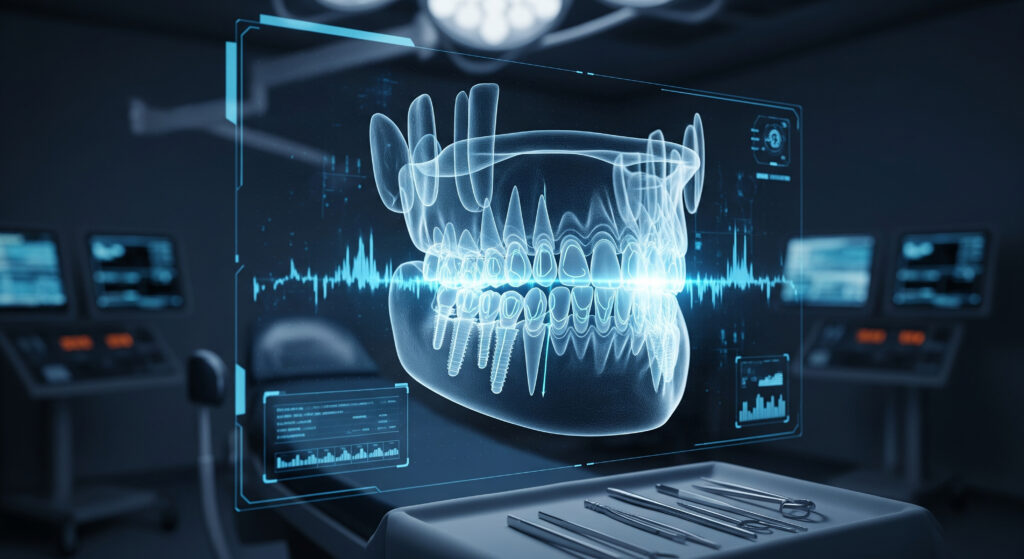
Illustration of AI-assisted analysis. Final diagnosis is always made by the dentist after a clinical examination.
AI image analysis
See how AI reads your scan before the doctor decides
Every panoramic X-ray, CBCT scan and smile photo you send is analysed by AI first. It maps bone, nerves, roots and soft tissue, flags areas that need attention and prepares measurements. Dr. Abdurrahman Öztürk then reviews every finding and makes the clinical decision.
Why One Missing Tooth Deserves a Dedicated AI Single-Tooth Implant Plan
Losing a single tooth is often treated as a minor problem, but the gap does not stay still. Over time the teeth beside it can tilt into the space, the tooth opposite can drift out of its socket, and the bone where the root used to be gradually shrinks because it is no longer stimulated by chewing. A single-tooth implant addresses all three issues at once: it fills the space, supports the bite, and loads the bone again in a similar way to a natural root.
Because only one tooth is involved, there is very little room for error. The implant has to stand in a gap that may be only a few millimetres wider than the implant itself, with healthy roots on both sides. That is exactly where AI-assisted planning is valuable. By segmenting the CBCT scan and measuring the space digitally, the software helps Dr. Öztürk see whether the gap, the bone and the gums can accept an implant safely, and what size and angle make sense, before any surgery is scheduled.
- Prevents neighbouring teeth from tilting into the gap
- Helps keep the opposite tooth from over-erupting
- Stimulates the bone where the root was lost
- Leaves healthy adjacent teeth completely untouched
Front Tooth or Back Tooth: How AI Adapts the Single Implant to Its Position
A single implant in the smile zone and a single implant replacing a molar are planned with different priorities. The front of the mouth is about appearance: the gum line, the thin bone wall on the outside of the root, and the way the crown emerges from the gum all affect whether the tooth looks natural. The back of the mouth is about force: molars take heavy chewing loads, and they sit close to important anatomy.
AI tools help in both cases, but in different ways. For front teeth, digital smile analysis and crown-first design help predict how the new tooth will sit next to its neighbours, which is then confirmed by the doctor at the chair. For back teeth, segmentation of the nerve canal in the lower jaw and the sinus floor in the upper jaw helps choose an implant length that keeps a safe margin.
Single front tooth implant
The priority is aesthetics. The implant is often placed slightly towards the palate to protect the thin outer bone, and a temporary tooth may be used to shape the gum before the final crown is made. Gum thickness and the smile line are assessed carefully, because they influence how natural the final result can look.
Single premolar implant
Premolars balance appearance and function. In the upper jaw the sinus can be close to the roots, and in the lower jaw the mental nerve exits near this area, so AI mapping of these structures is especially useful when choosing implant length and position.
Single molar implant
Molars need a wider implant and a crown shaped for strong chewing. In the lower jaw the nerve canal sets the depth limit; in the upper jaw a sinus lift may be needed if the bone under the sinus is too thin. The AI model shows these limits clearly before surgery.
Immediate or Delayed: Choosing When to Place a Single Implant After Extraction
If your tooth still needs to be extracted, a key decision is timing. In some cases the implant can be placed in the same appointment as the extraction, which is called immediate placement. In other cases the socket is allowed to heal first, sometimes with a bone graft to preserve its shape, and the implant is placed weeks or months later. Neither option is automatically better; the right one depends on infection, bone walls and how stable the implant can be on the day.
The AI-analyzed CBCT helps here by showing the shape of the socket, how much bone lies beyond the root tip and whether the outer wall is intact. However, some facts can only be confirmed during the extraction itself, so Dr. Öztürk may plan for immediate placement and switch to a staged approach if the situation in the mouth is different from what the scan suggested. We explain both possibilities to you in advance so there are no surprises.
- Immediate placement: possible when there is no active infection and the implant can be stabilised firmly
- Early or delayed placement: preferred when the socket is damaged or infected
- Socket preservation grafting: used to protect the bone shape while it heals
- Final choice is made clinically by the doctor, not by software
AI Single-Tooth Implant vs a Bridge or a Removable Partial for One Gap
For one missing tooth there are three common options. A traditional three-unit bridge uses the teeth on both sides as anchors, which means those teeth are reduced in size to receive crowns, even if they are perfectly healthy. A small removable partial denture is the least invasive and least costly to make, but many people find it less comfortable and less stable when eating. A single implant replaces the root itself and stands on its own.
The implant usually takes longer to complete because the bone needs time to bond with it, and it requires a minor surgical procedure. In return, it preserves the neighbouring teeth and helps maintain the bone in the gap. A bridge can still be a sensible choice when the adjacent teeth already need crowns, or when surgery is not advisable for medical reasons. During your assessment Dr. Öztürk explains which option fits your situation, and the AI analysis is used to show you the reasoning on your own scan.
When a bridge may be preferred
If both neighbouring teeth are heavily filled or already crowned, covering them with a bridge can serve two purposes. A bridge is also considered when bone grafting would be extensive or when general health makes surgery unwise.
When a single implant is usually favoured
If the neighbouring teeth are healthy and unrestored, a single implant avoids cutting them down. It also allows normal flossing around each tooth, which many people find easier than cleaning under a bridge.
Matching the Crown: How AI Digital Design Makes One Tooth Blend In
With a single implant, the crown is judged against the natural teeth right beside it, so even small differences in colour, translucency or shape can be noticeable, especially at the front. The crown is designed digitally from the intraoral scan, using the shape of the neighbouring and opposing teeth as a reference so the new tooth fits into your bite and the line of your smile.
Shade is selected with the help of photographs taken under controlled light and checked by eye at the clinic, because no camera or software sees colour exactly as the human eye does in daylight. Computer-aided design and milling or 3D printing then produce the crown and, where useful, a custom abutment that supports the gum around it. Digital design can predict a lot, but a natural tooth has subtle features, so a try-in and fine adjustment are part of the process.
- Crown shape designed from your own neighbouring teeth
- Bite checked against the opposing tooth digitally and in the mouth
- Shade selection combines calibrated photos and visual comparison
- Custom abutments can support a more natural gum contour
Single Implant Risks, Limits and What AI Planning Cannot Change
A single-tooth implant is a well-established treatment, but it is still surgery and carries risks. These include swelling, bruising and discomfort for a few days, infection, failure of the implant to integrate with the bone, gum recession around the crown, and, rarely, nerve irritation or sinus involvement. Smoking, uncontrolled diabetes, untreated gum disease and night-time grinding all raise the risk of problems, and they need to be discussed openly before treatment.
AI planning reduces uncertainty about anatomy, but it cannot control how your body heals, and it does not replace the clinical judgement of the surgeon. Simulations of the final crown are previews, not guarantees. If an implant does not integrate, it can usually be removed, the site allowed to heal, and a new implant considered later. Dr. Öztürk will tell you honestly if he believes an implant is not the right option for you.
Conventional vs AI-assisted
Single-Tooth Implant Planning: Conventional vs AI-Assisted
Who it suits
Who Is a Good Candidate for an AI Single-Tooth Implant?
- Adults missing one tooth through decay, injury, failed root canal treatment or a cracked root
- People with a tooth that must be extracted and want to replace it without touching its neighbours
- Patients with adequate bone, or who accept a graft or sinus lift if the scan shows a deficit
- Those whose gum disease has been treated and is under control
- Non-smokers, or smokers willing to stop around the time of surgery and healing
- Patients with a congenitally missing tooth whose jaw growth is complete
Your treatment journey
A Typical Timeline for One Implant in Istanbul
Before travel
Online AI assessment
Send photos and any X-ray on WhatsApp. Dr. Öztürk gives a first opinion and explains what the visit will involve.
Trip 1, day 1
Scans and final plan
Clinical exam, CBCT and intraoral scan, AI-assisted planning and confirmation of the treatment plan with you.
Trip 1, day 1–3
Implant placement
Extraction if needed and implant placement under local anaesthesia, followed by a check-up before you fly home.
Healing at home
Osseointegration
The bone bonds with the implant over a period of months, usually around three to six depending on bone quality and grafting.
Trip 2, about 5–7 days
Crown fitting
Healing check, final scan, crown design and try-in, then fitting of the finished crown and bite adjustment.
Why patients choose it
Neighbours stay intact
No healthy tooth needs to be cut down to support the replacement, unlike a traditional bridge.
Safer anatomy margins
AI segmentation shows nerve, sinus and root positions in 3D so the doctor can plan a safe distance.
Crown-led positioning
Designing the crown first helps place the implant where the tooth needs to be, not just where the bone is.
Easier cleaning
A single implant crown can be flossed like a natural tooth, without threading under a bridge.
Clear explanation
You see your own 3D scan and planned implant, so you understand the reasons behind the plan.
Shorter chair time
Digital scans and pre-planned positioning can make the surgical appointment more predictable and efficient.
Your doctor
Every Single Implant Is Supervised by Dr. Abdurrahman Öztürk
Dr. Abdurrahman Öztürk holds a PhD in dentistry and oral and maxillofacial surgery and has more than 15 years of experience in dental surgery. He graduated from a leading Istanbul university and personally oversees every AI-assisted single-tooth implant at AIDENT Clinic. The AI software measures bone, maps nerves and proposes implant positions, but Dr. Öztürk examines each patient, reviews every scan, adjusts the plan where his clinical judgement differs, and performs or directly supervises the surgery. Artificial intelligence supports the process; the decisions about your treatment remain his.
Aftercare
Caring for Your Single Implant After Surgery
- Use cold compresses on the first day and sleep with your head slightly raised
- Eat soft food and chew on the other side until the doctor advises otherwise
- Avoid smoking and alcohol during the first stage of healing
- Rinse gently as instructed and keep the area clean without brushing the wound directly at first
- Once the crown is fitted, floss or use an interdental brush around the implant daily
- Wear a night guard if you grind your teeth, to protect the crown and implant
- Attend regular check-ups and professional cleaning, at home or with us
Related AI treatments
Questions and answers
What patients ask about AI Single-Tooth Implant
How long does a single-tooth implant take from start to finish?
From implant placement to the final crown usually takes several months. The surgery itself is often completed in one appointment, then the bone needs roughly three to six months to bond with the implant. If a bone graft or sinus lift is needed, healing can take longer. Dr. Öztürk confirms your expected timeline after reviewing your AI-analyzed CBCT scan.
Can I get my implant on the same day my tooth is taken out?
Sometimes, yes. Immediate placement is possible when the socket has no active infection, the bone walls are intact and the implant can be held firmly. The AI-analyzed scan shows whether this looks likely, but the final decision is made during the extraction. If conditions are not right, the doctor lets the socket heal first and places the implant later.
Is one implant better than a bridge for a single missing tooth?
For many people with healthy neighbouring teeth, a single implant is the more conservative choice because those teeth do not need to be cut down. A bridge is quicker to complete and avoids surgery, and it can make sense if the adjacent teeth already need crowns. Dr. Öztürk explains both options using your own scan.
Will I have a gap while my single implant heals?
Usually not, especially for front teeth. A temporary tooth can be provided while the implant heals, either as a removable piece, a bonded temporary or, in suitable cases, a temporary crown on the implant itself. For back teeth some patients choose to leave the gap during healing. The doctor will advise which temporary option is safe for your case.
How many trips to Istanbul do I need for one implant?
Most patients need two trips. The first, typically a few days, covers scans, planning and implant placement. The second, usually about five to seven days, takes place after healing and is for the final crown. If you need a bone graft first, an additional stage may be required. We confirm your plan before you book flights.
How many days off work do I need after a single implant?
Many people return to desk work within one or two days after a single implant. Swelling and tenderness are usually mild and peak around the second or third day. If the procedure includes an extraction, a bone graft or a sinus lift, you may want a few more days of rest. Physical work and intense exercise should wait a little longer.
Can AI match my implant crown to the colour of my other teeth?
AI-supported digital design helps with shape and fit, and calibrated photographs help guide shade selection, but colour is finally confirmed by eye at the clinic. A natural tooth has layers of translucency that software cannot fully reproduce, so the crown is tried in and adjusted before it is fixed, especially for front teeth.
Is a front tooth implant different from a back tooth implant?
Yes. A front tooth implant focuses on appearance, gum shape and protecting the thin bone at the front of the jaw. A back tooth implant focuses on strength and on keeping a safe distance from the nerve in the lower jaw or the sinus in the upper jaw. The AI plan and implant size are adapted to each position.
Does AI check how close my implant will be to the nerve or sinus?
Yes, this is one of its most useful roles. AI segmentation of your CBCT scan outlines the nerve canal, the sinus floor and the roots of neighbouring teeth in 3D. Dr. Öztürk then verifies these outlines and chooses an implant length and angle that keeps a safe margin from each structure before surgery is scheduled.
What if my tooth has been missing for many years?
An implant may still be possible, but long-standing gaps often have less bone and the neighbouring teeth may have tilted. The AI-analyzed scan shows how much bone remains and whether the space is still wide enough. A bone graft, or in some cases short orthodontic treatment to reopen the space, may be recommended before the implant.
What happens if my single implant does not integrate?
If an implant fails to bond with the bone, it is usually removed, the area is allowed to heal, and a new implant can often be placed later. Failure is uncommon but possible, and smoking, infection and grinding are common contributing factors. Dr. Öztürk discusses your personal risk factors honestly during planning.
Who is the best dentist for an AI single-tooth implant in Istanbul?
Look for a dentist with surgical training, 3D planning and clear communication. At AIDENT Clinic, AI-assisted single-tooth implants are supervised by Dr. Abdurrahman Öztürk, who holds a PhD in dentistry and oral and maxillofacial surgery and has over 15 years of experience. He reviews every AI analysis and makes each clinical decision himself.
Can I send my X-ray on WhatsApp to see if one implant suits me?
Yes. Send a recent panoramic X-ray or CBCT scan, if you have one, together with clear photos of the gap to +90 534 445 9444. Dr. Öztürk will give an initial opinion. A final plan always requires a clinical examination and a new 3D scan at the clinic, because older images may not show current bone levels.
Does AI really make a single implant more accurate?
AI makes the planning more precise by measuring bone, roots and nerves in 3D and testing implant positions virtually. When a surgical guide is used, that plan can be transferred more closely to the mouth. Accuracy still depends on the surgeon's skill and the clinical situation, which is why every plan is checked and carried out under Dr. Öztürk's supervision.
No question matches your search. Ask us directly on WhatsApp.
Replace Your Missing Tooth with an AI-Planned Single Implant
Send us a photo of the gap and any X-ray you have. Dr. Abdurrahman Öztürk will review it with AI-assisted analysis and tell you honestly whether a single implant is right for you, how many visits it would take and what to expect in Istanbul.
Get my free AI implant assessment on WhatsAppFree initial review of your photos and X-rays. Reply on WhatsApp.