AI-Planned Orthodontics
AI Orthodontics in Istanbul: Straighter Teeth Planned and Predicted with Artificial Intelligence
At AIDENT Clinic, AI orthodontics means your teeth, bite and jaw are scanned in 3D, analyzed with artificial intelligence and moved according to a digital plan you can preview before treatment begins. Every step is reviewed and approved by Dr. Abdurrahman Öztürk.
 Medically reviewed by Dr. Abdurrahman Öztürk, PhD, oral & maxillofacial surgery
The model shows how AI separates each tooth so that its path from today's position to the planned position can be calculated and reviewed. Colors indicate teeth that need more or less movement.
Short answer
What is AI orthodontics?
AI orthodontics is teeth straightening and bite correction planned with artificial intelligence. A 3D scan of your teeth is analyzed by AI software that segments each tooth, predicts how it can move and simulates the final smile. At AIDENT Clinic in Istanbul, Dr. Abdurrahman Öztürk reviews and approves every plan before treatment starts.
- Treatments covered
- Clear aligners, bite correction
- Planning
- 3D scan + AI movement prediction
- Suitable for
- Teens and adults
- Supervision
- Dr. Abdurrahman Öztürk, 15+ years
AI
How AI orthodontic planning works at AIDENT
Artificial intelligence does not move your teeth; it helps us understand them better and plan each movement with more precision. Here is the pathway every orthodontic case follows, with the dentist in charge at each step.
- 1
Photo and goal review
You send smile photos on WhatsApp and tell us what bothers you. AI-assisted photo analysis gives a first impression of crowding, spacing and bite, which the dentist checks.
- 2
Intraoral 3D scan
A digital scanner records every tooth and the gums without messy impression trays. The result is an accurate 3D model of both arches.
- 3
X-ray and CBCT analysis
Panoramic X-rays and, when needed, CBCT scans are analyzed with AI to show roots, bone levels and jaw relationships that are invisible on the surface.
- 4
AI tooth segmentation
The software separates each tooth, its crown and its estimated root position, turning your mouth into a set of individual objects that can be moved digitally.
- 5
Movement prediction and simulation
AI proposes a sequence of small, biologically sensible movements and simulates the final alignment and bite so you can see a preview of the expected result.
- 6
Dentist approval and appliance choice
Dr. Öztürk edits the plan, rejects unsafe movements, decides between aligners, braces or combined care, and only then is the appliance produced.
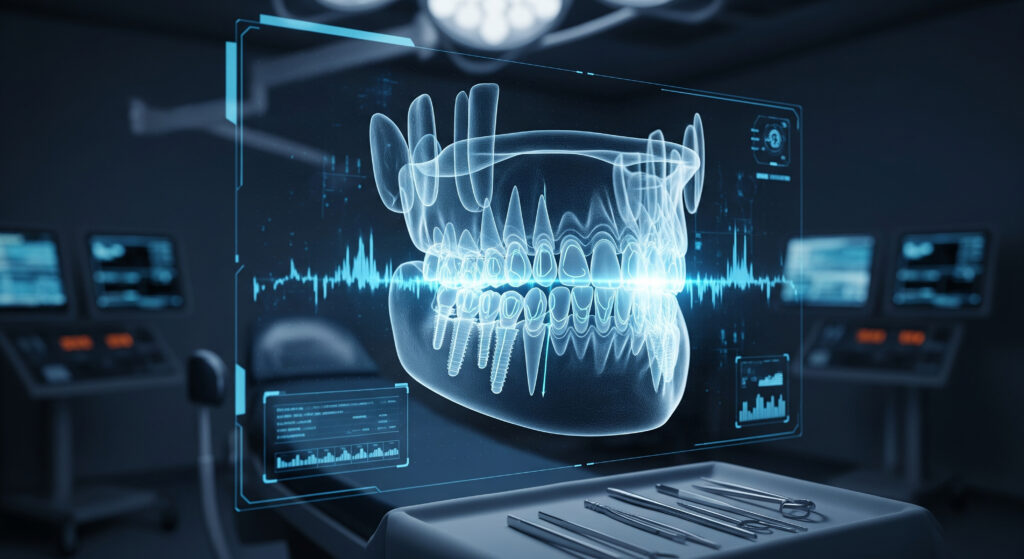
Illustration of AI-assisted analysis. Final diagnosis is always made by the dentist after a clinical examination.
AI image analysis
See how AI reads your scan before the doctor decides
Every panoramic X-ray, CBCT scan and smile photo you send is analysed by AI first. It maps bone, nerves, roots and soft tissue, flags areas that need attention and prepares measurements. Dr. Abdurrahman Öztürk then reviews every finding and makes the clinical decision.
What AI orthodontics means and why it matters
Orthodontics is the branch of dentistry that moves teeth and guides jaw relationships so that the bite works properly and the smile looks balanced. For decades, planning relied on plaster models, two-dimensional X-rays and the clinician's mental picture of how teeth would respond. AI orthodontics keeps the same biological principles but adds a digital layer: a precise 3D scan, software that recognises every tooth automatically and algorithms that estimate how teeth can move safely through the bone.
The practical difference for you is clarity. Instead of being told that your teeth will look better in a year, you can see a simulation of the planned alignment, understand which teeth move the most and discuss the plan in detail before committing. At AIDENT Clinic in Istanbul, this technology supports our decisions, but it never replaces them. Dr. Abdurrahman Öztürk reviews every AI suggestion and makes the final clinical call on each case.
- AI analysis of photos, intraoral scans, panoramic X-rays and CBCT
- Automatic segmentation of each tooth into a movable 3D object
- Prediction of tooth movements and simulation of the final smile
- A dentist-approved plan before any appliance is made
AI tooth-movement prediction: how software estimates where teeth can go
Teeth move when gentle, steady pressure stimulates the bone around the roots to remodel. Bone is resorbed on one side and rebuilt on the other, which is why orthodontic movement is gradual. AI tooth-movement prediction uses your 3D scan and radiographs to estimate the position of crowns and roots, then calculates a series of small steps from the current arrangement to the target. The software flags movements that may be difficult, such as large rotations or moving roots against thin bone.
Prediction is not a guarantee. Biology varies between people, and how consistently you wear an appliance has a strong influence on the outcome. That is why the AI forecast is a starting point that the dentist adjusts. Dr. Öztürk may slow a movement down, divide it into more stages, or recommend a different technique when the software's proposal looks too ambitious for your bone and gums.
What the AI looks at
Crowding and spacing, tooth rotations and tilts, arch width, overjet and overbite, midline position, and the available bone around each root.
What the dentist adds
Gum health, existing restorations, previous dental history, jaw joint comfort, facial profile and your personal priorities, which no algorithm can judge alone.
Digital orthodontic planning from scan to approved treatment plan
Digital orthodontic planning replaces guesswork with a documented, step-by-step plan. After your intraoral scan, the 3D model is combined with radiographic information so that both the visible crowns and the hidden roots are considered. The AI organises the case into stages, suggests where small attachments or gentle space creation between teeth might be needed, and estimates the number of stages involved. Every one of these suggestions is reviewed by the dentist.
Because the plan is digital, it can be compared with your progress at each check-up. If a tooth is lagging behind, a new scan shows the gap between planned and actual position, and the plan can be refined. This is especially useful for international patients, since progress photos and scans can be reviewed remotely between visits to Istanbul, reducing the number of trips needed while keeping the treatment under professional supervision.
- Combined 3D crown and root information
- Staged movement plan with clear milestones
- Planned versus actual comparison at each review
- Refinements when teeth do not track as predicted
How AI simulates your final orthodontic result
One of the most reassuring parts of AI orthodontics is the result simulation. Using the segmented 3D model, the software moves each tooth to its planned position and displays the expected alignment from the front, the sides and the biting surfaces. Many patients find it easier to decide once they can see how the gaps close, how crowded teeth line up and how the upper and lower arches fit together.
It is important to understand what a simulation is. It shows a carefully calculated target, not a photograph of your future smile. Real teeth can respond faster or slower than predicted, and some cases need refinements or additional cosmetic steps, such as minor tooth reshaping, to reach the final look. We use the simulation to align expectations honestly, and Dr. Öztürk will explain which parts of the preview are highly predictable and which depend on how your teeth respond.
Before and after views
You can switch between the starting position and the planned outcome to see exactly which teeth change.
Bite view
The simulation also shows how upper and lower teeth meet, which matters as much for function as for appearance.
Adult orthodontics with AI: it is not too late to straighten your teeth
Many of our orthodontic patients are adults. Some never had treatment as children, others had braces years ago and noticed their teeth shifting back, and some want to straighten teeth before veneers, crowns or implants. Teeth can be moved at any age as long as the gums and supporting bone are healthy. Adult bone is denser than a teenager's, so movement may take a little longer, and planning has to respect existing fillings, crowns, gum recession and missing teeth.
AI analysis is particularly valuable here because adult mouths are usually more complex. Bone-level assessment on X-rays and CBCT helps identify teeth that should be moved cautiously, and the simulation can show how orthodontics will prepare the mouth for later restorative or cosmetic work. Discreet options such as clear aligners suit working adults, while more complex bite problems may need a different approach that Dr. Öztürk will discuss with you openly.
- Gum health is checked and treated first if needed
- Plans account for crowns, fillings, implants and missing teeth
- Orthodontics can prepare the mouth for veneers or implants
- Discreet appliance options for professional life
Choosing between AI clear aligners and AI bite correction
This page is the overview of our orthodontic services. Two dedicated pages go deeper into the main treatment paths. AI Clear Aligners (Invisible Braces) covers removable transparent trays for crowding, spacing and mild to moderate alignment problems, including how they are made from your digital plan and what daily wear involves. AI Bite Correction (Overbite, Underbite, Crossbite) explains how we analyse and treat problems in the way the upper and lower jaws meet.
In many cases the two overlap: aligners can correct some bite problems, and bite correction often includes straightening. The AI analysis and the clinical examination together show which path suits you. If your main concern is the appearance of crooked or gapped teeth, start with the aligner page. If you notice that your front teeth stick out, your lower teeth sit in front of the upper ones, or teeth bite crossways, start with the bite correction page.
AI Clear Aligners (Invisible Braces)
Best known for discreet straightening of crowded or spaced teeth with removable trays produced from your approved digital plan.
AI Bite Correction (Overbite, Underbite, Crossbite)
Focused on how the jaws and teeth meet, with AI analysis of jaw relationships and a plan that may combine several techniques.
Risks, limits and honest expectations in AI orthodontics
Orthodontic treatment is safe when it is planned and supervised properly, but it is not risk-free. Temporary tenderness after each new stage is common. Poor cleaning during treatment can lead to decay or gum inflammation. Some roots shorten slightly during movement, which is why radiographic monitoring matters. Teeth also tend to drift back after treatment unless retainers are worn as instructed, often for many years.
AI improves planning, but it cannot overcome every limitation. Severe skeletal discrepancies may need surgical correction together with orthodontics, and some movements are simply less predictable with removable appliances. We will tell you clearly if your case is outside what aligners can achieve, if additional treatment is needed first, or if expectations shown in a simulation need to be adjusted. Our aim is a plan you understand fully, not a promise we cannot keep.
- Temporary pressure or soreness is normal after new stages
- Excellent oral hygiene is essential throughout treatment
- Retainers are needed to keep the result stable
- Severe jaw discrepancies may require a surgical opinion
Conventional vs AI-assisted
Conventional orthodontic planning compared with AI-assisted planning
Who it suits
Who is a good candidate for AI orthodontics?
- Adults and teenagers with crowded, rotated or overlapping teeth
- People with gaps between teeth they would like to close
- Patients with overbite, underbite, crossbite or open bite concerns
- Adults whose teeth have shifted after earlier braces
- Patients preparing for veneers, crowns or implants who need better tooth positions first
- Anyone with healthy or treatable gums who is willing to follow wear and hygiene instructions
Your treatment journey
Your AI orthodontic journey with AIDENT
Before travel
Online photo assessment
Send photos and any recent X-rays on WhatsApp. We give a first, non-binding opinion on which orthodontic path may suit you.
Day 1 in Istanbul
Examination and 3D scan
Clinical exam, intraoral scanning and the X-rays or CBCT needed for AI analysis of teeth, roots and jaws.
Day 2–3
AI plan and simulation review
Dr. Öztürk presents the AI-assisted plan, the simulation of the result and the recommended appliance, and answers your questions.
Treatment start
Appliance fitting and instructions
Your appliance is fitted when ready, and you learn how to wear and clean it. Timing depends on the appliance chosen.
During treatment
Remote and in-clinic reviews
Progress photos or scans are compared with the plan; refinements are made if teeth do not track as predicted.
After treatment
Retention phase
Retainers keep teeth in their new positions, with periodic checks to confirm stability.
Why patients choose it
See the plan before you start
A 3D simulation shows the planned alignment and bite, so your decision is based on your own teeth rather than generic photos.
More precise movement planning
AI segmentation and movement prediction help divide treatment into controlled, biologically sensible steps.
Roots and bone considered
X-ray and CBCT analysis helps keep roots within healthy bone and flags teeth that need extra care.
Fewer trips for international patients
Digital records allow much of the follow-up to happen online between visits to Istanbul.
Comfortable digital records
Intraoral scanning replaces traditional impression material for most patients.
Doctor-led decisions
Every AI suggestion is checked by Dr. Abdurrahman Öztürk, who decides what is safe and appropriate for you.
Your doctor
Every AI orthodontic plan is supervised by Dr. Abdurrahman Öztürk
Dr. Abdurrahman Öztürk holds a PhD in dentistry and oral and maxillofacial surgery and has more than 15 years of experience in dentistry and dental surgery. He graduated from a leading Istanbul university and personally reviews each orthodontic case at AIDENT Clinic. AI software helps him read scans, estimate tooth movements and simulate results, but he decides which movements are safe, which appliance is appropriate and when a case needs a different approach. His surgical background is especially valuable when bite problems involve the jaw rather than the teeth alone.
Aftercare
Aftercare and keeping your new smile stable
- Wear your retainer exactly as instructed; teeth naturally tend to drift back without it
- Clean your retainer daily and keep it in its case when not in your mouth
- Brush twice daily and clean between teeth with floss or interdental brushes
- Attend periodic check-ups so stability can be confirmed
- Avoid biting hard objects such as pens, nails or ice
- Contact us on WhatsApp if a retainer cracks, feels loose or no longer fits
Explore every treatment in this specialty
Questions and answers
What patients ask about AI Orthodontics
Does AI really make orthodontic treatment better?
AI makes orthodontic planning more detailed and easier to understand, but the dentist still makes the decisions. It speeds up tooth segmentation, helps predict movement sequences and creates a visual simulation of the planned result. At AIDENT, Dr. Öztürk reviews and adjusts each AI proposal, so you get the precision of digital tools together with clinical judgement.
How long does orthodontic treatment with AI planning take?
Treatment length depends on your case, not on the software. Mild alignment cases can take several months, while more complex crowding or bite problems often take longer, sometimes around two years. AI planning gives a clearer estimate of the number of stages, and your exact timeline is confirmed after the examination and scans.
Can adults straighten their teeth with AI orthodontics?
Yes, adults can straighten their teeth at almost any age if the gums and bone are healthy. Adult bone is denser, so movement may be slightly slower, and plans must account for crowns, fillings or missing teeth. AI analysis of X-rays and scans helps us plan these more complex adult cases carefully.
Is the AI simulation exactly what my teeth will look like?
No, the simulation is a planned target, not a guaranteed outcome. It shows where your teeth are intended to move based on your 3D scan. Real biological response varies, and some cases need refinements or small cosmetic touches to finish. Dr. Öztürk will explain which parts of your preview are most predictable.
How do I know whether I need clear aligners or bite correction?
The examination and AI analysis decide that, not a guess. If your main concern is crooked or gapped teeth, clear aligners are often considered first. If your jaws or bite do not meet properly, bite correction is the focus. Many cases combine both, and our dedicated pages explain each option in detail.
How much time do I need to stay in Istanbul for orthodontic treatment?
The first visit usually takes a few days for examination, scanning and plan review. Orthodontics itself continues for months, so most international patients return home and are followed up remotely with photos and scans, plus occasional visits to Istanbul. The exact schedule depends on your appliance and case complexity.
Is orthodontic treatment painful?
Orthodontic treatment is generally not painful, but you can expect pressure or mild soreness for a day or two after each new stage. This is a sign that the teeth are responding. Over-the-counter pain relief and soft foods usually help. Sharp or lasting pain is not normal and should be reported to us.
Can AI predict how my teeth will move?
Yes, AI can estimate tooth movement, but it is a prediction rather than a certainty. The software uses your 3D scan and X-rays to calculate a sequence of small movements and flags difficult ones. Your biology and how well you wear your appliance affect the result, so the dentist monitors and refines the plan.
Who is the best dentist for AI orthodontics in Istanbul?
The best choice is a clinic where AI planning is always supervised by an experienced dentist. At AIDENT Clinic, Dr. Abdurrahman Öztürk, with more than 15 years of experience and a PhD in dentistry and oral and maxillofacial surgery, reviews every AI-analyzed orthodontic case and makes all clinical decisions.
Can I start AI orthodontic assessment from home?
Yes, you can begin with an online assessment by sending clear smile photos and any recent X-rays on WhatsApp. This gives a first impression of crowding, spacing and bite. A full plan still requires an in-person examination and 3D scan in Istanbul before any appliance is produced.
Do I need a CBCT scan for orthodontics?
Not every orthodontic patient needs a CBCT scan. A panoramic X-ray is often enough, but CBCT may be recommended when roots, impacted teeth, thin bone or jaw relationships need closer study. The dentist decides based on your case, balancing diagnostic benefit against radiation exposure.
Will my teeth move back after orthodontic treatment?
Teeth can move back if retainers are not worn, because the surrounding tissues tend to pull them toward their old positions. Wearing your retainer as instructed is the most important step for keeping the result. We give clear retention instructions and can check stability remotely or at visits.
Can orthodontics be done before veneers or implants?
Yes, orthodontics is often recommended before veneers, crowns or implants. Moving teeth into better positions can reduce how much tooth structure needs to be prepared and can create the right space for an implant. AI simulation helps show how orthodontics and later restorative work fit together.
Is AI orthodontics suitable if I have gum disease?
Active gum disease must be treated and controlled before orthodontic movement starts. Moving teeth in inflamed gums can worsen bone loss. Once the gums are stable, carefully planned orthodontics is often possible, and AI analysis of bone levels helps us decide which movements are safe.
What does the first AI orthodontic consultation include?
The first consultation includes a clinical exam, an intraoral 3D scan and the X-rays needed for AI analysis. Dr. Öztürk then explains the findings, shows the simulated result and recommends a treatment path, along with its limits and alternatives. You decide only after you fully understand the plan.
No question matches your search. Ask us directly on WhatsApp.
See what AI orthodontics could do for your smile
Send us a few smile photos on WhatsApp and Dr. Abdurrahman Öztürk's team will give you a first opinion on whether clear aligners, bite correction or a combined plan may suit you, before you travel to Istanbul.
Get my free AI orthodontic assessment on WhatsAppFree initial review of your photos and X-rays. Reply on WhatsApp.