AI-Guided Prosthodontics
AI Crowns, Bridges & Prosthodontics in Istanbul
At AIDENT Clinic, AI crowns, bridges, dentures and full mouth rehabilitation start with an AI study of your photos, X-rays and 3D scans, so you can see a simulated result before any tooth is touched. Every plan is reviewed, adjusted and confirmed by Dr. Abdurrahman Öztürk.
 Medically reviewed by Dr. Abdurrahman Öztürk, PhD, oral & maxillofacial surgery
The 3D model shows how a fixed bridge is anchored on two prepared natural teeth and carries a replacement tooth across the gap. AI-assisted design helps balance thickness, contact points and gum-line shape.
Short answer
What is AI prosthodontics?
AI prosthodontics is the restoration or replacement of teeth with crowns, bridges, dentures or full-mouth reconstructions, where artificial intelligence helps analyze X-rays, 3D scans and photos, design the restoration digitally and simulate the final look and bite. At AIDENT in Istanbul, Dr. Abdurrahman Öztürk reviews every AI suggestion and makes each clinical decision himself.
- Treatments covered
- Crowns, bridges, dentures, fixed & full-mouth work
- Typical crown materials
- Zirconia and lithium disilicate (E-max)
- AI role
- Analysis, design support, outcome preview
- Supervision
- Dr. Abdurrahman Öztürk, 15+ years
AI
How AI Plans Your Crowns, Bridges or Dentures
Prosthodontics is about fit, bite and appearance at the same time. Our digital workflow uses AI at each stage to organize information and test options, while the dentist stays in charge of every decision.
- 1
Remote photo review
You send smile photos and any existing X-rays on WhatsApp. An initial AI-assisted review helps the doctor estimate which type of prosthetic work may be relevant before you travel.
- 2
AI X-ray and CBCT reading
Panoramic X-rays and, when needed, CBCT scans are analyzed with AI to highlight decay, old fillings, root problems and bone levels around the teeth that would support a crown or bridge.
- 3
Intraoral 3D scan
A handheld scanner records your teeth and gums as a precise 3D model, replacing most traditional impression trays and giving the software exact data on shape and spacing.
- 4
Bite and wear analysis
Software maps how upper and lower teeth meet, flagging overloaded areas, grinding wear and uneven contacts that a new restoration must respect.
- 5
Digital design and simulation
Crowns, bridges or a full arch are designed on screen and previewed on your face, so you can discuss shape, length and shade before anything is produced.
- 6
Doctor approval and fabrication
Dr. Öztürk checks and edits the design, then approves it for CAD/CAM milling or 3D printing; the restoration is tried in and adjusted in the chair.
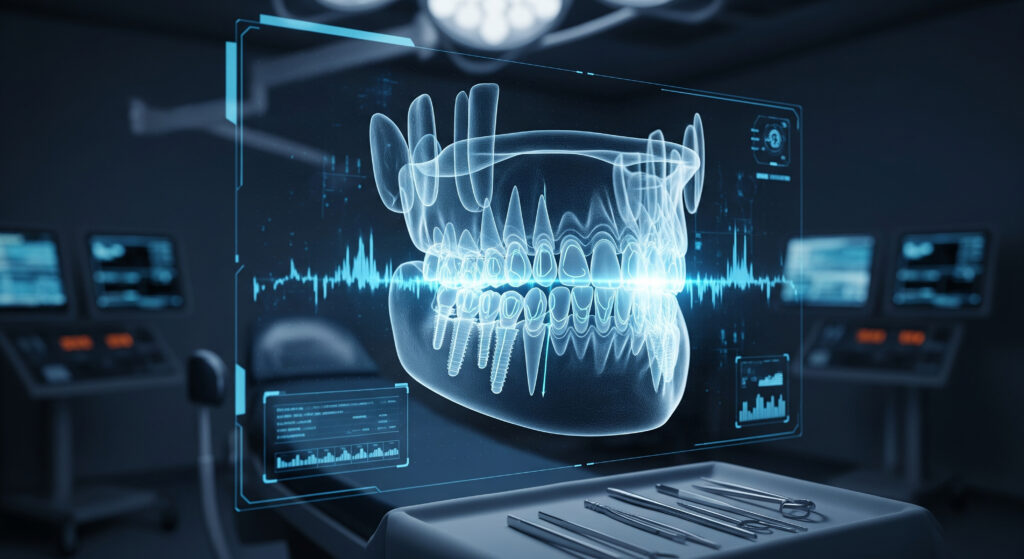
Illustration of AI-assisted analysis. Final diagnosis is always made by the dentist after a clinical examination.
AI image analysis
See how AI reads your scan before the doctor decides
Every panoramic X-ray, CBCT scan and smile photo you send is analysed by AI first. It maps bone, nerves, roots and soft tissue, flags areas that need attention and prepares measurements. Dr. Abdurrahman Öztürk then reviews every finding and makes the clinical decision.
What AI Prosthodontics Covers at AIDENT
Prosthodontics is the branch of dentistry that rebuilds damaged teeth and replaces missing ones. It ranges from a single crown on a cracked molar to a complete reconstruction of both jaws. At AIDENT Clinic in Istanbul we group this work into five treatment paths, each with its own detailed page: dental crowns in zirconia or E-max, dental bridges, removable full and partial dentures, fixed prosthodontics, and full mouth rehabilitation. This hub page explains how these options relate to each other and where artificial intelligence genuinely adds value.
The common thread is that every prosthetic restoration has to fit precisely, share chewing forces correctly and look natural next to your other teeth and your face. These are exactly the areas where AI-assisted dentistry helps: it organizes large amounts of image data, measures what is difficult to see by eye and lets us test several designs digitally. What AI does not do is choose your treatment. Dr. Abdurrahman Öztürk examines you, reads the findings and decides what is right for your mouth.
Restoring teeth you still have
Crowns cover and protect a tooth that is weakened by large fillings, fractures, wear or root canal treatment, keeping your natural root in place.
Replacing teeth you have lost
Bridges, dentures and implant-supported prostheses fill gaps, restore chewing and prevent neighboring teeth from drifting into the empty space.
How AI Changes Crowns, Bridges and Dentures
Traditional prosthetic dentistry relies heavily on soft impression material, plaster models and the experience of the dentist and technician. Those skills still matter, but digital tools now add precision and transparency. An intraoral scanner captures your teeth in 3D, AI software helps segment each tooth and the gum line, and design programs propose a starting shape for a crown or bridge based on the surrounding anatomy and your bite.
AI analysis of panoramic X-rays and CBCT scans can draw attention to areas that deserve a closer look, such as decay under an old crown, a root that may not support a bridge, or bone changes around a tooth. For larger cases, outcome simulation lets you preview tooth length, width and smile line on your own photos. This shared visual makes conversations about expectations clearer, and it gives the doctor a structured overview of the case before treatment begins.
It is important to be realistic. An AI preview is a simulation, not a guarantee. Shade, gum response and final fit are confirmed in the chair, and the design is often refined after a try-in. AI is a support tool that helps the team work more carefully; the clinical judgment remains with Dr. Öztürk.
- AI-assisted reading of X-rays and CBCT for hidden problems
- Digital 3D scans instead of most traditional impressions
- Bite mapping to protect restorations from overload
- On-screen design and smile simulation before preparation
- CAD/CAM milling or 3D printing from the approved digital file
Choosing Between Crowns, Bridges, Dentures and Full Mouth Work
Many patients contact us knowing they need 'new teeth' but unsure which option fits. The right choice depends on how many teeth are missing or damaged, the health of the remaining teeth and roots, bone and gum condition, your bite, your budget and how much time you can spend in Istanbul. AI-assisted analysis helps lay these factors side by side, but the recommendation always comes from the clinical exam.
As a simple orientation: one damaged tooth usually points toward a crown; one to three missing teeth in a row with healthy neighbors may suit a bridge or implants; many missing teeth may be managed with a partial or full denture or an implant-supported option; and widespread wear, failing old dental work or a collapsed bite often calls for a planned full mouth rehabilitation. Each of these paths is explained in depth on its own page.
AI Dental Crowns (Zirconia & E-max)
For single teeth that need strength or a better appearance. Read our crowns page for material choices and the step-by-step process.
AI Dental Bridges
For short gaps where the neighboring teeth can act as supports. The bridges page explains tooth-supported and implant-supported designs.
AI Removable Dentures (Full & Partial)
For several or all missing teeth when a removable solution suits your health, budget or bone situation.
AI Fixed Prosthodontics
An overview of non-removable restorations, including combinations of crowns, bridges and implant-retained work.
AI Full Mouth Rehabilitation
For complex cases where the whole bite needs to be rebuilt in a coordinated, staged plan.
Materials Used in AI-Designed Restorations
Modern crowns and bridges are most often made from zirconia or lithium disilicate ceramic, widely known by the brand-neutral term E-max. Zirconia is very strong and is frequently chosen for back teeth and longer bridges, while lithium disilicate offers high translucency and is popular for front teeth where natural light transmission matters. Removable dentures are typically made from acrylic resin, sometimes combined with a metal or flexible framework for partial dentures.
AI-assisted design helps match the material to the situation. The software can show where a restoration would be too thin for a given material, where the bite places extra load, or where space is limited. Dr. Öztürk weighs these findings together with aesthetics, gum health and your preferences. No material is perfect for every case, and we will explain the trade-offs openly during your consultation.
- Zirconia: high strength, common for molars and multi-unit bridges
- Lithium disilicate (E-max): high translucency, common for front teeth
- Acrylic and framework dentures: removable, adjustable options
- Shade matching checked in the chair, not only on screen
Treatment in Istanbul for International Patients
Many of our prosthodontic patients travel to Istanbul from abroad. To use your time well, the planning begins remotely. You send clear photos of your smile and any recent X-rays on WhatsApp, and the team prepares a preliminary overview of what may be needed. This is not a diagnosis; it is a starting point that helps you understand likely options and plan your trip.
Once you arrive, the clinical exam, 3D scanning and imaging are completed, the AI-assisted analysis is finalized and Dr. Öztürk confirms the plan with you. Simple crown and bridge cases can often be completed within a single stay, because digital design and in-house or lab CAD/CAM production shorten the waiting between steps. Larger cases, particularly those involving implants, gum treatment or a full mouth rehabilitation, may require two visits with a healing period in between. We will tell you honestly which category your case is likely to fall into.
Risks, Limits and Honest Expectations
Prosthodontic treatment is reliable when it is planned and maintained well, but it has limits. Preparing a tooth for a crown removes some enamel, and a tooth with a deep cavity may later need root canal treatment. Bridges depend on the health of their supporting teeth, and cleaning under the replacement tooth requires extra care. Dentures need an adaptation period and periodic relining as the jaw changes. Ceramic restorations can chip or fracture, especially in people who grind their teeth.
AI tools reduce some sources of error, such as missed findings on an image or an unbalanced bite design, but they cannot remove biological risk or guarantee a particular result. The quality of your daily hygiene, regular check-ups, a night guard if you grind, and control of conditions such as gum disease all influence how long restorations last. Dr. Öztürk will discuss which risks apply to your case before you agree to treatment.
- Sensitivity after preparation is common and usually temporary
- Supporting teeth and gums must be healthy enough
- Grinding increases the risk of chipping
- Simulations are previews, not promises
Why Patients Choose AIDENT for AI Prosthodontics
Patients choose us because the process is transparent. You can see the AI analysis of your images, view a digital design of your future teeth and ask questions before anything is irreversible. The supervising dentist, Dr. Abdurrahman Öztürk, holds a PhD in dentistry and oral and maxillofacial surgery and has more than 15 years of experience, which matters when a prosthetic case also involves extractions, implants or bone considerations.
We also value clear communication across languages. Consultations can start online, plans are explained in plain language, and the reasons behind every recommendation are shared with you. Our aim is not to sell the largest treatment, but to recommend the most suitable one for your teeth, your health and your expectations.
Conventional vs AI-assisted
Conventional vs AI-Assisted Prosthodontics
Who it suits
Who Is a Good Candidate for AI Prosthodontics?
- People with cracked, heavily filled or worn teeth that need protection
- Patients with one or more missing teeth who want a fixed or removable replacement
- Those with old crowns, bridges or dentures that no longer fit or look right
- Patients whose bite has collapsed from tooth loss or grinding
- International patients who want a clear digital plan before traveling to Istanbul
- Anyone who wants to preview the likely look of new teeth before treatment
Your treatment journey
Typical Path of an AI-Planned Prosthetic Treatment
Before travel
Online assessment
Photos and X-rays sent on WhatsApp are reviewed to outline likely options and the expected length of stay.
Day 1
Exam, imaging and 3D scan
Clinical exam, X-rays or CBCT as needed, intraoral scanning and AI-assisted analysis; Dr. Öztürk confirms the plan with you.
Day 1–2
Design and preparation
Teeth are prepared where required, temporaries are fitted and the final restorations are designed digitally.
Following days
Try-in and adjustment
Restorations are produced, tried in, and adjusted for fit, bite and shade before final placement.
After return
Follow-up
Remote check-ins and, for staged cases such as implants or full mouth work, a planned second visit.
Why patients choose it
Clearer diagnosis
AI-assisted image review helps ensure that decay, root issues and bone changes are noticed and discussed.
Precise digital fit
3D scans and CAD/CAM production support accurate margins and comfortable contacts.
See it before you commit
Smile simulations let you discuss shape and proportions before tooth preparation begins.
Bite-aware design
Digital bite mapping helps distribute chewing forces and protect both restorations and natural teeth.
Efficient trips to Istanbul
Remote planning and digital workflows help organize visits and reduce unnecessary waiting.
Expert oversight
Every design and decision is checked by Dr. Abdurrahman Öztürk, not left to software.
Your doctor
Every AI Plan Is Supervised by Dr. Abdurrahman Öztürk
Dr. Abdurrahman Öztürk is a graduate of a leading Istanbul university and holds a PhD in dentistry and oral and maxillofacial surgery, with more than 15 years of experience in dentistry and dental surgery. At AIDENT he personally reviews every AI-analyzed X-ray, scan and digital design for crowns, bridges, dentures and full mouth cases. He decides which teeth can be saved, which support is reliable, which material suits each position and whether a simulation is realistic. Artificial intelligence helps him see and measure more, but the diagnosis, the plan and the final approval are always his responsibility.
Aftercare
Caring for Your Crowns, Bridges and Dentures
- Brush twice daily and clean between teeth with floss, interdental brushes or a water flosser
- Use a bridge threader or special floss to clean under the replacement tooth of a bridge
- Remove and clean dentures daily and keep them moist when not worn
- Avoid biting very hard objects such as ice, nut shells or pens
- Wear a night guard if you grind or clench your teeth
- Book regular dental check-ups and professional cleanings
- Contact us on WhatsApp if you notice looseness, sharp edges or a change in your bite
Explore every treatment in this specialty
Questions and answers
What patients ask about AI Crowns, Bridges & Prosthodontics
What is the difference between a crown and a bridge?
A crown covers one existing tooth, while a bridge replaces a missing tooth by anchoring on the teeth beside the gap. A crown protects a weakened tooth that still has a healthy root. A bridge is a single connected piece made of supporting crowns and a replacement tooth. AI analysis of your X-rays helps show whether neighboring teeth are strong enough to carry a bridge.
Does AI really make crowns and bridges better?
AI does not replace skill, but it can make planning more precise and transparent. It helps highlight findings on X-rays, segment teeth on 3D scans, map your bite and propose a digital design. The dentist then refines that design. The value lies in fewer overlooked details and a clearer preview for you, always checked by Dr. Öztürk.
How long do I need to stay in Istanbul for crowns or bridges?
Many straightforward crown and bridge cases can be completed in a single trip lasting several days. The exact length depends on how many teeth are involved, whether root canal or gum treatment is needed first, and the production time for your restorations. After reviewing your photos and X-rays on WhatsApp, we give you a realistic estimate.
Is getting a crown painful?
Getting a crown is usually not painful because the tooth is numbed with local anesthetic during preparation. Some people feel mild sensitivity or gum tenderness for a few days afterward, which normally settles on its own. If the tooth already has a deep infection, root canal treatment may be needed, and we explain that before starting.
Can AI show me what my new teeth will look like?
Yes, AI-supported smile simulation can show a realistic preview of new crowns or a full arch on your own photos. It helps you judge length, width and proportions before treatment. It remains a simulation, so final shade and fit are confirmed in the chair, and small adjustments are normal after the try-in.
Which is better, zirconia or E-max crowns?
Neither material is better for everyone; the right choice depends on the tooth position, bite forces and aesthetic goals. Zirconia is very strong and often used for molars and longer bridges, while lithium disilicate (E-max) is valued for translucency on front teeth. Dr. Öztürk recommends a material after the exam and digital bite analysis.
Should I choose a bridge or a dental implant for a missing tooth?
Both can work well, and the best choice depends on your neighboring teeth, bone and timing. A bridge needs the adjacent teeth to be prepared, while an implant replaces the root without involving them but needs enough bone and a healing period. CBCT analysis with AI helps the doctor compare both options for you.
Can I get dentures if I have only a few teeth left?
Yes, a partial denture can replace missing teeth while using your remaining teeth for support and retention. If the remaining teeth are weak, the doctor may discuss a full denture or implant-supported options instead. Digital scanning and AI-assisted analysis help design a denture that fits more comfortably and supports a balanced bite.
What is full mouth rehabilitation and do I need it?
Full mouth rehabilitation is a coordinated plan to restore most or all teeth in both jaws, often combining crowns, bridges, implants and bite correction. It is considered when there is widespread wear, many failing restorations or a collapsed bite. Only a clinical exam can confirm the need; our dedicated page explains the process in depth.
How long do crowns and bridges last?
Crowns and bridges can last many years when the supporting teeth and gums stay healthy and are maintained well. There is no fixed lifespan, because longevity depends on hygiene, bite forces, grinding habits and regular check-ups. A night guard and professional cleanings help protect your investment over time.
Can my old crowns or bridge be replaced?
Yes, old crowns and bridges can be removed and replaced when they leak, chip, look dark at the gum line or no longer fit. Before replacing them, AI-assisted X-ray review helps check for decay or root problems underneath. Sometimes the supporting teeth need treatment first, which affects the plan and timing.
Can I start my AI prosthodontic consultation online?
Yes, you can start online by sending smile photos and any recent X-rays on WhatsApp. The team reviews them and gives you an initial overview of possible options and the expected stay in Istanbul. This preliminary assessment is not a final diagnosis; the plan is confirmed only after an in-person exam.
Who is the best dentist for AI crowns and bridges in Istanbul?
The best dentist is one who combines digital tools with strong clinical judgment and explains every decision clearly. At AIDENT, Dr. Abdurrahman Öztürk, who holds a PhD and has over 15 years of experience, supervises every AI-analyzed case. We encourage you to ask questions, review your digital plan and compare options before deciding.
Will my crowns match the color of my natural teeth?
Yes, crowns are shade-matched to your neighboring teeth or to the shade you choose if several teeth are being restored. Digital photos assist the process, but the final shade is checked in natural light in the chair. If you plan whitening, it should be done before the crowns are made, because ceramic does not whiten.
Can a cracked tooth be saved with a crown?
Often yes, a crown can hold a cracked tooth together and protect it from further splitting, provided the crack does not extend deep into the root. X-rays, CBCT where useful and a clinical exam help determine how far the crack goes. If the tooth cannot be saved, the doctor will discuss a bridge or an implant instead.
No question matches your search. Ask us directly on WhatsApp.
Find Out Which Prosthetic Option Suits You
Send us your smile photos and any X-rays on WhatsApp at +90 534 445 9444 or email info@aidentclinic.com. We will review them with AI support and Dr. Öztürk will guide you toward a crown, bridge, denture or full mouth plan that fits your needs.
Get my free AI assessment on WhatsAppFree initial review of your photos and X-rays. Reply on WhatsApp.