AI-Planned Orthognathic Surgery
AI Corrective Jaw Surgery in Istanbul: Orthognathic Surgery Planned in 3D
AI corrective jaw surgery at AIDENT combines CBCT imaging, AI segmentation of bone and nerves and virtual surgical planning to reposition the upper jaw, lower jaw or chin with millimetre-level preparation. Every plan is built, checked and performed under the supervision of Dr. Abdurrahman Öztürk.
 Medically reviewed by Dr. Abdurrahman Öztürk, PhD, oral & maxillofacial surgery
The 3D model shows the upper and lower jaw as separate segments, with the planned cut lines and the nerve canal highlighted so that bone movements can be tested safely on screen before surgery.
Short answer
What is AI corrective jaw surgery?
AI corrective jaw surgery is orthognathic surgery in which artificial intelligence helps analyze CBCT scans, separate the jaws, teeth and nerve canals in 3D and simulate the planned bone movements before the operation. The surgeon uses this virtual plan to design printed splints and guides, while every decision and the surgery itself remain in the surgeon's hands.
- Procedures
- Le Fort I, BSSO, genioplasty
- Anesthesia
- General, in a hospital setting
- Planning
- CBCT + AI virtual surgery
- Supervision
- Dr. Abdurrahman Öztürk
AI
How AI prepares your jaw surgery, step by step
Orthognathic surgery depends on planning more than almost any other dental procedure. Our AI-assisted workflow turns your scans into a digital patient on which the operation is rehearsed before the real one is scheduled.
- 1
Records and imaging
We collect a CBCT scan of the face and jaws, an intraoral 3D scan of the teeth and standardized facial photographs from the front and side.
- 2
AI segmentation
AI software separates the maxilla, mandible, teeth, condyles and the inferior alveolar nerve canals into individual 3D structures, and the surgeon checks every boundary.
- 3
Cephalometric analysis
Landmarks and angles describing jaw position, facial height and symmetry are measured digitally and compared with the clinical examination.
- 4
Virtual osteotomy
The planned bone cuts are made on the 3D model, and the jaw segments are moved to test different positions for bite, airway and facial balance.
- 5
Soft-tissue simulation
A simulated profile shows how the lips, nose base and chin may follow the bone movement. It is an estimate for discussion, not a guaranteed result.
- 6
Splints and guides
Once Dr. Öztürk approves the plan, intermediate and final occlusal splints and, where useful, cutting guides are designed and 3D printed for the operation.
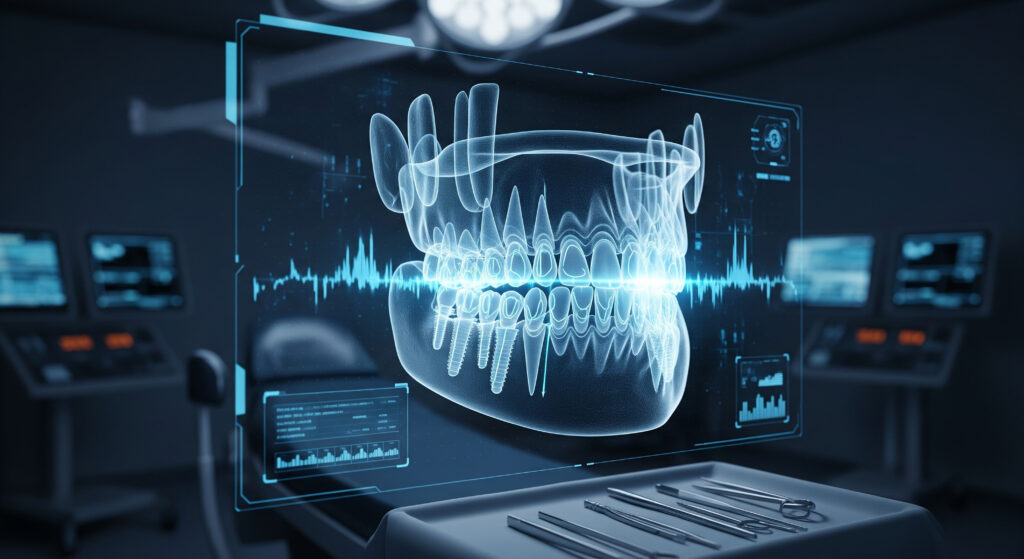
Illustration of AI-assisted analysis. Final diagnosis is always made by the dentist after a clinical examination.
AI image analysis
See how AI reads your scan before the doctor decides
Every panoramic X-ray, CBCT scan and smile photo you send is analysed by AI first. It maps bone, nerves, roots and soft tissue, flags areas that need attention and prepares measurements. Dr. Abdurrahman Öztürk then reviews every finding and makes the clinical decision.
What Corrective Jaw Surgery Treats and When Braces Alone Are Not Enough
Corrective jaw surgery, also called orthognathic surgery, changes the position of the jaw bones themselves rather than only moving teeth. It is recommended when the upper and lower jaws are significantly out of proportion, so that a stable, comfortable bite cannot be reached with orthodontics alone. Typical examples are a pronounced underbite where the lower jaw sits far forward, a deep retruded lower jaw, a long or short face, a gap between front teeth that never meet, or a visibly asymmetric jaw.
The decision is skeletal, not cosmetic. When the discrepancy is mild, teeth can often be tilted to compensate and the bite works well. When it is larger, compensating the teeth would push them beyond what the bone and gums can support, and the result tends to be unstable or unattractive. AI analysis of the CBCT scan helps quantify how much of the problem lies in the bone and how much lies in tooth position, which is the starting point for choosing between camouflage orthodontics and surgery.
- Skeletal underbite (Class III) or retruded lower jaw (Class II)
- Anterior open bite where front teeth cannot touch
- Facial and jaw asymmetry from uneven growth
- Excessive gum display linked to a long upper jaw
- Selected cases of obstructive sleep apnea related to jaw position
- Chewing, speech or lip-closure problems caused by jaw imbalance
The Main Orthognathic Procedures Planned with AI
Most orthognathic surgery is built from a small number of well-established operations, used alone or combined. The cuts are made inside the mouth in nearly all cases, so there are usually no visible scars on the face. Small titanium plates and screws hold the bone in its new position while it heals. Which combination you need depends on where the discrepancy sits, and the AI-assisted 3D plan is used to compare these options side by side before one is chosen.
Le Fort I osteotomy (upper jaw)
The upper jaw is separated above the tooth roots and can be moved forward, raised, lowered, rotated or, in some cases, widened. It is used for a retruded midface, excessive or insufficient tooth display and many open bites. The AI model helps measure the safe distance from the roots and the sinus floor.
Bilateral sagittal split osteotomy, BSSO (lower jaw)
The back of the lower jaw is split lengthwise on both sides so the tooth-bearing part can be advanced or set back. Because the inferior alveolar nerve runs inside this bone, AI segmentation of the nerve canal is particularly valuable for planning the split.
Genioplasty (chin)
The lower border of the chin bone is repositioned forward, backward, up, down or sideways to refine facial balance. It may be combined with jaw surgery or, in selected cases, performed alone when the bite is already correct.
Bimaxillary (double jaw) surgery
When both jaws contribute to the problem, the upper and lower jaws are moved in the same operation. Virtual planning is especially helpful here because the order of movements and the intermediate splint must be designed precisely.
Why AI Virtual Surgical Planning Changes Orthognathic Surgery
Traditionally, jaw surgery was planned with plaster models mounted on an articulator and two-dimensional X-ray tracings. These methods work, but they cannot show the full three-dimensional relationship between the jaws, the skull base, the joints and the nerves. Small errors in transferring a plaster plan to the patient can affect the final position of the jaw.
With AI-assisted virtual surgical planning, your actual anatomy becomes the planning surface. AI tools speed up segmentation of bone and teeth, identify landmarks consistently and flag asymmetries that are hard to see by eye. The surgeon can then try several movements, check where bone segments would collide, see how the condyles sit in the joints and estimate airway changes. The final plan is converted directly into printed splints, so what was approved on screen is what guides the operation. AI never chooses the movement on its own; it gives Dr. Öztürk clearer information to make that decision.
- Full 3D view of jaw, joint and nerve anatomy
- Several surgical scenarios compared before choosing one
- Bone interferences detected on screen, not in theatre
- Splints printed directly from the approved digital plan
- Visual profile simulation to support an informed decision
The Orthodontic Phases Before and After Jaw Surgery
Corrective jaw surgery is almost always a team treatment between surgery and orthodontics. In the conventional sequence, braces or, in suitable cases, aligners are used before the operation to decompensate the teeth, meaning the teeth are moved back to a natural angle over their own bone. This can temporarily make the bite look worse, which is expected. This pre-surgical phase often takes many months and in many patients a year or more.
After surgery, a shorter orthodontic phase fine-tunes how the teeth meet in the new jaw position. In carefully selected cases a surgery-first approach can shorten the early orthodontic stage, but it is not suitable for everyone. AI tooth-movement prediction and digital models help coordinate both phases, so that the surgeon and the orthodontist work toward the same final bite. This page focuses on the surgical part; milder bite problems that may be solved without surgery are covered on our orthodontic pages.
Risks, Recovery and the Honest Limits of AI Jaw Surgery
Orthognathic surgery is a major operation performed under general anesthesia, usually followed by a short hospital stay. Swelling is significant in the first days and gradually settles over the following weeks, with residual swelling sometimes lasting longer. A soft or liquid diet is needed while the bone heals, and early bone healing usually takes around six weeks. Most people need time away from work or study in the first weeks.
Possible risks include bleeding, infection, temporary or, less commonly, long-lasting numbness of the lower lip, chin or upper gums, changes in the jaw joints, the need to remove plates later, and relapse, meaning some movement back toward the original position. AI planning improves preparation and helps avoid structures such as the nerve canal, but it cannot remove biological risk or predict exactly how each person's soft tissues will heal. The facial simulation is a guide for discussion. Dr. Öztürk will explain which risks apply to your specific plan before you agree to anything.
- Swelling and bruising peak in the first few days
- Numbness is common at first and often improves over months
- Final facial appearance settles over several months
- Regular follow-up is essential to protect stability
Planning AI Orthognathic Surgery in Istanbul from Abroad
Many of our jaw surgery patients travel to Istanbul from other countries, so the process starts remotely. You can send facial photos from the front and side, smile and bite photos and any existing X-rays or CBCT scans on WhatsApp. An AI-assisted first review and Dr. Öztürk's opinion will tell you whether surgery is likely to be considered and what records are still needed.
Because orthognathic treatment includes an orthodontic phase that can last many months, international patients often have orthodontic treatment coordinated with an orthodontist near home, with digital records shared between both teams. The surgical trip itself is planned around the operation, the hospital stay and the early follow-up visits. Your exact length of stay is set after the clinical examination and depends on the procedure, healing and flight safety, and it is always confirmed with you in advance.
Conventional vs AI-assisted
Conventional planning versus AI-assisted planning for jaw surgery
Who it suits
Who may be a candidate for AI corrective jaw surgery?
- Adults whose facial growth is complete, usually from the late teens or early twenties
- People with a moderate to severe skeletal underbite, overbite or open bite
- Patients with visible jaw or chin asymmetry
- Those whose bite problem cannot be stably corrected with orthodontics alone
- Selected patients with sleep apnea where jaw position contributes to airway narrowing
- People in good general health, willing to complete the orthodontic phases and follow-up
Your treatment journey
Your AI corrective jaw surgery journey
Before travel
Online photo and X-ray review
Send facial photos and any scans on WhatsApp for an AI-assisted first look and Dr. Öztürk's initial opinion.
Assessment
Examination and 3D records
Clinical examination, CBCT scan, intraoral scan and photographs, plus coordination with your orthodontist.
Pre-surgical phase
Orthodontic decompensation
Teeth are aligned over the bone so the jaws can be moved into a good bite. This phase usually lasts many months.
Planning
AI virtual surgery
Updated scans are used for the virtual operation, the plan is approved and splints are 3D printed.
Surgery
Operation and hospital stay
Surgery under general anesthesia, followed by a short hospital stay and close early follow-up in Istanbul.
After surgery
Healing and finishing
Soft diet, check-ups and a final orthodontic phase to settle the bite in its new position.
Why patients choose it
A plan you can see
You review your own 3D jaw model and the planned movements before surgery, so the goals are clear.
Careful nerve planning
AI-traced nerve canals help the surgeon design the lower jaw split with the nerve's path in mind.
Precise splint transfer
Printed splints carry the approved digital plan into the operating room without manual model steps.
Function and balance together
Bite, airway and facial proportions are assessed in the same plan rather than separately.
Remote first step
International patients can start with photos and existing scans on WhatsApp before booking travel.
Surgeon-led decisions
AI prepares the data, but every movement and every clinical step is decided by Dr. Öztürk.
Your doctor
Every AI jaw surgery plan is led by Dr. Abdurrahman Öztürk
Corrective jaw surgery at AIDENT is supervised by Dr. Abdurrahman Öztürk, who holds a PhD in dentistry and oral and maxillofacial surgery and has more than 15 years of experience in dentistry and dental surgery. He graduated from a leading Istanbul university. Dr. Öztürk reviews every AI segmentation and every virtual osteotomy himself, decides on the bone movements, approves the printed splints and works with the orthodontic team throughout. AI gives him faster, clearer three-dimensional information, but the diagnosis, the surgical plan and the responsibility for your care always remain with him.
Aftercare
Aftercare following corrective jaw surgery
- Use cold packs and keep your head elevated in the first days to help control swelling
- Follow the liquid and then soft diet exactly as instructed until the surgeon allows chewing
- Keep the mouth clean with gentle brushing and the prescribed rinses around the incisions
- Take medication as prescribed and do not smoke, as smoking slows bone healing
- Avoid contact sports and any pressure on the jaw until healing is confirmed
- Attend every follow-up, including remote photo check-ins once you return home
- Wear elastics or retainers exactly as your orthodontist and surgeon advise
Related AI treatments
Questions and answers
What patients ask about AI Corrective Jaw Surgery
How long does corrective jaw surgery take?
The operation itself usually takes a few hours, depending on whether one jaw, both jaws or the chin are treated. Double jaw surgery generally takes longer than single jaw surgery. Because the AI virtual plan and printed splints are prepared in advance, much of the decision-making is completed before you reach the operating room, and the surgeon can focus on executing the approved plan.
Is jaw surgery painful?
Jaw surgery is done under general anesthesia, so you feel nothing during the operation. Afterwards, most people describe swelling, pressure and stiffness more than sharp pain, and this is managed with prescribed medication. Numbness of the lips or chin is common at first and can actually reduce the sensation of discomfort. The first several days are usually the most demanding, and comfort improves steadily after that.
How long do I need to stay in Istanbul for jaw surgery?
Most patients plan a stay of around two to three weeks for the surgical trip, but the exact time is set individually. It includes the pre-operative checks, the operation, a short hospital stay and early follow-up visits until Dr. Öztürk confirms it is safe to fly. The orthodontic phases before and after surgery happen over a longer period and are often coordinated with an orthodontist near your home.
How does AI help plan orthognathic surgery?
AI helps by turning your CBCT scan into a detailed 3D model quickly and consistently. It separates the jaws, teeth and nerve canals, locates measurement landmarks and supports virtual surgery, where the bone cuts and movements are tested on screen. The surgeon reviews and corrects every step, approves the final plan and uses it to print the splints that guide the real operation.
Will I have scars on my face after jaw surgery?
In most cases there are no visible facial scars, because the bone cuts for Le Fort I, BSSO and genioplasty are made through incisions inside the mouth. Occasionally a very small skin puncture is needed to place a screw in the lower jaw, and it usually becomes hard to notice. Your surgeon will tell you in advance if your plan requires any external access.
Can I eat normally after orthognathic surgery?
Not immediately. You will start with liquids and move to a soft diet that does not require chewing while the bone heals, which usually takes around six weeks for early healing. Modern plates and screws mean the jaws are rarely wired shut, but chewing force must be avoided. Your surgeon will gradually allow firmer foods based on your healing and follow-up checks.
Is double jaw surgery more risky than single jaw surgery?
Double jaw surgery is a longer operation with more swelling, so the recovery is usually more demanding, but it is a routine, well-established procedure when properly indicated. The specific risks, such as numbness, bleeding or relapse, depend on the size and direction of the movements. Virtual planning helps sequence both jaws accurately, and Dr. Öztürk will explain how the risks apply to your case.
Can corrective jaw surgery fix sleep apnea?
It can help in selected patients whose obstructive sleep apnea is linked to a retruded jaw position. Advancing the upper and lower jaws can enlarge the airway behind the tongue and soft palate. It is not the right treatment for every person with sleep apnea, so a sleep study and medical assessment are needed. AI airway analysis on the CBCT supports, but does not replace, that evaluation.
Will my lips or chin stay numb after the lower jaw surgery?
Numbness of the lower lip and chin is common right after BSSO because the nerve runs through the bone being split. In many people sensation returns gradually over weeks to months. In some patients a degree of altered sensation can persist long term. Tracing the nerve canal in 3D with AI helps the surgeon plan the split carefully, but it cannot eliminate this risk completely.
How old do I need to be for jaw surgery?
Corrective jaw surgery is usually performed after facial growth has finished, which is commonly in the late teens for girls and somewhat later for boys, often around the early twenties. Operating before growth ends can lead to the problem returning. There is no strict upper age limit; healthy adults of many ages are treated, and the decision is based on health and growth assessment.
Do I need braces before corrective jaw surgery?
In most cases, yes. Braces or suitable aligners straighten and decompensate the teeth so that, once the jaws are moved, the upper and lower teeth fit together properly. This pre-surgical phase often takes many months. Some carefully selected patients can follow a surgery-first approach with orthodontics mainly afterwards, and your digital records will show whether that is a reasonable option for you.
Who is the best surgeon for AI jaw surgery in Istanbul?
The best choice is a qualified oral and maxillofacial surgeon who uses 3D virtual planning and explains your plan openly. At AIDENT, AI corrective jaw surgery is supervised by Dr. Abdurrahman Öztürk, who holds a PhD in oral and maxillofacial surgery and has more than 15 years of experience. He reviews every AI analysis personally and makes all clinical decisions.
Does AI really make jaw surgery more accurate?
AI mainly improves the planning stage. It speeds up 3D segmentation, makes measurements more consistent and supports virtual surgery and digitally printed splints, which reduce manual transfer steps. Accuracy in the operating room still depends on the surgeon's skill, the patient's anatomy and healing. AI is a tool that supports precision; it does not perform the operation or guarantee the result.
Can I see what my face might look like before deciding on surgery?
Yes, a soft-tissue simulation based on your 3D scan can show an estimated profile after the planned bone movements. It is useful for discussing goals and comparing options, such as whether a chin procedure is worth adding. Soft tissues heal differently in each person, so the simulation is not a promise. The final decision is made together with Dr. Öztürk after the clinical exam.
No question matches your search. Ask us directly on WhatsApp.
Find out if AI corrective jaw surgery is right for you
Send your front and side facial photos, bite photos and any X-rays or CBCT scans on WhatsApp at +90 534 445 9444. You will receive an AI-assisted first review and Dr. Abdurrahman Öztürk's opinion on your options in Istanbul.
Get my free AI jaw assessment on WhatsAppFree initial review of your photos and X-rays. Reply on WhatsApp.