AI-Planned Third Molar Surgery
AI Impacted Wisdom Teeth Removal in Istanbul
AI impacted wisdom teeth removal at AIDENT starts with an AI-analysed 3D scan that maps the tooth, its roots and the nerve beside it, so Dr. Abdurrahman Öztürk can plan the gentlest possible extraction before the first incision.
 Medically reviewed by Dr. Abdurrahman Öztürk, PhD, oral & maxillofacial surgery
The model shows a lower wisdom tooth tilted against the second molar, with its roots running close to the nerve canal inside the jaw, the exact relationship AI highlights before surgery.
Short answer
What is AI impacted wisdom teeth removal?
AI impacted wisdom teeth removal is a surgical extraction of a wisdom tooth that cannot erupt properly, planned with AI analysis of X-rays and CBCT scans. The software maps the tooth angle, root shape and nearby nerve or sinus, and Dr. Abdurrahman Öztürk uses that map to choose the safest technique and decide every step himself.
- Imaging
- Panoramic X-ray, CBCT when roots are near the nerve
- Anaesthesia
- Local, with sedation options
- Surgeon
- Dr. Abdurrahman Öztürk, 15+ years
- Typical stay
- About 5–7 days in Istanbul
AI
How AI Studies Your Wisdom Tooth Before Surgery
Every impacted wisdom tooth case at AIDENT passes through the same AI-assisted planning sequence. The software measures and highlights; Dr. Öztürk reviews each finding and makes the surgical decisions.
- 1
Photo and X-ray triage
You send photos and any existing panoramic X-ray on WhatsApp. AI flags the impacted teeth, their angle and visible problems such as decay on the neighbouring molar.
- 2
CBCT acquisition
If the roots appear to touch the mandibular canal or the sinus, a low-dose CBCT scan is taken in Istanbul to see the tooth in three dimensions.
- 3
AI segmentation
AI separates the wisdom tooth, the second molar, the bone and the inferior alveolar nerve canal into distinct 3D structures that can be rotated and measured.
- 4
Risk mapping
The software measures the distance between root tips and the nerve, shows root curvature and bone thickness, and highlights the zones that need extra care.
- 5
Technique simulation
Dr. Öztürk uses the 3D model to plan the access, whether the crown must be sectioned, and where bone removal can be kept to a minimum.
- 6
Post-op comparison
After healing, follow-up images can be compared with the original plan so the doctor can check the socket and the second molar.
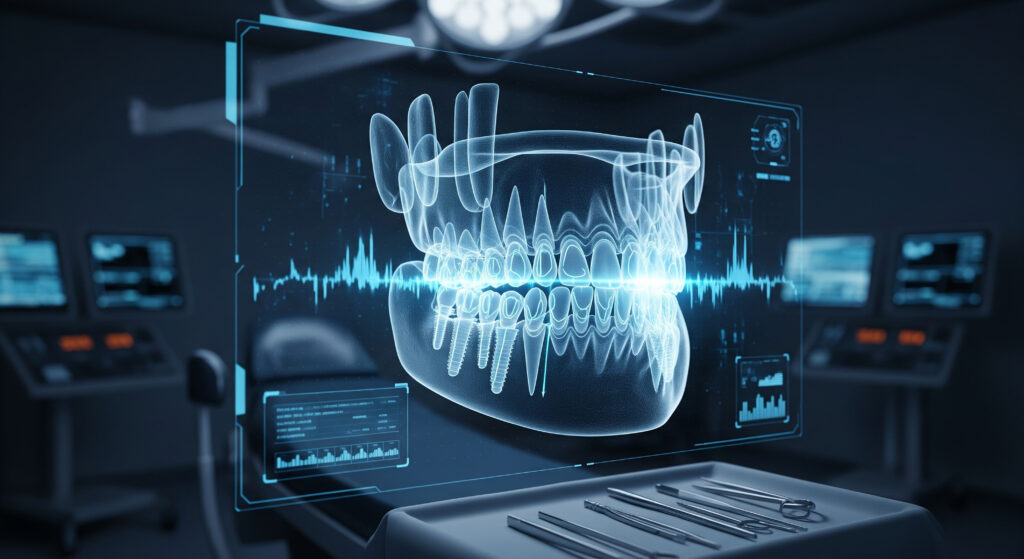
Illustration of AI-assisted analysis. Final diagnosis is always made by the dentist after a clinical examination.
AI image analysis
See how AI reads your scan before the doctor decides
Every panoramic X-ray, CBCT scan and smile photo you send is analysed by AI first. It maps bone, nerves, roots and soft tissue, flags areas that need attention and prepares measurements. Dr. Abdurrahman Öztürk then reviews every finding and makes the clinical decision.
Why Wisdom Teeth Become Impacted
Wisdom teeth, or third molars, are the last teeth to develop and usually try to erupt in the late teens or early twenties. By then the jaw often has little space left behind the second molars, so the tooth gets blocked by bone, gum or the neighbouring tooth. When it cannot reach its normal position, dentists call it impacted. Some impacted teeth stay quiet for years, while others trap food under a flap of gum, push against the second molar or slowly develop a cyst around the crown.
Impaction is described by the direction the tooth is tilted and how deeply it sits. A tooth can be mesioangular, leaning forward into the second molar, which is the most common pattern in the lower jaw. It can be horizontal, lying on its side, vertical but stuck below the gum, or distoangular, leaning back towards the jaw angle. A partially erupted tooth shows a little through the gum; a fully bony impaction is completely covered. Each pattern needs a different surgical approach, which is why precise 3D information matters.
Soft tissue versus bony impaction
In a soft tissue impaction the crown is covered mainly by gum, and removal is usually simpler. In a bony impaction the tooth is partly or fully encased in bone, so some bone must be gently removed or the tooth divided into pieces.
Upper versus lower wisdom teeth
Upper wisdom teeth are often easier to remove but can sit close to the maxillary sinus. Lower wisdom teeth are surrounded by denser bone and may lie near the nerve that gives feeling to the lip and chin.
Signs Your Impacted Wisdom Tooth Needs Removal
Not every wisdom tooth has to come out. A fully erupted, cleanable tooth in good position may simply be monitored. Removal is usually recommended when an impacted tooth causes repeated problems or is likely to damage the teeth and bone around it. Our AI analysis helps document these findings clearly, and Dr. Öztürk explains whether surgery is advisable or whether watchful monitoring is a reasonable option for you.
Many patients first notice discomfort at the back of the jaw that comes and goes, or swelling of the gum over a half-erupted tooth after eating. Others have no symptoms at all and learn about the impaction from a routine X-ray. Both situations deserve a careful look, because silent problems such as decay on the back of the second molar can progress without pain.
- Recurring pericoronitis: painful, swollen gum around a partially erupted tooth
- Decay in the wisdom tooth or on the back surface of the second molar
- Pressure or resorption damaging the root of the neighbouring molar
- A cyst or enlarged follicle around the crown seen on X-ray
- Food trapping and bad taste that cleaning cannot control
- Planned orthodontic or jaw treatment where the tooth would interfere
AI CBCT Nerve Mapping for Lower Wisdom Teeth
The most important structure near a lower wisdom tooth is the inferior alveolar nerve, which runs through a canal inside the jaw and provides sensation to the lower lip, chin and teeth on that side. On a flat panoramic X-ray the roots and the canal can appear to overlap even when they are actually separated, or they can look apart when they touch. A CBCT scan shows the true three-dimensional relationship.
At AIDENT, AI software traces the nerve canal through the CBCT slices and segments the roots of the wisdom tooth, so their relationship can be viewed from any angle. Dr. Öztürk checks the tracing slice by slice, because AI can misread a canal in unusual anatomy. If the roots wrap around the nerve or press into the canal, the plan may change to a more conservative technique, such as removing only the crown and leaving the roots in place, known as coronectomy, when that is clinically appropriate.
When a CBCT is not needed
If the panoramic X-ray clearly shows the roots well away from the canal, a CBCT may not add useful information. The doctor decides case by case, keeping radiation exposure as low as reasonably possible.
Upper teeth and the sinus
For upper wisdom teeth the same 3D analysis shows how thin the bone is between the roots and the maxillary sinus, so the surgeon can anticipate and manage a possible small sinus opening.
The Surgical Procedure Step by Step
On the day of surgery the area is numbed with local anaesthesia, and many anxious patients choose additional sedation so they feel relaxed and remember little of the procedure. Once the area is fully numb, Dr. Öztürk makes a small gum incision when the tooth is not visible, gently lifts the gum and, if needed, removes a minimal amount of bone around the crown using the access planned on the 3D model.
Impacted teeth are often divided into two or more sections so each piece can be lifted out along its natural path rather than forced, which protects the bone and the neighbouring molar. The socket is then cleaned, rinsed and checked, and the gum is closed with a few stitches. A simple soft tissue impaction may take well under half an hour, while a deep horizontal tooth can take longer. You rest briefly before leaving with written aftercare instructions and prescribed medication.
- Local anaesthesia, with optional sedation for anxious patients
- Small incision and minimal bone removal guided by the 3D plan
- Sectioning the tooth to reduce force on bone and nerve
- Thorough socket cleaning and stitches to support healing
Recovery After Wisdom Tooth Surgery
Swelling, stiffness of the jaw and some discomfort are normal after impacted wisdom tooth removal. Swelling usually builds over the first two to three days and then gradually settles, and bruising on the cheek can appear in some people. Prescribed or recommended pain relief generally keeps discomfort manageable. Most patients return to desk work and normal daily routines within a few days, although the socket itself continues to heal over the following weeks.
Honest information about complications matters. The most common is dry socket, when the blood clot is lost and the bone becomes painful several days after surgery; it is treatable but uncomfortable. Infection, bleeding and limited mouth opening can also occur. Less commonly, the nerve near a lower wisdom tooth can be bruised, causing numbness or tingling of the lip or chin, which is usually temporary but in rare cases can be long-lasting. AI mapping helps reduce such risks; it cannot remove them entirely.
Why we check you before you fly
International patients have a review visit before returning home so Dr. Öztürk can examine the sockets, remove stitches if needed and confirm you are healing as expected.
Planning Impacted Wisdom Teeth Removal in Istanbul
Many patients travel to Istanbul for wisdom teeth removal and combine it with other dental care. The process begins remotely: you send photos and any X-ray you already have on WhatsApp, and Dr. Öztürk gives a preliminary AI-assisted opinion on how many teeth are impacted, how complex they look and whether a CBCT will be needed. The final plan is always confirmed after the clinical examination in Istanbul.
Whether to remove one, two or all four wisdom teeth in one session depends on their difficulty, your general health and your preference. Treating both sides on the same day means one recovery period, but chewing is harder for a few days, so some patients prefer one side per visit. We plan a stay that leaves time for the surgery, the first healing days and a final check, and we can advise on soft-food options and comfortable accommodation near the clinic.
Conventional vs AI-assisted
Conventional vs AI-Assisted Wisdom Tooth Removal
Who it suits
Who Is a Good Candidate for AI Wisdom Teeth Removal?
- Adults with an impacted or partially erupted wisdom tooth causing pain or swelling
- Patients with repeated gum infections around a lower wisdom tooth
- People whose X-ray shows decay or damage on the second molar
- Patients whose wisdom tooth roots appear close to the nerve or sinus
- Orthodontic or implant patients who need the tooth removed first
- Anxious patients who want a clear 3D explanation and sedation options
Your treatment journey
Typical Timeline for Impacted Wisdom Teeth Removal
Before travel
WhatsApp assessment
Send photos and X-rays for an AI-assisted preliminary review and a suggested length of stay.
Day 1
Exam and 3D imaging
Clinical examination, panoramic X-ray or CBCT, AI nerve mapping and a personal explanation of the plan.
Day 1–2
Surgery
Removal under local anaesthesia, with sedation if chosen; you go home the same day with instructions.
Days 2–4
Early healing
Rest, cold compresses and soft food; swelling usually peaks and then begins to settle.
Around day 5–7
Review before flying
Dr. Öztürk checks the sockets and removes stitches if needed before you return home.
Why patients choose it
Clear view of the nerve
AI-traced 3D imaging shows how close the roots are to the nerve, so risks are understood before surgery.
Gentler technique
Planning the access and sectioning in advance helps keep bone removal and surgical time to what is needed.
Honest risk discussion
You see your own anatomy and hear plainly what the possible complications are for your specific tooth.
Alternatives considered
When the nerve is at high risk, options such as coronectomy or monitoring are discussed rather than ignored.
Comfort options
Local anaesthesia with sedation choices helps anxious patients get through surgery calmly.
Experienced surgeon
Every extraction is performed or directly supervised by Dr. Abdurrahman Öztürk, an oral and maxillofacial surgery PhD.
Your doctor
Dr. Abdurrahman Öztürk Supervises Every AI-Planned Extraction
Impacted wisdom teeth at AIDENT are removed by Dr. Abdurrahman Öztürk, who holds a PhD in dentistry and oral and maxillofacial surgery and brings more than 15 years of experience in dentistry and dental surgery. A graduate of a leading Istanbul university, he personally reviews every AI analysis of your X-ray and CBCT, checks the nerve tracing and decides the surgical technique. AI gives him precise measurements and a 3D view of your anatomy, but it never makes a clinical decision. If he believes surgery is not in your interest, he will tell you, and he remains your contact throughout recovery.
Aftercare
Aftercare Instructions Following Wisdom Tooth Extraction
- Bite on the gauze for the time advised and avoid spitting or rinsing hard on the first day
- Use cold compresses on the cheek during the first 24–48 hours to limit swelling
- Eat soft, lukewarm food and chew on the other side for the first days
- Do not smoke or drink through a straw, as suction can dislodge the clot
- Begin gentle salt-water rinses from the day after surgery, or as instructed
- Take medication exactly as prescribed and keep your head raised when resting
- Contact us on WhatsApp if pain worsens after day three, or if bleeding or fever appears
Related AI treatments
Questions and answers
What patients ask about AI Wisdom Teeth Removal
How long does impacted wisdom tooth removal take?
Most impacted wisdom teeth are removed in roughly 20 to 60 minutes per tooth. A tooth covered only by gum is usually quick, while a deep horizontal tooth in bone takes longer because it must be sectioned carefully. Preparation, numbing and recovery time at the clinic add to the total, so plan for a few hours on the day of surgery.
Is wisdom tooth surgery painful?
You should not feel pain during the surgery because the area is fully numbed, although you may feel pressure. Afterwards there is usually soreness and swelling for several days, which is generally controlled with prescribed or recommended pain relief. Discomfort that increases after the third day can signal dry socket, so let us know straight away.
How does AI help with wisdom teeth removal?
AI helps by analysing your X-ray and CBCT to show the tooth angle, root shape and the distance to the nerve or sinus in 3D. This lets Dr. Öztürk plan the access, decide whether to section the tooth and explain your specific risks before surgery. AI does not operate; the surgeon performs and decides everything.
Can AI tell if my wisdom tooth roots touch the nerve?
AI can trace the nerve canal on a CBCT scan and measure how close the roots are, which gives a much clearer picture than a flat X-ray. The tracing is then checked by Dr. Öztürk slice by slice, because unusual anatomy can confuse software. The combination gives a reliable basis for choosing the safest technique.
How many days do I need to stay in Istanbul for wisdom teeth removal?
About five to seven days is a comfortable plan for most patients. That allows a day for examination and imaging, the surgery itself, the first days of swelling and a review before you fly. Very simple extractions may need less time, and complex cases or combined treatments may need longer; we suggest a stay after your WhatsApp assessment.
Can I have all four wisdom teeth removed at once?
Yes, all four can often be removed in one session, especially with sedation, and that means only one recovery period. However, eating is harder when both sides are sore, and very deep teeth may be better treated separately. Dr. Öztürk weighs the difficulty of each tooth and your preference before recommending one or two sessions.
Will I be asleep during wisdom tooth removal?
Most patients are awake but completely numb under local anaesthesia, and many choose sedation so they feel relaxed and drowsy. Sedation options are discussed during your consultation based on your health and anxiety level. Whatever you choose, your comfort and safety are monitored throughout the procedure.
When can I fly home after wisdom teeth surgery?
Many patients fly home after their review visit, typically around five to seven days after surgery, once Dr. Öztürk has confirmed normal healing. Flying sooner is sometimes possible for simple extractions, but staying for the check reduces the chance of an unmanaged complication. Upper teeth near the sinus may need specific advice about pressure changes.
What is coronectomy and when is it used?
Coronectomy means removing the crown of a wisdom tooth while deliberately leaving the roots in the bone. It may be considered when 3D imaging shows the roots closely entwined with the nerve and full removal would carry a higher risk of numbness. It is only suitable in selected cases, and the doctor explains its pros and cons.
Should I remove a wisdom tooth that does not hurt?
Not always. A painless impacted tooth may still need removal if X-rays show decay, damage to the second molar or a cyst. If it is healthy, deeply covered and causing no harm, monitoring with periodic X-rays can be reasonable. AI analysis helps document the situation, and Dr. Öztürk gives an honest recommendation.
What can I eat after impacted wisdom tooth removal?
Eat soft, lukewarm foods such as yoghurt, soups that are not hot, mashed potatoes, eggs and smoothies taken with a spoon. Avoid crunchy, spicy and very hot foods and anything with small seeds for the first days. You can gradually return to normal food as swelling settles, usually within about a week.
Who is the best dentist for AI wisdom teeth removal in Istanbul?
Choose a surgeon with oral and maxillofacial surgery training who uses 3D imaging for difficult teeth. At AIDENT, Dr. Abdurrahman Öztürk, a PhD in oral and maxillofacial surgery with 15+ years of experience, reviews every AI-analysed scan and performs the surgery. You can send your X-ray on WhatsApp for a free preliminary assessment.
Can I send my X-ray before coming to Turkey?
Yes, and we encourage it. Send a panoramic X-ray or CBCT, plus photos if you have symptoms, on WhatsApp to +90 534 445 9444. Dr. Öztürk reviews the AI-assisted analysis and tells you how complex the extraction looks and how long to plan your stay. A final decision is made after examining you in Istanbul.
No question matches your search. Ask us directly on WhatsApp.
Find Out How Complex Your Wisdom Tooth Is
Send your X-ray or a photo on WhatsApp and Dr. Abdurrahman Öztürk will review an AI-assisted analysis of your impacted wisdom tooth, explain your options honestly and suggest how long to stay in Istanbul.
Get my free AI wisdom tooth assessmentFree initial review of your photos and X-rays. Reply on WhatsApp.