AI-Planned Full Mouth Rehabilitation
AI Full Mouth Rehabilitation in Istanbul: Rebuilding Your Whole Bite, Not Just Your Teeth
AI full mouth rehabilitation at AIDENT rebuilds worn, broken, decayed and missing teeth as one coordinated system, with your bite, gums, joints and smile planned together in a single digital model. Artificial intelligence analyzes your scans and simulates the outcome; Dr. Abdurrahman Öztürk confirms every decision.
 Medically reviewed by Dr. Abdurrahman Öztürk, PhD, oral & maxillofacial surgery
The model shows both arches with the planned restorations in place, the worn zones AI detected, and how upper and lower teeth meet at the new bite height.
Short answer
What is AI full mouth rehabilitation?
AI full mouth rehabilitation is the rebuilding of most or all teeth in both jaws through a combined plan of crowns, root canals, gum care, implants or bridges, designed around a corrected bite. AI analyzes X-rays, CBCT and 3D scans, measures wear and simulates the result, while the dentist confirms every clinical step.
- Scope
- Upper and lower jaws as one system
- Typical phases
- Health, stabilize, test, finalize
- Planning data
- CBCT, intraoral scan, photos, bite record
- Supervision
- Dr. Abdurrahman Öztürk, 15+ years
AI
How AI Builds Your Full Mouth Rehabilitation Plan
A full mouth case involves dozens of decisions that affect each other. AI helps organize them into one plan, and the doctor checks and approves each stage before anything is done in your mouth.
- 1
Whole-mouth data capture
We take a panoramic X-ray or CBCT, a full intraoral 3D scan of both arches, facial and smile photos, and a digital record of how your jaws close.
- 2
AI tooth-by-tooth charting
AI software flags decay, old fillings, failing crowns, bone loss around roots and possible infections on the images, producing a draft chart that Dr. Öztürk reviews tooth by tooth.
- 3
Wear and bite analysis
The 3D scans are analyzed to map worn surfaces, lost tooth height and uneven contacts, helping explain why teeth are breaking and how much height the bite may have lost.
- 4
Prognosis per tooth
Each tooth is sorted into keep, treat and protect, or replace, based on the AI findings and the clinical exam, so the plan saves every tooth that can reasonably be saved.
- 5
Digital mock-up of the new bite
A virtual set of restored teeth is designed at the proposed bite height and shown on your face, so you can see the simulated result and discuss changes before treatment.
- 6
Phased roadmap
The approved design is turned into an ordered sequence of appointments, from urgent care through temporary teeth to final restorations, timed around your trips to Istanbul.
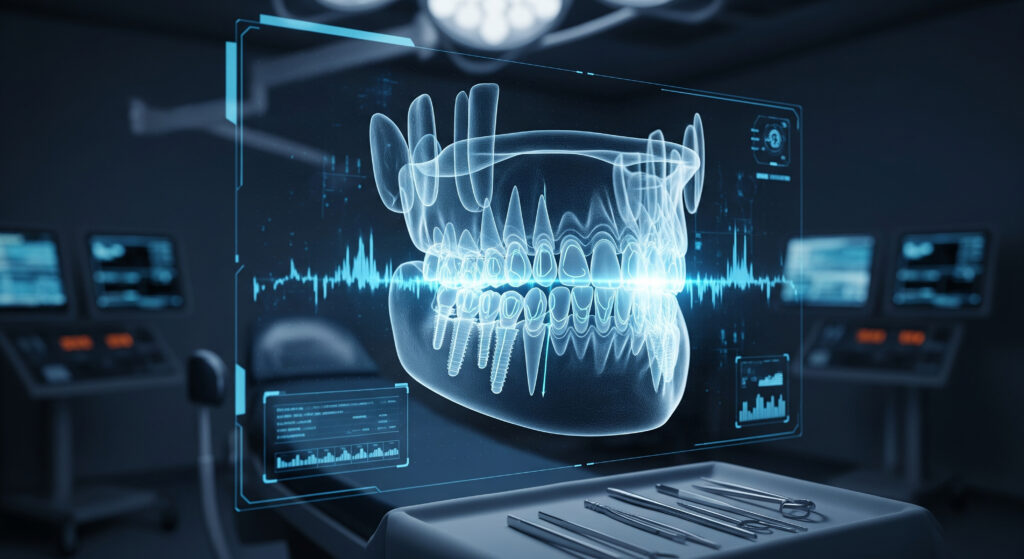
Illustration of AI-assisted analysis. Final diagnosis is always made by the dentist after a clinical examination.
AI image analysis
See how AI reads your scan before the doctor decides
Every panoramic X-ray, CBCT scan and smile photo you send is analysed by AI first. It maps bone, nerves, roots and soft tissue, flags areas that need attention and prepares measurements. Dr. Abdurrahman Öztürk then reviews every finding and makes the clinical decision.
What AI Full Mouth Rehabilitation Actually Involves
Full mouth rehabilitation, sometimes called full mouth reconstruction, is not a single procedure. It is a coordinated treatment plan for a mouth in which many teeth are damaged at the same time, often for connected reasons. A patient may have teeth worn flat by grinding, several old crowns that have failed, a few infected roots, some missing teeth and gums that bleed. Fixing one tooth at a time in that situation usually leads to repeated breakage, because the underlying bite problem stays the same.
In an AI full mouth rehabilitation at AIDENT, we look at the whole system first: teeth, gums, bone, jaw joints, chewing muscles and the way your face and smile look. AI tools help us read the scans in detail and simulate the end result, and Dr. Abdurrahman Öztürk uses that information to build one plan in which every crown, root canal, implant or bridge has a purpose within the new bite.
- Most often involves both upper and lower jaws
- Combines restorative, gum, endodontic and sometimes surgical or orthodontic care
- Designed around a stable, comfortable bite, not only around appearance
- Usually delivered in planned phases rather than all at once
Who Needs Full Mouth Rehabilitation with AI Planning
The patients who benefit most are those whose problems are spread across the mouth and interact with one another. The most common example is severe tooth wear. Long-term grinding or clenching, acid erosion from reflux or diet, and missing back teeth that force the front teeth to do the chewing can all shorten teeth until the face looks older and the bite feels collapsed.
Other typical situations include multiple failing restorations done at different times by different dentists, congenital conditions that affect enamel, and mouths where neglect over several years has left decay, infection and gaps together. In each of these, AI analysis is useful because it compares every tooth against the same data set and shows how one problem affects the next.
Worn teeth and a lost bite height
When teeth wear down, the distance between the jaws can reduce. Rebuilding that height carefully, and testing it before making it permanent, is often the core of the treatment.
Many failing old restorations
Leaking fillings, loose crowns and old bridges with decay underneath are replaced in a coordinated way, so the new restorations share one bite design.
Mixed decay, infection and missing teeth
Infections and active gum disease are treated first; the remaining teeth are then restored and gaps are filled with bridges, implants or dentures as appropriate.
Why the Bite Comes First: AI Occlusal Analysis
The word that defines a full mouth case is occlusion, meaning how your upper and lower teeth meet. If new crowns are placed on a bite that is unbalanced, they can chip, loosen or cause jaw discomfort. That is why AI full mouth rehabilitation starts with the bite, not with the shade of the teeth.
With a digital bite record and 3D scans, the software shows where teeth touch, where contacts are heavy and where surfaces have been ground away. Dr. Öztürk combines this with a clinical check of your jaw joints and chewing muscles, then decides the target bite position and height. AI can propose and measure; the decision on how far to change your bite is a clinical judgement made by the doctor, and it is always tested in temporary teeth before final restorations are made.
- Heavy and missing contacts highlighted on the 3D model
- Measured loss of tooth height in worn areas
- Jaw joint and muscle check before any bite change
- New bite height tested in temporaries, never assumed
Saving Teeth Where Possible: Root Canals, Gum Care and Build-Ups
A good full mouth plan keeps healthy and treatable natural teeth whenever that makes sense. AI-assisted reading of X-rays helps identify which roots have infection, which have enough bone support and which teeth have cracks or decay reaching close to the nerve. The doctor then confirms each finding with a clinical exam, because images alone can mislead.
Teeth that can be saved may need root canal treatment, a post and core build-up, or crown lengthening of the gum so there is enough tooth for a crown to grip. Gum inflammation is brought under control before final crowns are made, because crown edges placed on swollen gums do not seal well. Teeth with a poor long-term outlook are discussed openly, and replacing them is considered only when it gives you a more predictable result.
Endodontic care
Infected teeth that are worth keeping receive root canal treatment before being crowned, so the final restoration sits on a healthy foundation.
Periodontal preparation
Deep cleaning and, where needed, gum procedures stabilize the gums so restorations have healthy, stable margins.
Combining Crowns, Bridges, Implants and Dentures in One Design
Once the foundation is healthy, the restorative design brings different solutions together in one mouth. Natural teeth that are worn or weakened usually receive crowns or onlays; short gaps may be closed with bridges; teeth that cannot be saved may be replaced with implants; and in some cases a removable partial denture is the most sensible option for one arch. The aim is a single, harmonious bite rather than a collection of separate fixes.
AI design software makes this easier because every restoration is modelled in the same digital space. Tooth shapes, lengths and contacts are planned together, so a crown on a natural tooth and an implant crown beside it share the same guidance and the same smile line. Materials such as zirconia, lithium disilicate (E-max) or ceramic on metal frameworks are chosen per area according to strength, appearance and your habits, for example grinding.
Testing Your New Bite with AI-Designed Temporary Teeth
The most important safety step in full mouth rehabilitation is the trial phase. The approved digital design is turned into temporary restorations, usually milled or 3D printed, that you wear for a period decided by the doctor. During this time you check how you chew, speak, smile and feel in your jaw joints with the new tooth shapes and bite height.
If something feels wrong, such as speech changes, muscle tiredness or teeth that look too long, the temporaries are adjusted and the digital plan is updated. Only when the bite has proven comfortable and stable are the final restorations made from the refined design. This step takes time, but it is what protects the final work from surprises. AI previews are simulations; the temporaries are where the plan is confirmed in real life.
- Wear the proposed bite and smile before committing
- Adjust length, shape and height based on your feedback
- Final restorations copy the tested temporaries digitally
Risks, Limits and Honest Expectations
Full mouth rehabilitation is a major treatment and it has real limits. Crowned teeth can still develop decay at the edges, root-treated teeth can fracture, ceramic can chip, and implants depend on bone quality, general health and hygiene. Patients who grind their teeth need a night guard to protect the new work, and even then some maintenance over the years is normal. Changes to bite height need an adaptation period and are not suitable for every patient.
AI improves the consistency of diagnosis and design, but it does not remove biological risk and it does not replace clinical examination. Every AI finding is checked by Dr. Öztürk, and the final plan is only confirmed after he has examined you in person in Istanbul. We do not promise a guaranteed outcome or a fixed number of visits before that examination.
Conventional vs AI-assisted
Full Mouth Rehabilitation: Conventional vs AI-Assisted
Who it suits
You May Be a Candidate for AI Full Mouth Rehabilitation If
- Your teeth are worn short or flat from grinding, clenching or erosion
- Several crowns, bridges or large fillings are failing at the same time
- Your bite feels collapsed, or your lower face looks shorter than before
- You have a mix of decayed, broken and missing teeth in both jaws
- You have jaw or muscle discomfort linked to an uneven bite (after clinical assessment)
- You want one coordinated plan instead of years of separate repairs
Your treatment journey
A Typical AI Full Mouth Rehabilitation Journey
Before travel
Online AI pre-assessment
You send photos and any recent X-rays on WhatsApp. We give a preliminary view of what may be needed, clearly marked as provisional.
Visit 1, first days
Scans, exam and plan
CBCT, 3D scans, bite record and a full exam with Dr. Öztürk. The AI-assisted plan and smile simulation are reviewed with you and adjusted.
Visit 1, following days
Health phase
Urgent infections, root canals, gum treatment and extractions are done first; implants are placed if they are part of the plan.
Visit 1, end
Trial teeth
Teeth are prepared and AI-designed temporaries are fitted at the proposed bite height for you to test.
Visit 2
Final restorations
After the trial period and any healing time, final crowns and bridges are made from the refined design, fitted and the bite fine-tuned.
After treatment
Protection and follow-up
A night guard is made if needed, and check-ups are arranged in Istanbul or with photo reviews from home.
Why patients choose it
One plan for the whole mouth
All treatments are designed together, so new restorations support rather than fight each other.
Bite stability first
AI occlusal analysis and a trial phase help protect your new teeth from chipping and overload.
See it before you commit
A simulation of your restored smile, then temporaries in your mouth, let you give feedback early.
Natural teeth kept when sensible
Tooth-by-tooth prognosis aims to save teeth that have a reasonable long-term future.
Efficient for travelling patients
Digital planning groups appointments into fewer, well-organized trips to Istanbul.
Doctor-led decisions
AI supports analysis and design; Dr. Öztürk confirms every diagnosis and clinical step.
Your doctor
Every AI Full Mouth Plan Is Supervised by Dr. Abdurrahman Öztürk
Full mouth rehabilitation requires judgement that no software can provide alone. Dr. Abdurrahman Öztürk holds a PhD in dentistry and oral and maxillofacial surgery, graduated from a leading Istanbul university and has more than 15 years of experience in dentistry and dental surgery. At AIDENT he personally reviews every AI chart, wear map and smile simulation, examines your teeth, gums and jaw joints, and decides which teeth to keep, how to change the bite and in what order to treat. The AI speeds up analysis and design; the clinical decisions and responsibility remain with him.
Aftercare
Caring for Your Rehabilitated Mouth
- Wear your night guard every night if you grind or clench your teeth
- Brush twice daily and clean between teeth and under bridges with floss, interdental brushes or a water flosser
- Avoid biting ice, hard sweets, bones or opening packages with your teeth
- Report any change in bite, chipping or jaw discomfort early, with photos on WhatsApp
- Keep regular check-ups and professional cleanings, ideally every six months
- Manage reflux or acidic drinks if erosion was part of the original problem
Related AI treatments
Questions and answers
What patients ask about AI Full Mouth Rehabilitation
What is the difference between full mouth rehabilitation and getting new crowns?
Full mouth rehabilitation treats the whole system, while new crowns fix individual teeth. A rehabilitation plan looks at your bite, gums, roots and jaw joints together, often includes root canals, gum treatment, implants or bridges, and usually tests a new bite with temporary teeth before final crowns are made.
How long do I need to stay in Istanbul for full mouth rehabilitation?
Most patients need two trips, each typically lasting one to two weeks, but the exact plan depends on your case. The first visit covers scans, treatment of infections and gums and fitting trial teeth. The second visit, after testing and any healing, is for final restorations. Cases with implants need more healing time between visits.
Does AI really help with full mouth rehabilitation?
Yes, AI helps mainly with analysis, design and communication. It drafts a chart of problems on X-rays, maps wear and bite contacts on 3D scans and simulates your restored smile. It does not decide treatment. Dr. Öztürk checks every finding and makes all clinical decisions after examining you.
Is full mouth rehabilitation painful?
The treatment itself is done under local anaesthesia, so you should not feel pain during procedures. Afterwards, sensitivity, gum soreness or jaw tiredness for a few days is common and usually managed with simple painkillers. Surgical steps such as extractions or implants can cause swelling for several days.
Can my teeth worn down from grinding be rebuilt?
In many cases, yes. Worn teeth can often be rebuilt with crowns or onlays that restore their length, sometimes combined with a carefully tested increase in bite height. The cause of the wear, such as grinding or acid erosion, must also be managed, which usually means wearing a night guard afterwards.
Will my bite height be changed, and is that safe?
Bite height is changed only when the exam shows it has been lost and a change will help. AI measures the wear and simulates the new height, but Dr. Öztürk decides the amount after checking your jaw joints and muscles. You wear the new height in temporary teeth first, so it can be adjusted before anything is permanent.
Do I have to replace all my teeth in full mouth rehabilitation?
No, the aim is to keep every natural tooth that has a reasonable future. Healthy teeth may need nothing or only minor work, damaged teeth are restored, and only teeth that cannot be predictably saved are replaced with implants, bridges or dentures. Each tooth is assessed individually.
Can AI show me what my mouth will look like after rehabilitation?
Yes, a digital simulation of your restored smile can be shown on your own photos before treatment. It is a planning preview, not a guarantee. The real shape and length are then tested in temporary teeth, and the final restorations are made only after you and the doctor are satisfied with the trial.
What happens if I have jaw pain along with damaged teeth?
Jaw pain needs to be examined before any bite change is planned. Dr. Öztürk checks your jaw joints and chewing muscles and may recommend a splint or a period of observation first. A full mouth rehabilitation can address bite problems, but jaw pain has many causes and not all of them are solved by new teeth.
Which materials are used for full mouth rehabilitation at AIDENT?
Materials are chosen area by area. Zirconia is commonly used where strength is needed, especially for grinders and back teeth, while lithium disilicate (E-max) is often chosen for front teeth for its translucency. Implant restorations and partial dentures use materials suited to their design, discussed with you before treatment.
How long does a full mouth rehabilitation last?
Well-made restorations can last many years, but no dental work is permanent. Lifespan depends on your hygiene, grinding habits, gum health, diet and regular check-ups. Wearing a night guard and attending cleanings are the most important things you can do to protect the result over time.
Can I start my AI full mouth rehabilitation assessment online from abroad?
Yes. Send clear photos of your smile and teeth, a description of your concerns and any recent X-rays or CBCT to us on WhatsApp at +90 534 445 9444. We give a preliminary, AI-supported view of the likely treatment and trip plan. The final plan is confirmed only after an in-person exam in Istanbul.
Who is the best dentist for AI full mouth rehabilitation in Istanbul?
Look for a dentist with surgical and restorative experience who plans the whole bite and tests it before final work. At AIDENT, Dr. Abdurrahman Öztürk, with a PhD in dentistry and oral and maxillofacial surgery and 15+ years of experience, supervises every AI-planned full mouth case personally.
Is full mouth rehabilitation suitable if I have gum disease?
It can be, but gum disease must be treated and controlled first. Restorations placed on inflamed gums have poorer seals and a shorter life. After deep cleaning and any needed gum procedures, Dr. Öztürk reassesses which teeth have enough support before final crowns, bridges or implants are planned.
No question matches your search. Ask us directly on WhatsApp.
Start Your AI Full Mouth Rehabilitation Plan
Send us photos of your teeth and any recent X-rays on WhatsApp. We will review them with AI support and Dr. Öztürk will outline the likely phases and trips to Istanbul, so you know what to expect before you travel.
Get my free AI full mouth assessment on WhatsAppFree initial review of your photos and X-rays. Reply on WhatsApp.