AI-Assisted Fixed Restorations
AI Fixed Prosthodontics in Istanbul: Permanent Teeth Planned with Artificial Intelligence
AI fixed prosthodontics at AIDENT means every permanently fixed restoration, from a single onlay to an implant-supported bridge, is planned on AI-analyzed scans and digital bite data, then confirmed and delivered by Dr. Abdurrahman Öztürk.
 Medically reviewed by Dr. Abdurrahman Öztürk, PhD, oral & maxillofacial surgery
The 3D model compares a tooth-supported restoration with an implant-supported one. Both are fixed in place permanently, but they connect to the jaw in different ways and are planned differently.
Short answer
What is AI fixed prosthodontics?
AI fixed prosthodontics is the restoration of damaged or missing teeth with permanently attached replacements, such as onlays, crowns, bridges and implant-supported teeth, planned with artificial intelligence. AI reviews X-rays, 3D scans and bite records to support the design, while the dentist examines you, makes every clinical decision and fits the final restoration.
- Attachment
- Cemented, bonded or screwed; not removed by the patient
- Restoration types
- Onlays, crowns, bridges, implant teeth
- Typical trips
- 1 for tooth-borne work, 2 with implants
- Clinical lead
- Dr. Abdurrahman Öztürk, 15+ years
AI
How AI Supports a Fixed Prosthodontic Plan
Fixed work lasts only as long as the teeth, bone and bite that carry it. Our AI-assisted workflow is built to study those foundations before any tooth is touched, and every step ends with the doctor's review.
- 1
Photo and X-ray screening
AI software highlights possible decay, old fillings, bone levels and root-filled teeth on your images, so the doctor can review them quickly and thoroughly.
- 2
CBCT and root analysis
Where needed, a 3D CBCT scan is segmented to show root length, bone support and areas around the nerve or sinus that affect fixed or implant options.
- 3
Intraoral 3D scan
A digital scanner records the teeth and gums without traditional impression trays, creating an accurate model for design and occlusion checks.
- 4
Digital bite analysis
Bite records and jaw movements are studied on the computer to see where forces land, which matters for every fixed restoration and for patients who grind.
- 5
Restoration design and preview
CAD software, supported by AI tooth libraries, proposes shapes and shows a simulated result. It is a preview for discussion, not a guaranteed outcome.
- 6
Doctor's decision and fabrication
Dr. Öztürk adjusts and approves the design, chooses the attachment method, and the restoration is milled or printed, then fitted and checked in the mouth.
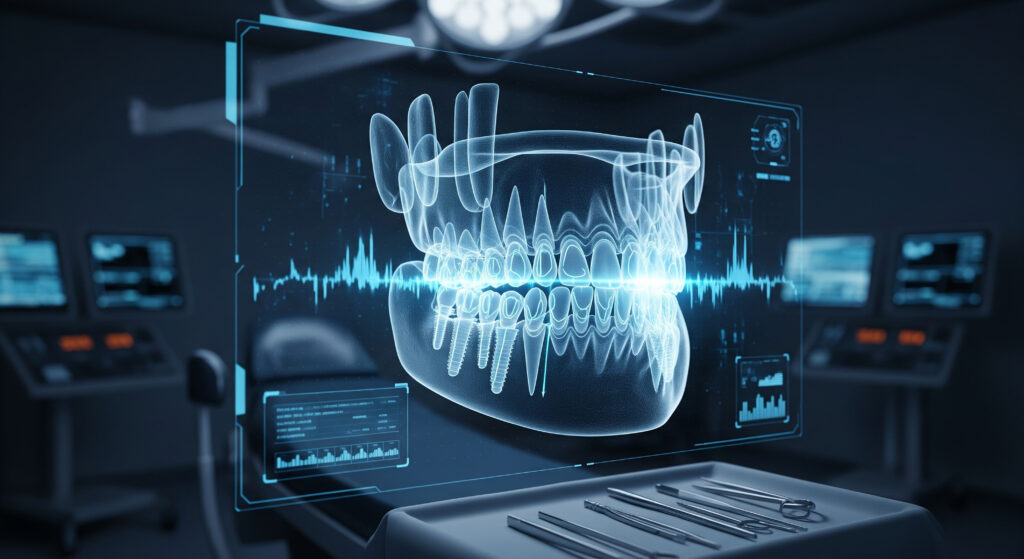
Illustration of AI-assisted analysis. Final diagnosis is always made by the dentist after a clinical examination.
AI image analysis
See how AI reads your scan before the doctor decides
Every panoramic X-ray, CBCT scan and smile photo you send is analysed by AI first. It maps bone, nerves, roots and soft tissue, flags areas that need attention and prepares measurements. Dr. Abdurrahman Öztürk then reviews every finding and makes the clinical decision.
What Fixed Prosthodontics Means, and Where AI Fits In
Prosthodontics is the branch of dentistry that restores and replaces teeth. The fixed part of it covers every restoration that stays in your mouth permanently: you do not take it out at night, clean it in a glass or clip it onto clasps. It is held by dental cement, by adhesive bonding to enamel and dentine, or by a small screw into a dental implant. Only a dentist can remove it.
That permanence is the main attraction, and also the reason planning has to be careful. A fixed restoration depends on the health of the teeth or implants underneath it and on how your jaws meet. At AIDENT, AI fixed prosthodontics means we use artificial intelligence to read your X-rays, CBCT scans, photographs and bite records in more detail before treatment. The software flags what it sees; Dr. Abdurrahman Öztürk interprets it, examines you in person and decides what is right.
- Partial coverage: inlays, onlays and overlays that rebuild part of a tooth
- Full coverage: crowns that cover the whole visible tooth
- Tooth replacement: fixed bridges anchored on neighbouring teeth
- Implant-supported: single implant crowns and fixed implant bridges
- Foundations: post and core build-ups for heavily broken, root-filled teeth
AI Assessment of Abutment Teeth and Foundations
In fixed prosthodontics, a tooth or implant that carries a restoration is called an abutment. Choosing good abutments is arguably the most important decision in the whole treatment, because even a perfectly made restoration fails if the root beneath it is weak, infected or cracked. This is where AI-assisted image analysis is genuinely useful.
On panoramic and periapical X-rays, AI tools can mark bone levels, existing root fillings, shadows suggestive of infection at the root tip and decay hidden under old fillings. On a CBCT scan, segmentation separates roots, bone and nerve canals in three dimensions. The doctor uses these findings, together with gum measurements and a clinical check, to judge whether each tooth can carry the load you will place on it.
Root length and bone support
A tooth with a short root or significant bone loss may not be a safe anchor for a bridge. In that case, the plan may change to an implant or a different design.
Root canal status
A badly treated or infected root canal is normally addressed before a fixed restoration is placed, since redoing it later through a new crown is harder.
Cracks and fractures
Some cracks are visible only clinically or with magnification. AI helps with images, but the doctor's examination remains essential.
Minimally Invasive Preparation Guided by Digital Design
Every tooth-supported fixed restoration needs some shaping of the tooth, but the amount should be no more than the material and the bite require. Modern fixed prosthodontics favours keeping healthy enamel wherever possible. If a back tooth has lost one or two cusps, an onlay that replaces only the missing part is often kinder to the tooth than a full crown.
Because the final restoration is designed digitally before preparation, the dentist can see how much space the chosen material needs and where reduction is necessary. Software can compare the planned outer shape with the existing tooth and show areas that need adjustment, which supports a more conservative preparation. Margins, the edges where restoration meets tooth, are placed where they can be cleaned and checked, ideally at or slightly above the gumline when aesthetics allow.
- Onlays and overlays can preserve more natural tooth than full crowns in suitable cases
- Digital design helps estimate the space each material needs
- Clean, well-defined margins reduce the risk of decay at the edge
- Temporary restorations protect prepared teeth while the final work is made
Bite Forces, Occlusion and AI Analysis
A fixed restoration lives in a demanding environment. Each time you chew, clench or grind, it absorbs force, and the way your upper and lower teeth meet decides where that force goes. Restorations that are slightly too high or that take heavy sideways contact can chip, loosen, or overload the tooth or implant underneath.
With digital scans and bite records, the planning software can display contact points and help the technician and doctor shape restorations so forces spread more evenly. For people who grind their teeth at night, the plan usually includes stronger material choices, careful contact design and a protective night guard. Final bite adjustment still happens in the chair, because the mouth always has the last word; AI shortens that process but does not replace it.
Cemented, Bonded or Screw-Retained: How Fixed Teeth Are Attached
How a restoration is attached is a clinical decision that depends on the material, the amount of tooth remaining and whether an implant is involved. The patient feels no difference day to day, since all three methods are fixed, but they behave differently over many years and when repairs are needed.
Dr. Öztürk selects the method for each restoration after reviewing the AI-supported plan and the condition of the tooth or implant at the time of fitting.
Conventional cementation
Used for many crowns and bridges on teeth with good retention shape. It is predictable and well established.
Adhesive bonding
Glass-ceramic onlays and thin restorations are bonded to the tooth, which allows a more conservative preparation but requires a dry, carefully controlled field.
Screw-retained implant restorations
Implant crowns and bridges can be screwed onto the implant, so they can be removed by the dentist for maintenance and leave no excess cement under the gum. Cement-retained implant crowns are also used when the implant angle or aesthetics favour them.
Fixed Prosthodontics for International Patients in Istanbul
Many patients who come to Istanbul for fixed work want to know whether their case can be completed in one trip. For restorations carried by natural teeth, such as onlays, crowns and bridges, the clinical work is usually organised within a single stay, because digital scanning and in-house design shorten the time between preparation and fitting. Exact days depend on the number of teeth, any root canal treatment needed first, and the bite adjustments required.
When implants are part of the plan, a second visit is normally needed after the bone has healed around the implant, a process that usually takes months. Before you travel, you can send photos and any recent X-rays on WhatsApp for an AI-supported first review. The doctor then gives an honest initial opinion, which is always confirmed or revised after a clinical examination in Istanbul.
Risks and Limits of Fixed Restorations
Fixed prosthodontics is reliable when it is well planned and well maintained, but no restoration lasts forever and no technology removes all risk. Being clear about the possible problems helps you protect your investment and recognise early warning signs.
AI improves the information available to the dentist; it does not change biology. The final plan is always a clinical judgement made after examination.
- Tooth sensitivity after preparation, which usually settles but occasionally needs root canal treatment
- New decay at restoration margins if cleaning is poor
- Chipping or fracture of ceramic, especially with grinding
- Loosening or debonding, which normally needs re-cementing rather than a new restoration
- Gum inflammation around margins or around implants, which needs professional care
- Shade or shape that looks slightly different from the digital preview, since previews are simulations
Conventional vs AI-assisted
Fixed Prosthodontics: Conventional vs AI-Assisted
Who it suits
Who Is a Good Candidate for AI Fixed Prosthodontics?
- People with large fillings or broken cusps who want a stronger, permanent repair
- Patients with root-filled back teeth that need protective coverage
- Adults missing one or a few teeth who prefer fixed teeth over a removable plate
- Implant patients ready for their permanent crown or fixed bridge
- People with old fixed work that is failing, leaking or no longer looks good
- Patients with healthy gums, or those willing to treat gum disease first
Your treatment journey
A Typical AI Fixed Prosthodontics Timeline
Before travel
Online AI review
Photos and existing X-rays shared on WhatsApp, reviewed with AI support and an initial opinion from the doctor.
Day 1
Examination and scans
Clinical exam, X-rays or CBCT, intraoral scan, bite records and a discussion of your options.
Day 2
Foundation work and preparation
Any required fillings or root treatment, conservative tooth preparation and temporary restorations.
Following days
Design and fabrication
The restoration is designed digitally, approved by the doctor and milled or printed.
Final days
Try-in, fitting and bite check
Fit, colour and contacts are checked, the restoration is fixed and the bite is fine-tuned before you fly.
Why patients choose it
Feels like your own teeth
Fixed restorations do not move when you speak or eat, and there is nothing to take out at night.
Better-informed planning
AI analysis of scans helps the doctor spot weak abutments and hidden problems before treatment begins.
More tooth preserved
Digital design supports conservative options such as onlays when a full crown is not needed.
Bite-aware design
Contact mapping helps restorations share chewing forces more evenly, which protects them over time.
Fewer days in the chair
Digital scanning and design shorten the gap between preparation and fitting for many cases.
Supervised at every step
Dr. Abdurrahman Öztürk reviews every AI finding and makes every clinical decision himself.
Your doctor
Fixed Prosthodontics Supervised by Dr. Abdurrahman Öztürk
Every AI fixed prosthodontics case at AIDENT is led by Dr. Abdurrahman Öztürk, who holds a PhD in dentistry and oral and maxillofacial surgery and has more than 15 years of experience in dentistry and dental surgery. He graduated from a leading Istanbul university. AI tools help him read X-rays, CBCT scans and bite data in more depth, but he personally examines each patient, decides which teeth or implants can safely carry a restoration, chooses the attachment method and approves every design before it is made. AI supports the process; the doctor decides.
Aftercare
Caring for Fixed Restorations
- Brush twice a day with a soft brush, paying attention to the gumline around restorations
- Clean under bridges and around implant teeth daily with floss threaders, super floss or interdental brushes
- Avoid biting very hard objects such as ice, nut shells or pen tops
- Wear a night guard if you grind or clench your teeth
- Report any looseness, sharp edges, bad taste or persistent sensitivity promptly
- Have regular check-ups and professional cleaning, at home or back in Istanbul
Related AI treatments
Questions and answers
What patients ask about AI Fixed Prosthodontics
What is fixed prosthodontics?
Fixed prosthodontics is the part of dentistry that repairs or replaces teeth with restorations that stay permanently in the mouth. It includes onlays, crowns, bridges and implant-supported teeth. They are cemented, bonded or screwed in place, so you never remove them yourself; only a dentist can take them off when maintenance is needed.
Is a fixed prosthesis better than a removable one?
For most people who are suitable, a fixed prosthesis feels more natural and stable than a removable one. It does not move while eating or speaking. However, it needs healthy supporting teeth or implants. When those are missing or weak, a removable option may still be the safer or more practical choice, which the doctor will explain.
Does AI design my fixed teeth, or does the dentist?
The dentist does. AI tools analyse your scans, highlight possible problems and help CAD software propose a shape, but Dr. Abdurrahman Öztürk reviews, adjusts and approves every design. He also decides which teeth are prepared, which material is used and how the restoration is attached.
Will my healthy teeth need to be filed down for fixed restorations?
Some shaping is usually needed, but we keep it as small as possible. A tooth-supported bridge requires preparing the neighbouring teeth, which is one reason an implant may be preferable when those teeth are healthy. For damaged teeth, an onlay can sometimes replace a full crown and preserve more natural structure.
What is an onlay, and when is it used instead of a crown?
An onlay is a fixed restoration that covers and replaces one or more cusps of a back tooth, rather than the whole tooth. It is used when a tooth has lost a significant part but still has strong walls remaining. Because less tooth is removed, it can be a more conservative choice than a full crown.
Can fixed teeth be placed on dental implants?
Yes. Implants can carry a single fixed crown or, with several implants, a fixed bridge. The implant must first integrate with the bone, which usually takes a few months. After that, a new scan is taken and the permanent implant restoration is designed and fitted, usually during a second visit to Istanbul.
Which is better for implant teeth, screw-retained or cemented?
Neither is better for every case. Screw-retained restorations can be removed by the dentist for maintenance and avoid leftover cement under the gum. Cement-retained ones can suit certain implant angles or aesthetic situations. The doctor chooses after reviewing the implant position on your scans.
Is preparation for fixed restorations painful?
No, the preparation is done under local anaesthesia, so you should feel pressure but not pain. Some teeth feel sensitive to cold for a few days or weeks afterwards. This usually fades, but if a nerve was already irritated, root canal treatment may occasionally be needed later.
How many days do I need in Istanbul for AI fixed prosthodontics?
For tooth-supported work, most patients complete treatment in one stay, typically about a week, depending on the number of teeth and whether root canal treatment is needed first. Cases involving implants usually need two trips separated by a healing period of a few months. Your exact schedule is given after the examination.
Can I have fixed restorations if I grind my teeth?
Usually yes, with precautions. Grinding increases the risk of chipping and loosening, so the plan may use stronger materials, careful bite design and a night guard to wear while sleeping. Severe untreated grinding is discussed openly, because it can shorten the life of any fixed work.
What should I do if a fixed restoration comes loose?
Keep it safe, avoid chewing on that side and contact a dentist promptly. In many cases a loose crown or bridge can be cleaned and re-cemented if the tooth underneath is healthy. Do not glue it back yourself with household adhesives, as this can damage the tooth and the restoration.
Does AI really make fixed restorations last longer?
AI cannot guarantee a longer life, but it can support better planning. By helping the doctor detect weak abutments, hidden decay and uneven bite forces before treatment, it reduces some avoidable causes of failure. Long-term success still depends on good preparation, accurate fitting and your daily cleaning and check-ups.
Can I start my fixed prosthodontics consultation online?
Yes. Send clear photos of your teeth and any recent X-rays or CBCT scans to our WhatsApp at +90 534 445 9444. The images are reviewed with AI support and by Dr. Öztürk, who gives a preliminary opinion. A final plan is only made after an in-person examination in Istanbul.
Who is the best dentist for AI fixed prosthodontics in Istanbul?
The right dentist is one who combines digital tools with surgical and restorative experience and examines you personally. At AIDENT, every fixed prosthodontics case is supervised by Dr. Abdurrahman Öztürk, who holds a PhD in dentistry and oral and maxillofacial surgery and has more than 15 years of experience.
No question matches your search. Ask us directly on WhatsApp.
Plan Your Fixed Teeth with AI and an Experienced Dentist
Send your photos and X-rays on WhatsApp. We will review them with AI support, and Dr. Abdurrahman Öztürk will tell you honestly which fixed options suit your teeth.
Get my free AI assessment on WhatsAppFree initial review of your photos and X-rays. Reply on WhatsApp.