AI-Assisted Dental Traumatology
AI Dental Trauma Treatment in Istanbul: Saving Injured Teeth with Precision
A fall, a sports collision or a bite on something hard can chip, crack, loosen or knock out a tooth in a second. At AIDENT Clinic, AI dental trauma treatment combines AI-analysed X-rays and CBCT scans with the hands-on judgement of Dr. Abdurrahman Öztürk to find hidden fractures quickly and give each injured tooth its best chance.
 Medically reviewed by Dr. Abdurrahman Öztürk, PhD, oral & maxillofacial surgery
The model shows an upper front tooth after an impact, with an AI-highlighted fracture line, the pulp chamber and the supporting socket bone. Viewing the injury in 3D helps explain why some fractures need only bonding while others need root treatment or splinting.
Short answer
What is AI dental trauma treatment?
AI dental trauma treatment is the emergency and follow-up care of chipped, cracked, displaced or knocked-out teeth, where AI software helps analyse X-rays, CBCT scans and photos to spot fractures, root damage and bone injury. The dentist uses these findings to plan repair, splinting or root treatment, and makes every clinical decision personally.
- Most urgent case
- Knocked-out adult tooth: act within minutes
- Imaging
- AI-analysed X-rays and CBCT
- Typical splint time
- About 2–4 weeks, injury-dependent
- Supervision
- Dr. Abdurrahman Öztürk, 15+ years
AI
How AI supports every step of trauma care
Dental injuries are often more complex than they look in the mirror. A crown can seem only slightly chipped while the root beneath it has cracked. Our AI-assisted workflow helps the team see the whole injury, and Dr. Öztürk turns those findings into a treatment decision.
- 1
Rapid triage
We record how the injury happened, how long ago, and where any lost tooth or fragment has been kept, because timing changes the treatment options.
- 2
AI image reading
Periapical X-rays and, where needed, a low-dose CBCT scan are processed with AI tools that highlight possible fracture lines, widened ligament spaces and displaced roots.
- 3
3D segmentation
AI segmentation separates the tooth, root, socket and surrounding bone in 3D, so subtle root or bone-wall fractures are easier to examine from every angle.
- 4
Clinical confirmation
Dr. Öztürk checks mobility, bite, soft tissues and pulp response, and compares them with the AI findings before choosing any treatment.
- 5
Digital treatment plan
Repositioning, splinting, fragment reattachment, bonding or root treatment is planned digitally, with intraoral scans used for any restoration that is needed.
- 6
AI-assisted follow-up
Follow-up X-rays are compared with the baseline images so that early signs of pulp death or root resorption can be noticed and acted on promptly.
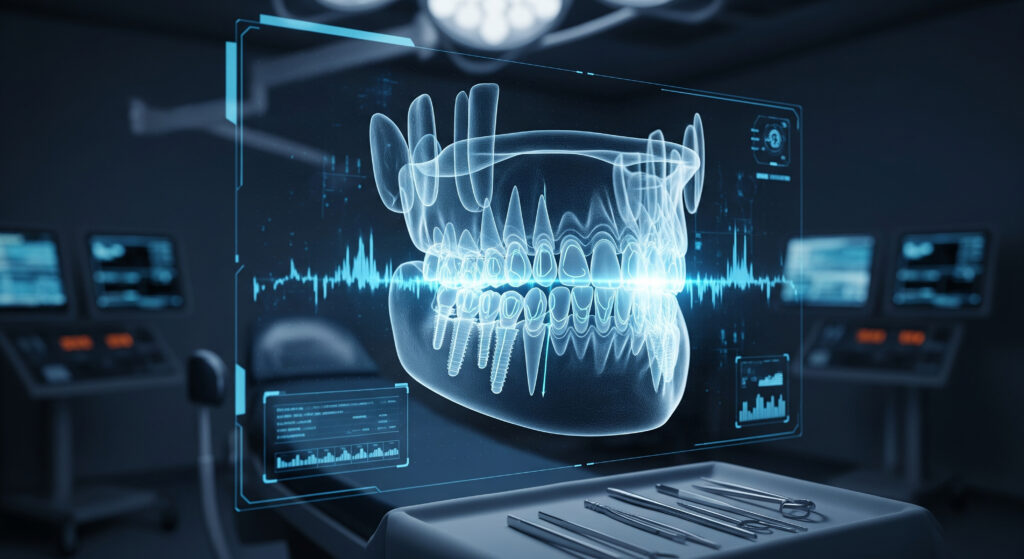
Illustration of AI-assisted analysis. Final diagnosis is always made by the dentist after a clinical examination.
AI image analysis
See how AI reads your scan before the doctor decides
Every panoramic X-ray, CBCT scan and smile photo you send is analysed by AI first. It maps bone, nerves, roots and soft tissue, flags areas that need attention and prepares measurements. Dr. Abdurrahman Öztürk then reviews every finding and makes the clinical decision.
Types of traumatic dental injuries and how AI helps classify them
Dentists group dental injuries into two broad families: injuries to the hard tissue of the tooth itself, and injuries to the structures that hold the tooth in its socket. A single accident can cause both. Correct classification matters because each injury type has its own recommended treatment, splinting time and follow-up schedule, and an unrecognised injury may cause problems months later.
AI image analysis is useful here because many trauma findings are small: a hairline root fracture, a slightly widened ligament space or a tooth pushed a millimetre into the bone. The software flags these areas for review, and Dr. Abdurrahman Öztürk confirms the diagnosis by comparing the images with what he sees and feels in the mouth.
Fractures of the tooth
These range from enamel chips and enamel-dentine fractures to complicated crown fractures that expose the pulp, crown-root fractures extending below the gum, and horizontal or oblique root fractures that are often invisible without imaging.
Injuries to the supporting tissues
Concussion and subluxation leave a tooth tender or slightly loose. Luxation injuries move it out of position: extrusion pulls it partly out, lateral luxation tilts it, and intrusion drives it into the bone. Avulsion means the tooth has come out completely.
Soft-tissue and bone injuries
Lips, gums and the tongue are frequently cut in the same accident, and the thin bone around front teeth can fracture. These injuries are cleaned, assessed and repaired as part of the same visit.
Knocked-out tooth: first aid in the first hour
A permanent tooth that has been completely knocked out is one of the few true emergencies in dentistry. The cells on the root surface begin to die quickly once they dry out, and their survival strongly influences whether a replanted tooth heals well. What happens at the scene of the accident often matters as much as what happens in the clinic.
If you or your child has a knocked-out adult tooth in Istanbul, follow the steps below and contact us on WhatsApp immediately so we can prepare for your arrival. Baby teeth are handled differently: a knocked-out primary tooth is not put back, because replanting it could harm the permanent tooth developing underneath.
- Pick the tooth up by the crown (the white part), never by the root.
- If it is dirty, rinse it briefly in milk or saline for a few seconds; do not scrub it or use soap.
- If you feel able to, gently push it back into its socket and bite on a clean cloth to hold it.
- If replanting is not possible, keep it moist in cold milk, saline or the patient's own saliva, not in tap water and never wrapped dry in tissue.
- Get to a dentist as quickly as possible and bring any fragments you find.
How AI X-ray and CBCT analysis finds hidden damage
Standard two-dimensional X-rays can miss a root fracture if the X-ray beam does not pass along the line of the crack. For this reason, trauma cases often need several X-ray angles, and in selected cases a small-field CBCT scan. CBCT shows the tooth and bone in three dimensions, which makes root fractures, alveolar bone fractures and the true direction of tooth displacement much clearer.
At AIDENT, AI tools assist with reading these images. They can segment the tooth from the bone, mark possible fracture lines and measure how far a tooth has moved. This makes the review faster and more systematic, but it does not replace it. Some image artefacts look like fractures, and some true fractures are faint, so every AI flag is checked by Dr. Öztürk against the clinical picture. We use CBCT only when its information is likely to change the treatment, to keep radiation exposure as low as reasonably possible.
- Detects candidate root and crown-root fracture lines for dentist review
- Measures displacement in luxation and intrusion injuries
- Shows the relationship of a fracture to the gum line and bone crest
- Creates a baseline for comparing follow-up images over months and years
Treatment options for each type of dental injury
Treatment is chosen according to the injury type, the stage of root development, the time since the accident and the condition of the pulp. Young permanent teeth with open root tips have a better capacity to heal their pulp, so the dentist will often try to preserve pulp tissue in a teenager where root canal treatment would be chosen in an adult.
The aim is always to keep the natural tooth when this is realistic. When it is not, the plan includes a well-timed replacement, and AI-assisted planning helps prepare that next step without rushing it.
Chips and crown fractures
Small chips are smoothed or rebuilt with composite bonding. If the broken fragment was saved, it can often be bonded back in place, which gives a very natural result. Where the pulp is exposed, a pulp-capping or partial pulpotomy procedure may preserve the living nerve, especially in young teeth.
Crown-root and root fractures
Fractures that extend below the gum may need the fragment removed, the margin exposed or the root gently extruded before restoration. A horizontal root fracture is repositioned if needed and splinted; many such teeth heal and stay vital, while a deep vertical fracture usually cannot be saved.
Luxation and avulsion
Displaced teeth are repositioned under local anaesthesia and held with a flexible splint bonded to neighbouring teeth. A replanted avulsed tooth is also splinted. In fully developed teeth that have been avulsed or severely displaced, root canal treatment is usually started within about one to two weeks, because the pulp is very unlikely to survive.
Monitoring after trauma: why follow-up matters
Many complications of dental trauma appear weeks or months after the accident, not on the day itself. The pulp may die slowly and become infected, a tooth may darken, or the root may start to resorb. Some replanted teeth fuse with the bone, a process called ankylosis, which in growing children can leave the tooth sitting lower than its neighbours over time.
For this reason, international guidelines recommend a series of check-ups with clinical tests and X-rays, typically at a few weeks, a few months, about one year and, for more serious injuries, yearly for several years. AI comparison of follow-up images with the original scans helps us spot small changes in the root or bone early. International patients can send new X-rays from home and have them reviewed remotely by our team, with Dr. Öztürk deciding whether further treatment is needed.
- Watch for darkening of the tooth, swelling, a gum pimple or new pain
- Pulp tests can give false readings in the first weeks after injury, so one test alone is never decisive
- Root resorption is often painless and is usually found on X-rays
Dental trauma care in Istanbul for visitors and international patients
Accidents do not wait for convenient timing, and some of our trauma patients are visitors who were injured while travelling in Turkey. Others come to Istanbul specifically to restore teeth damaged in an older accident, such as a front tooth that darkened years ago or a fractured crown that was patched temporarily at home.
For emergencies, message us on WhatsApp with a short description and photos, and we will advise on first aid and arrange to see you as quickly as possible. For older injuries, you can send existing X-rays and photos before you travel, so the team can study the case with AI tools and Dr. Öztürk can give a preliminary view of the likely options. The final plan is always confirmed after an in-person examination, because trauma diagnosis depends on clinical testing as well as imaging.
Conventional vs AI-assisted
Conventional trauma assessment vs AI-assisted care at AIDENT
Who it suits
Who needs AI-assisted dental trauma treatment?
- Anyone with a tooth knocked out, pushed in or moved out of position in an accident
- Children and teenagers with sports, playground or bicycle injuries to front teeth
- Adults with a chipped or broken tooth after biting something hard or a fall
- People with a tooth that has turned grey or dark after an old knock
- Patients with a loose or tender tooth following a blow to the face
- Visitors to Istanbul who need urgent assessment of a dental injury while travelling
Your treatment journey
A typical dental trauma treatment timeline
Day of injury
Emergency visit
Examination, AI-assisted imaging, repositioning or replantation, splinting or temporary repair, and pain control.
About 1–2 weeks
Early review
Healing check; for fully developed avulsed or severely displaced teeth, root canal treatment is usually started in this period.
About 2–4 weeks
Splint removal
The flexible splint is removed once the tooth is stable; the exact time depends on the injury type.
Weeks to months
Final restoration
Bonding, a veneer or a crown is completed once the pulp and supporting tissues have settled.
Up to several years
Long-term monitoring
Scheduled X-ray reviews, compared with baseline images using AI, to detect pulp or root changes early.
Why patients choose it
Fewer missed fractures
AI highlighting of possible fracture lines encourages a careful second look at every image.
Clearer 3D picture
Segmented CBCT views show the tooth, root and bone separately, which helps with complex injuries.
Natural tooth first
Treatment aims to keep your own tooth whenever the evidence suggests it can survive.
Better informed decisions
Dr. Öztürk weighs the AI findings with clinical tests, so the decision reflects the whole picture.
Planned long-term follow-up
Baseline images make it easier to detect slow complications such as root resorption.
Remote support from abroad
International patients can share follow-up X-rays online and receive guidance from the same team.
Your doctor
Dental trauma cases supervised by Dr. Abdurrahman Öztürk
Every dental injury treated at AIDENT Clinic is personally supervised by Dr. Abdurrahman Öztürk, who holds a PhD in dentistry and oral and maxillofacial surgery and has more than 15 years of experience in dentistry and dental surgery. His surgical background is valuable in trauma cases, where tooth, bone and soft-tissue injuries often occur together. AI tools help him review X-rays, CBCT scans and photos thoroughly, but he examines each patient, interprets the findings and decides on repositioning, splinting, restoration or root treatment himself. AI supports the process; Dr. Öztürk makes the clinical decisions.
Aftercare
Aftercare following treatment of a dental injury
- Eat a soft diet for the period your dentist advises and avoid biting directly on the injured tooth.
- Brush gently with a soft toothbrush and keep the area clean; a prescribed mouth rinse may be recommended.
- Do not play contact sports until you are cleared, and wear a properly fitted mouthguard afterwards.
- Take medication exactly as prescribed and check that your tetanus protection is up to date if the wound was contaminated.
- Contact us at once if you notice swelling, a gum pimple, increasing pain or darkening of the tooth.
- Attend every scheduled review, even if the tooth feels fine, because some complications are painless.
Related AI treatments
Questions and answers
What patients ask about AI Dental Trauma Treatment
What should I do first if my adult tooth gets knocked out?
Hold the tooth by the crown, rinse it briefly in milk or saline if dirty, and try to place it back in the socket. If you cannot, keep it in milk, saline or saliva and see a dentist immediately. The quicker the tooth is replanted, the better the chance that the root surface cells survive.
How long do I have to save a knocked-out tooth?
Minutes matter, so replant it or reach a dentist as fast as possible. Root surface cells start dying soon after the tooth dries out, and the outlook becomes much less favourable once it has been dry for around an hour. Keeping it moist in milk or saliva buys valuable time but does not stop the clock.
Does AI really help detect a cracked or fractured tooth root?
Yes, AI can help by flagging possible fracture lines on X-rays and CBCT scans that deserve a closer look. It is a support tool rather than a final verdict, because image artefacts can mimic cracks and faint fractures can be missed. Dr. Öztürk confirms every finding with clinical tests before deciding on treatment.
Is treatment of a broken front tooth painful?
Treatment itself is usually comfortable because it is done under local anaesthesia. The injured area may feel sore for a few days after repositioning, splinting or bonding, and this is generally managed with ordinary pain relievers. Severe or increasing pain later on should always be reported, as it can signal pulp inflammation.
Can my broken tooth fragment be glued back on?
Often, yes, if the fragment is intact and has been kept moist, for example in water, milk or saline. Reattaching your own fragment with modern bonding gives a natural colour and shape. Whether it is suitable depends on the fracture pattern and whether the pulp is exposed, which the dentist checks on examination.
Why has my tooth turned grey months after an accident?
A grey or dark tooth after trauma usually means the pulp was injured, sometimes with bleeding inside the tooth or pulp death. Not every discoloured tooth needs root canal treatment, but it should be assessed with X-rays and pulp tests. If the pulp has died and become infected, root canal treatment and internal whitening may be options.
How long will my tooth need a splint after an injury?
Most injured teeth are splinted for roughly two to four weeks, depending on the injury. Avulsed and extruded teeth are commonly splinted for about two weeks, while lateral luxations and many root fractures need longer. Dr. Öztürk removes the splint when the tooth is stable enough to function on its own.
How much time do I need to stay in Istanbul for dental trauma treatment?
It depends on the injury. A simple chip can be repaired in one visit, while a replanted or displaced tooth ideally needs reviews over the first two to four weeks. If you must travel sooner, we coordinate follow-up remotely by reviewing X-rays you send from home and advising on any local care needed.
Should a knocked-out baby tooth be put back in?
No, a knocked-out primary tooth is normally not replanted. Putting it back could damage the developing permanent tooth underneath. The child should still see a dentist to check the area, the neighbouring teeth and any soft-tissue injuries, and parents should look out for changes when the adult tooth erupts.
Can a tooth that was pushed into the gum come back down by itself?
Sometimes, especially in children with immature roots, an intruded tooth can re-erupt spontaneously. In fully developed teeth, the dentist may need to reposition it surgically or with gentle orthodontic forces. AI-assisted CBCT measurement of how far the tooth moved helps Dr. Öztürk choose between waiting and active repositioning.
Will my injured tooth need root canal treatment?
Not always. Teeth with minor injuries often keep a healthy pulp. Root canal treatment is usually needed when the pulp shows signs of death or infection, and it is generally started within about two weeks for fully developed teeth that were knocked out or severely displaced. Young teeth are given more chance to heal.
Who is the best dentist for AI dental trauma treatment in Istanbul?
The best choice is a dentist who combines trauma and surgical experience with careful imaging and long-term follow-up. At AIDENT Clinic, Dr. Abdurrahman Öztürk, with a PhD in oral and maxillofacial surgery and 15+ years of experience, supervises every trauma case and uses AI analysis to support his clinical decisions.
Can I send photos of my dental injury on WhatsApp first?
Yes. Send clear photos of the injured area and any X-rays to +90 534 445 9444 and describe how and when the injury happened. Our team can give first-aid advice and an initial opinion. A photo cannot replace an examination, so urgent injuries such as a knocked-out tooth still need to be seen in person quickly.
How can I protect my teeth from future sports injuries?
Wear a well-fitting mouthguard during contact and high-risk sports. A custom mouthguard made from a digital scan of your teeth usually fits and stays in place better than a generic one. Patients whose front teeth stick out may also benefit from discussing orthodontic options, since protruding teeth are more vulnerable to injury.
No question matches your search. Ask us directly on WhatsApp.
Injured a tooth? Get expert AI-assisted help today
Send photos or X-rays of your dental injury on WhatsApp and our team will advise you on first aid and next steps. Every case is reviewed with AI tools and decided by Dr. Abdurrahman Öztürk.
Get my free AI trauma assessment on WhatsAppFree initial review of your photos and X-rays. Reply on WhatsApp.