AI-Driven Digital Fabrication
AI CAD/CAM & 3D Printing in Dentistry: Precise Restorations Designed with Artificial Intelligence in Istanbul
At AIDENT Clinic, AI CAD/CAM turns a 3D scan of your teeth into a digitally designed crown, veneer, inlay, splint or surgical guide, then mills or prints it with machine precision. Dr. Abdurrahman Öztürk checks and approves every design before anything is made.
 Medically reviewed by Dr. Abdurrahman Öztürk, PhD, oral & maxillofacial surgery
The 3D model shows a crown designed on screen over a prepared tooth. The highlighted margin line and contact areas are what AI helps detect before the dentist finalises the design for milling.
Short answer
What is AI CAD/CAM dentistry?
AI CAD/CAM dentistry means a restoration such as a crown, veneer or inlay is designed on a computer from a 3D scan of your teeth, with artificial intelligence proposing the shape, margins and bite contacts. The approved design is then milled from a ceramic block or 3D printed. At AIDENT the dentist reviews and adjusts every AI proposal.
- What is made
- Crowns, veneers, inlays, onlays, bridges, guides, splints
- Main materials
- Zirconia, lithium disilicate, composite, resins
- AI role
- Margin detection, tooth shape proposal, bite check
- Supervision
- Dr. Abdurrahman Öztürk, 15+ years
AI
From Scan to Finished Restoration: The AI CAD/CAM Workflow
Every restoration follows the same digital chain. Artificial intelligence speeds up the design stages, while the dentist controls the decisions that affect fit, function and appearance.
- 1
Intraoral 3D scan
A handheld scanner records the prepared tooth, the neighbouring teeth and the opposing jaw as a precise 3D model, replacing putty impressions.
- 2
AI margin and anatomy detection
Software assisted by AI traces the finish line of the preparation and identifies cusps, contacts and the space available for the restoration.
- 3
AI design proposal
Based on the surrounding teeth and the bite, the system proposes a first tooth shape, wall thickness and contact strength for the dentist to refine.
- 4
Doctor review and adjustment
Dr. Öztürk checks the margins, the occlusion and the aesthetics on screen, changes what needs changing and approves the final design.
- 5
Milling or 3D printing
The approved file is sent to a milling unit for ceramic or zirconia, or to a 3D printer for guides, models, splints and temporaries.
- 6
Finishing and fitting
The piece is sintered or crystallised if the material requires it, stained, glazed, tried in your mouth, adjusted and then bonded or cemented.
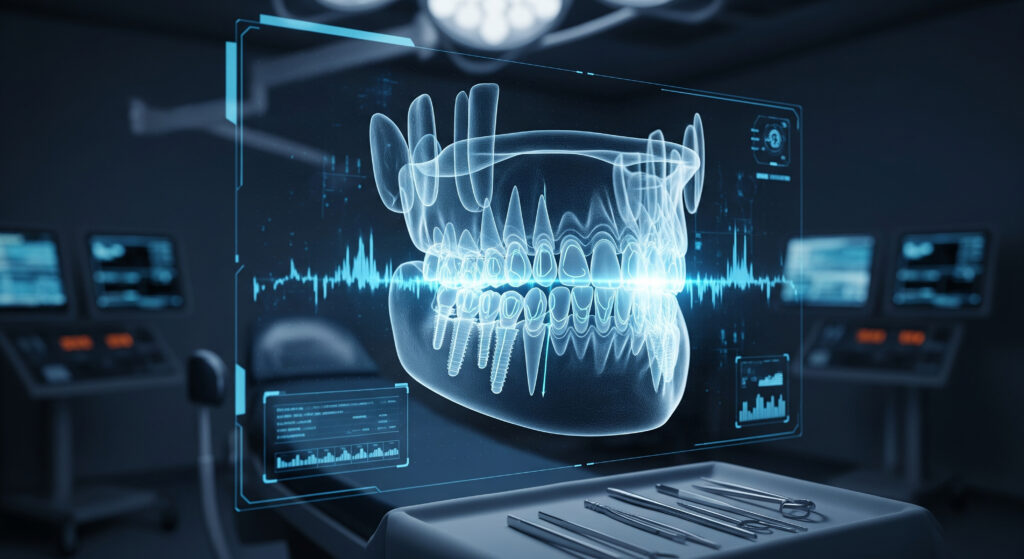
Illustration of AI-assisted analysis. Final diagnosis is always made by the dentist after a clinical examination.
AI image analysis
See how AI reads your scan before the doctor decides
Every panoramic X-ray, CBCT scan and smile photo you send is analysed by AI first. It maps bone, nerves, roots and soft tissue, flags areas that need attention and prepares measurements. Dr. Abdurrahman Öztürk then reviews every finding and makes the clinical decision.
What AI CAD/CAM and 3D printing actually mean in a dental clinic
CAD stands for computer-aided design and CAM for computer-aided manufacturing. In dentistry, the two terms describe a fully digital way of making restorations: your teeth are scanned, the restoration is designed in software, and a machine produces it. Traditional workflows rely on a putty impression, a plaster model and a technician shaping wax and porcelain by hand. A digital workflow removes most of those manual steps, which means fewer places where small distortions can creep in.
Artificial intelligence adds a new layer on top of classic CAD/CAM. Instead of the dentist drawing every margin and sculpting every cusp from a library tooth, AI-assisted design software can suggest a margin line, propose a tooth shape that fits the space and the opposing bite, and flag areas where the material would be too thin. At AIDENT Clinic these suggestions are a starting point. The final design is always reviewed, corrected where needed and approved by Dr. Abdurrahman Öztürk before any milling or printing begins.
Milling versus 3D printing
Milling is subtractive: a machine carves the restoration out of a solid block of ceramic, zirconia or composite. 3D printing is additive: a printer builds the object layer by layer from liquid resin. Milling is generally preferred for long-term crowns and veneers, while printing is ideal for models, surgical guides, splints, trays and many temporary restorations.
Restorations and devices we produce with AI CAD/CAM
The same digital chain can produce a wide range of items. Some are permanent restorations that stay in your mouth for many years; others are tools that make another treatment safer or more predictable. Knowing which category your case falls into helps you understand how long the process takes and which material makes sense.
For permanent work, CAD/CAM is most often used for single crowns, partial crowns called onlays, inlays that replace part of a chewing surface, veneers on front teeth and short bridges. For supporting work, 3D printing produces surgical guides for implant placement, study models for planning, night guards for clenching, bleaching trays, and temporary crowns that protect prepared teeth while final restorations are completed.
- Single crowns on natural teeth or on implants
- Inlays and onlays that preserve more natural tooth than a full crown
- Veneers designed from a digital smile plan
- Short bridges, depending on the span and material limits
- 3D-printed surgical guides for implant placement
- Printed models, night guards, bleaching trays and temporaries
How AI improves the design of a CAD/CAM crown or veneer
The design stage is where artificial intelligence makes the most visible difference. A restoration has to meet several demands at once: it must seal precisely at the margin, touch the neighbouring teeth with the right pressure, meet the opposing teeth without creating high spots, and look natural in shape and proportion. Balancing all of that manually takes time and depends heavily on individual skill.
AI-assisted design tools learn from large numbers of tooth shapes and can produce a sensible first proposal in moments. They can also measure material thickness in every area and warn when a section falls below what the chosen ceramic needs. For the dentist, this means less time sculpting from scratch and more time evaluating details that really matter for your bite and your smile. It does not mean the computer decides: if the AI proposal looks wrong for your face, your gum line or your chewing pattern, it is changed.
Bite analysis in the digital model
Because both jaws are scanned, the software can show colour maps of where the new restoration contacts the opposing teeth. This helps reduce the amount of grinding needed in the chair after the crown is placed.
Matching your natural teeth
For front teeth, the design can mirror the shape of the same tooth on the other side, then be fine-tuned to your smile photos so that proportions and edges look harmonious.
Choosing the right material for milled and printed restorations
Material choice is a clinical decision, not a software setting. Zirconia is very strong and is often chosen for back teeth, bridges and patients who grind; modern layered or multilayer zirconia can also look quite natural. Lithium disilicate, often known by the trade name E-max, offers excellent translucency and is popular for front crowns, veneers and partial restorations. Composite and hybrid ceramic blocks are gentler on opposing teeth and easier to repair, but they generally wear more over time.
Printed resins are a separate group. Many are designed for temporary use, models or guides, while some newer resins are approved for longer-term restorations. Dr. Öztürk weighs the position of the tooth, the forces it carries, the colour of the underlying tooth, your habits and your aesthetic expectations before recommending a material. AI can help estimate the space available, but the dentist decides what will last in your specific mouth.
- Zirconia: high strength, suited to molars, bridges and implant crowns
- Lithium disilicate: high aesthetics, suited to front teeth and veneers
- Composite or hybrid blocks: repairable, kind to opposing teeth
- Printed resins: guides, models, splints and temporaries
Same-day crowns: when chairside CAD/CAM is possible and when it is not
When a tooth needs a single crown, inlay or onlay and the material can be milled and finished in the clinic, chairside CAD/CAM can allow the restoration to be designed, produced and fitted in a single long appointment. This is especially attractive for international patients with limited time in Istanbul, because it avoids weeks of waiting with a temporary crown.
Same-day treatment is not right for every case, and it is important to be honest about that. Large bridges, complex full-mouth cases, restorations that need gum healing first, teeth that still need root canal treatment, or work that requires layered porcelain for a very demanding aesthetic result usually need more time. Zirconia also has to be sintered in a furnace, which adds hours. During your consultation, Dr. Öztürk will tell you whether your case can realistically be completed the same day or whether a staged approach will give a better result.
3D printing for surgical guides, models and temporary teeth
Printing is the quiet workhorse of a digital clinic. When an implant is planned on a CBCT scan, the planned position can be converted into a surgical guide, a small resin template that sits on the teeth or gum and directs the drill to the planned angle and depth. The guide itself is printed from the digital plan, so the accuracy of the surgery depends on the accuracy of the scan, the plan and the print together.
Printed models let you and the dentist hold a physical copy of your teeth, which is useful for explaining treatment or checking a design. Printed temporaries can reproduce the shape of a planned smile so you can test it in daily life before the final ceramics are milled. Night guards and trays printed from a scan tend to fit closely because they are made from the same digital data as the rest of your treatment.
Why print quality matters
A printed object is only as good as the printer calibration, the resin and the post-processing. Prints are washed, cured and checked on the model before use; a guide that does not seat fully is not used for surgery.
Limits and risks of CAD/CAM restorations you should know
Digital fabrication improves consistency, but it cannot overcome every biological or mechanical limit. A crown still depends on a healthy foundation: if the tooth has untreated decay, a deep crack, weak walls or gum disease, a well-designed restoration may still fail. Scans can be affected by saliva, blood or a margin hidden below the gum, which is why the dentist checks the scan quality before designing.
Ceramics can chip or fracture under heavy grinding, and a perfect digital design can still feel slightly different once in the mouth, so small adjustments at the fitting appointment are normal. Like any crown, a CAD/CAM restoration can develop decay at the margin if hygiene is poor. AI previews and colour maps are aids for planning, not a guarantee. The dentist's clinical judgement and your home care remain the most important factors for how long the result lasts.
Conventional vs AI-assisted
Conventional Lab Workflow vs AI CAD/CAM at AIDENT
Who it suits
Who Is a Good Candidate for AI CAD/CAM Restorations?
- Patients with a broken, heavily filled or root-treated tooth that needs a crown or onlay
- International patients who want restorations completed within a short stay in Istanbul
- People who find traditional impression trays uncomfortable or trigger a gag reflex
- Patients planning veneers who want a printed trial smile before final ceramics
- Implant patients whose surgery will use a printed surgical guide and a digitally designed crown
- People who clench or grind and need a precisely fitting printed night guard
Your treatment journey
Typical Timeline for an AI CAD/CAM Restoration
Before travel
Remote review
You send photos and any X-rays on WhatsApp; the team gives a first opinion on whether CAD/CAM restorations suit your case.
Day 1
Exam and scanning
Clinical examination, X-rays or CBCT if needed, tooth preparation where indicated and an intraoral 3D scan of both jaws.
Day 1
AI-assisted design
The restoration is designed with AI support and reviewed by Dr. Öztürk; you can see the design on screen.
Day 1–3
Milling, printing and finishing
Single units may be completed the same day; zirconia, multiple units or aesthetic cases can take a few more days.
Final visit
Try-in and placement
Fit, bite and colour are checked and adjusted before the restoration is bonded or cemented.
Why patients choose it
Comfortable digital impressions
A scanner replaces most putty trays, which many patients find much easier to tolerate.
Consistent precision
Design and machining are controlled digitally, reducing small errors that manual steps can introduce.
Fewer appointments
Suitable single restorations can be finished in one visit, which suits patients travelling to Istanbul.
See your design first
You can view the planned restoration on screen and discuss shape before it is produced.
Digital record for the future
Your scan and design are stored, so a restoration can be reproduced if it is ever lost or damaged.
Doctor-controlled AI
AI speeds up design, but Dr. Öztürk approves every margin, contact and material choice.
Your doctor
Dr. Abdurrahman Öztürk Approves Every Digital Design
Dr. Abdurrahman Öztürk holds a PhD in dentistry and oral and maxillofacial surgery, graduated from a leading Istanbul university, and has more than 15 years of experience in dentistry and dental surgery. At AIDENT he personally reviews each intraoral scan, each AI-proposed crown, veneer or guide, and each material choice before anything is milled or printed. He checks that the margins are sealed, the bite is balanced and the shape suits your face. Artificial intelligence gives him faster, more measurable design proposals; the clinical decision and the final approval always remain his responsibility.
Aftercare
Caring for Your CAD/CAM Restorations
- Wait until any numbness wears off before eating to avoid biting your cheek or tongue.
- Brush twice a day and clean between teeth daily, paying attention to the edge where the crown meets the tooth.
- Avoid biting on very hard objects such as ice, nut shells or pens.
- Wear a night guard if you clench or grind your teeth.
- Contact the clinic if the bite feels high or uneven after a few days; a small adjustment usually solves it.
- Attend regular check-ups and cleanings with your local dentist or at AIDENT.
Related AI treatments
Questions and answers
What patients ask about AI CAD/CAM & 3D Printing
How are CAD/CAM crowns made step by step?
A CAD/CAM crown is made by scanning the prepared tooth, designing the crown on a computer and milling it from a ceramic block. At AIDENT, AI helps propose the margins and shape, Dr. Öztürk refines the design, and the milled crown is then finished, glazed, tried in and bonded. Zirconia crowns also need firing in a furnace before fitting.
Can I really get a crown in one day in Istanbul?
Yes, for many single crowns, inlays and onlays a same-day result is possible with chairside milling. It depends on the tooth's condition, the material and whether other treatment is needed first. Complex cases, bridges, zirconia that needs sintering or demanding front-tooth aesthetics may need a few extra days. The dentist confirms this after your examination.
Does AI design my crown by itself?
No, AI only creates a first proposal. The software suggests the margin line, tooth shape and contacts based on your scan and similar teeth. Dr. Öztürk then checks every detail, adjusts the bite, thickness and appearance, and approves the final file. Nothing is milled or printed without his review.
What is the difference between milling and 3D printing in dentistry?
Milling carves a restoration out of a solid block, while 3D printing builds an object layer by layer from resin. Milling is usually chosen for long-lasting ceramic crowns and veneers. Printing is ideal for surgical guides, study models, night guards, trays and temporary teeth, and some newer resins are used for longer-term restorations.
Is a digital scan better than a traditional impression?
For most patients a digital scan is more comfortable and very accurate. It avoids putty trays, can be repeated instantly if an area is unclear, and goes straight into the design software. In some situations, such as margins deep under the gum, the dentist may still combine techniques to get the best possible record.
Is getting a CAD/CAM crown painful?
Getting a CAD/CAM crown is usually not painful because the tooth is numbed with local anaesthetic during preparation. Scanning itself causes no pain. Afterwards some patients notice mild sensitivity or gum soreness for a few days, which normally settles on its own. Let the clinic know if discomfort persists or the bite feels wrong.
Which material is best for a milled crown?
There is no single best material; it depends on the tooth. Zirconia is very strong and suits back teeth and bridges, lithium disilicate offers high translucency for front teeth and veneers, and composite blocks are repairable and gentle on opposing teeth. Dr. Öztürk recommends a material after assessing your bite, habits and aesthetic goals.
How long do CAD/CAM restorations last?
With good care, CAD/CAM crowns and onlays can last many years, similar to well-made conventional restorations. Their lifespan depends on the material, the health of the tooth underneath, grinding habits and daily hygiene. No restoration is permanent or guaranteed, so regular check-ups help catch small problems early.
What is a 3D-printed surgical guide used for?
A 3D-printed surgical guide transfers a digital implant plan into the mouth. It is a resin template that fits over the teeth or gum and directs the drill to the planned position, angle and depth. It is printed from the plan made on your CBCT scan and checked for fit before surgery begins.
Can I try my new smile before the final veneers are made?
Yes, a printed trial or temporary version of the planned design can often be made. It lets you see and feel the shape in your own mouth before the final ceramics are milled. Changes you request at this stage can be made in the digital file, then the definitive veneers are produced from the approved design.
What happens if my CAD/CAM crown breaks or gets lost?
If a CAD/CAM crown breaks or is lost, the stored digital design can often be used to produce a new one, as long as the tooth underneath has not changed. The dentist first checks the tooth and may take a new scan. Contact the clinic with photos so the team can advise on the next step.
How much time do I need to stay in Istanbul for CAD/CAM crowns?
For one or two suitable single crowns, a stay of a few days is often enough, and some cases finish in a single visit. Larger cases, combined treatments or work that needs healing first take longer. After reviewing your photos and X-rays on WhatsApp, the team gives you a realistic estimate before you book travel.
Who is the best dentist for AI CAD/CAM dentistry in Istanbul?
The best choice is a dentist who combines digital equipment with surgical and restorative experience and personally checks each design. At AIDENT, Dr. Abdurrahman Öztürk, who holds a PhD and has more than 15 years of experience, reviews every AI-assisted scan and restoration. Comparing credentials and asking how designs are approved helps you decide.
Can AI CAD/CAM be used for crowns on implants?
Yes, implant crowns are very well suited to digital design. A scan body is attached to the implant, scanned, and the crown and its connection are designed in software, often in zirconia. AI helps shape the crown to the gum and the neighbouring teeth, and the dentist checks the fit and the bite before final placement.
No question matches your search. Ask us directly on WhatsApp.
Find Out If AI CAD/CAM Suits Your Teeth
Send photos of your teeth and any recent X-rays on WhatsApp at +90 534 445 9444 or email info@aidentclinic.com. Our team will review them with AI support and Dr. Öztürk will tell you which restorations, materials and timeline fit your case.
Get my free AI assessment on WhatsAppFree initial review of your photos and X-rays. Reply on WhatsApp.