AI Digital Smile Preview
AI Virtual Smile Design in Istanbul: See and Try Your New Smile First
AI virtual smile design turns your photos, video and 3D scan into a preview of your future smile, then lets you test it in your own mouth as a temporary mock-up. Every design is checked and approved by Dr. Abdurrahman Öztürk before any tooth is touched.
 Medically reviewed by Dr. Abdurrahman Öztürk, PhD, oral & maxillofacial surgery
The 3D model shows your scanned teeth aligned with your facial photo, with the proposed new tooth outlines overlaid so you can compare the current and planned smile side by side.
Short answer
What is AI virtual smile design?
AI virtual smile design is a planning step in which software analyzes photos, video and a 3D scan of your teeth to propose tooth shape, length and position that suit your face. The dentist refines the proposal, and you can see it on screen and try it as a temporary mock-up before any treatment begins.
- What you send first
- Smile photos via WhatsApp
- In-clinic design visit
- Usually one appointment
- Drilling for the preview
- None
- Final approval
- Dr. Abdurrahman Öztürk
AI
How your AI smile preview is built, step by step
A virtual smile design is not a filter on a selfie. It is a sequence of measured steps that link your face, your lips and your teeth, so that what you approve on screen can later be transferred precisely to the real treatment.
- 1
Photo and video capture
We take standardized portrait, smile and close-up photos plus a short video of you talking and laughing, because a smile is dynamic and still images alone can mislead.
- 2
AI facial landmark analysis
AI software locates facial reference points such as the eyes, nose, facial midline and lip contours, and measures how much tooth and gum you show at rest and in a full smile.
- 3
Intraoral 3D scan
An intraoral scanner records your teeth and gums in 3D without traditional impression trays, giving the design an accurate base model of your current bite.
- 4
Merging face and teeth
The 2D facial images and the 3D dental model are aligned so proposed tooth shapes can be judged against your real face, not in isolation.
- 5
AI proposal and dentist refinement
The software suggests tooth proportions and edge positions; Dr. Abdurrahman Öztürk then adjusts length, width, symmetry and character to fit your face, bite and wishes.
- 6
Mock-up and approval
The approved design is converted into a temporary mock-up you can wear in your mouth, and it becomes the reference for guides, temporaries and final restorations.
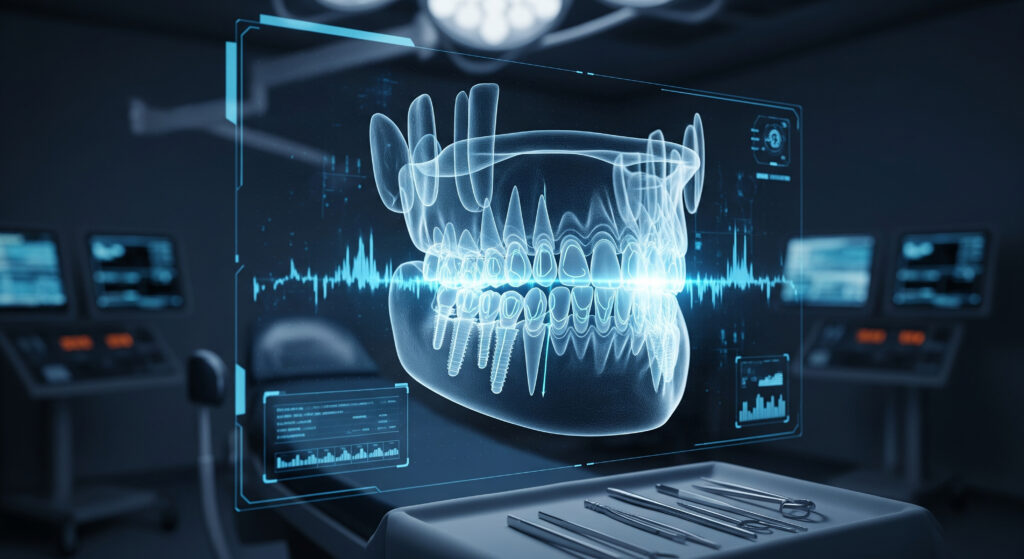
Illustration of AI-assisted analysis. Final diagnosis is always made by the dentist after a clinical examination.
AI image analysis
See how AI reads your scan before the doctor decides
Every panoramic X-ray, CBCT scan and smile photo you send is analysed by AI first. It maps bone, nerves, roots and soft tissue, flags areas that need attention and prepares measurements. Dr. Abdurrahman Öztürk then reviews every finding and makes the clinical decision.
What happens in an AI virtual smile design session
An AI virtual smile design session at AIDENT is a planning appointment, not a treatment. It begins with a conversation about what bothers you about your smile today: the colour, short or worn teeth, gaps, crowding, a crooked midline or too much visible gum. We then capture the records the software needs. These include a series of standardized photographs taken with controlled lighting and a fixed head position, a short video in which you speak and smile naturally, and an intraoral 3D scan of both jaws and your bite.
Once the records are complete, the AI tools analyze proportions and reference lines and generate a first design proposal. This is where the dentist's work begins. Dr. Abdurrahman Öztürk reviews the proposal with you on screen, explains why each tooth is shaped the way it is, and changes the design live where your preferences or clinical findings require it. The session ends with a digital design you understand and, when appropriate, a plan for a trial mock-up.
- Discussion of your goals and concerns
- Standardized photos and a short smile video
- Intraoral 3D scan instead of impression trays
- AI-generated design proposal reviewed on screen
- Live adjustments with the dentist
- Decision on whether a trial mock-up is useful
What AI measures on your face and smile
The value of AI in smile design lies in consistent, repeatable measurement. Human eyes are easily distracted by colour or by a single dark tooth, while software can calmly map reference lines across the whole face. It compares the facial midline with the dental midline, checks whether the line connecting the canine tips is parallel to the eyes, and traces how the edges of the upper front teeth follow the curve of the lower lip when you smile.
AI also helps estimate how much tooth shows when your lips are relaxed, which is important because front teeth that are too short often make a face look older, while teeth that are too long can look artificial. These measurements are starting points, not rules. Faces are rarely perfectly symmetrical, and a smile that follows every ideal ratio can look generic. That is why the dentist uses the data as a guide and keeps the character of your face.
Reference lines
Facial midline, interpupillary line and the horizontal plane help the software judge whether the smile appears level and centred.
Tooth display at rest
The amount of upper incisor visible with relaxed lips guides how much length can be added or should be kept.
Gum display and lip movement
Video analysis shows how high the lip rises in a full smile, which affects whether gum contouring needs to be discussed.
Tooth proportions
Width-to-length ratios of the central incisors and the progression towards the canines are compared with your face shape.
From screen to mouth: the trial smile mock-up
A picture on a monitor is helpful, but most people only truly decide when they see and feel the new shape in their own mouth. For this reason the digital design can be turned into a physical trial. The approved design is printed or milled as a model, a transparent silicone key is made from it, and the key is filled with a tooth-coloured temporary material and placed over your natural teeth for a few minutes until it sets.
The result is a mock-up that shows the planned length, width and outline directly on your face. You can smile in a mirror, speak, take photos and show them to family. In most cases the mock-up is placed over your existing teeth without drilling and is removed afterwards. It is important to understand its limits: a mock-up can only add material, so it cannot show teeth being made shorter or narrower, and its colour and surface are simpler than final ceramic restorations.
- Shows planned tooth length and shape on your real face
- Lets you test speech and lip comfort
- Usually placed without drilling and removed after the visit
- Cannot fully simulate reductions or final ceramic colour
Starting your AI smile preview online from abroad
Many of our patients live outside Turkey, so the first stage of virtual smile design often happens before you travel to Istanbul. You can send photos through WhatsApp, and we use them for an initial AI smile analysis and a remote opinion on which treatments may be realistic. This first look helps you understand options and plan how long you may need to stay, but it is not a final design.
For a useful remote assessment, take photos in daylight facing a window, without a flash or beauty filters, with the phone held at eye level. Include a relaxed face, a big natural smile, a close-up of the teeth with lips pulled back, and if possible a short video of you talking. Existing X-rays are welcome. The full virtual smile design, 3D scan and any mock-up are completed once you are in the clinic and Dr. Abdurrahman Öztürk has examined you.
Photos to send
Front portrait at rest, full smile, close-up of teeth, both side profiles and, if you can, a 10 to 20 second talking video.
What the remote preview gives you
An initial view of possibilities, a likely treatment direction and an estimate of visits, all to be confirmed by clinical examination.
How the approved design guides your real treatment
The approved virtual design is the blueprint for whatever treatment follows, whether that is veneers, crowns, bonding, whitening, gum contouring, orthodontics or a combination. Because the design is digital, it can be transferred into practical tools: reduction guides that help the dentist remove only the amount of enamel the plan needs, temporary restorations that copy the approved shape, and CAD/CAM files for the laboratory that produces the final restorations.
This continuity matters. Without a shared reference, the outcome depends on verbal descriptions passed between patient, dentist and technician. With the design in hand, everyone works towards the same shape. In some cases the design shows that a smaller treatment is enough, for example whitening plus bonding on two teeth rather than a full set of veneers. In other cases it reveals that gum health, bite problems or tooth position should be addressed first.
Limits of AI smile simulation you should know
Honest expectations are part of good smile design. A virtual preview is a simulation based on your records, and the final result can differ in small ways. Lighting, camera angle and screen settings affect how colour looks; gum tissue may respond differently than planned after treatment; and the natural translucency of ceramic is difficult to reproduce on a screen or in temporary material. The design also cannot predict how your lips and facial muscles will adapt over the first weeks.
AI does not examine your health. It cannot see decay under old fillings, cracks, bone loss or gum disease on photographs alone, and it does not decide whether a treatment is safe for you. Those judgements require clinical examination and, where needed, X-rays or a CBCT scan, all interpreted by the dentist. We use the preview to communicate and to plan carefully, never as a guarantee of the final appearance.
- Colour on screen is approximate
- Gum response can vary from the plan
- Mock-ups cannot show tooth reduction
- Photos alone cannot detect hidden dental problems
- Final plan is confirmed only after clinical examination
Conventional vs AI-assisted
Traditional smile planning vs AI virtual smile design
Who it suits
Who benefits most from an AI virtual smile design
- People considering veneers, crowns or a Hollywood Smile who want to see the shape first
- Patients unsure how much change they want and needing options compared
- Anyone with worn, short, chipped or uneven front teeth
- Patients with gaps, a shifted midline or mild crowding exploring alternatives
- International patients who want a clear plan before travelling to Istanbul
- People who have had cosmetic work before and want a more natural redesign
Your treatment journey
Typical timeline of a virtual smile design
Before travel
Remote AI smile analysis
You send photos and a short video on WhatsApp; we share an initial assessment and possible directions.
Day 1
Examination and records
Clinical exam, X-rays if needed, standardized photos, video and intraoral 3D scan.
Day 1 to 2
Design review
The AI proposal is refined with the dentist and adjusted to your feedback on screen.
Day 2
Trial mock-up
When suitable, the design is placed in your mouth as a temporary mock-up for you to evaluate.
After approval
Treatment begins
The approved design guides the chosen procedures, temporaries and laboratory work.
Why patients choose it
Decide with your own eyes
You see a proposed smile on your face instead of imagining it from descriptions or other people's photos.
Natural, face-based proportions
AI measurements are combined with clinical judgement so tooth shapes suit your face, lips and age.
Room to change your mind
Adjusting a digital design is simple, so you can ask for softer edges, shorter teeth or a different outline before anything is permanent.
Better communication
You, the dentist and the dental technician share one visual reference, which reduces misunderstandings.
Possibly less invasive plans
Seeing the target shape helps the dentist judge whether bonding or whitening may be enough instead of more extensive work.
Planning before you fly
A remote first assessment helps international patients plan their stay in Istanbul more realistically.
Your doctor
Every AI smile design is approved by Dr. Abdurrahman Öztürk
AI at AIDENT proposes, measures and simulates, but the decisions are clinical. Dr. Abdurrahman Öztürk, who holds a PhD in dentistry and oral and maxillofacial surgery and has more than 15 years of experience in dentistry and dental surgery, reviews each virtual smile design personally. He checks the proposal against your examination findings, your bite, your gum health and the shape of your face, and he explains which changes are realistic and which are not. No design is turned into treatment until he and you are both satisfied with it.
Aftercare
After your mock-up and design visit
- If the mock-up was removed, no special care is needed; any small remnants are polished away
- If you keep a mock-up for a short trial, avoid very hard or sticky foods and dark drinks
- Take photos in daylight and note what you like or would change
- Share feedback with the clinic before the design is finalized
- Continue normal brushing and flossing around temporary material
- Contact us on WhatsApp if a temporary piece feels rough or comes loose
Related AI treatments
Questions and answers
What patients ask about AI Virtual Smile Design
What photos should I send for an AI smile preview?
Send a relaxed front portrait, a full natural smile, a close-up of your teeth and both side profiles. Take them in daylight with no flash or filters, with the phone at eye level. A short video of you talking and laughing helps the AI and the dentist judge how your lips move and how much tooth and gum you show.
How long does a virtual smile design appointment take?
Recording photos, video and the 3D scan usually fits into a single visit. Reviewing and refining the design may take a second short session, and a trial mock-up adds some extra chair time. The exact schedule depends on how complex your case is and whether additional diagnostics such as X-rays are needed first.
Does the trial smile mock-up damage my teeth?
No, in most cases the mock-up is placed over your natural teeth without drilling and is removed afterwards. It is made from a temporary tooth-coloured material shaped by a silicone key. Small remnants are polished off. Your dentist will tell you in advance if your particular situation requires anything different.
Can I change the design after I see it?
Yes, and we encourage it. Because the design is digital, tooth length, width, edge shape and symmetry can be adjusted during the consultation. Many patients ask for a softer or more natural look after seeing the first version. The dentist will explain if a requested change would affect your bite or long-term health.
Do I have to start treatment after the virtual smile design?
No, the design is a planning step and you decide afterwards. It gives you a clear picture of what is possible, which treatment could achieve it and how many visits it may need. You can take time to think, discuss it with family or come back later.
What is the difference between the AI preview and the mock-up?
The AI preview is a digital image or 3D model you see on a screen, while the mock-up is a physical temporary version you wear in your mouth. The preview is good for comparing options quickly; the mock-up lets you feel the shape, test speech and see it in a mirror under real light.
Can AI design my smile from photos alone without a visit?
AI can make an initial analysis from good photos, but it cannot produce a final, treatment-ready design without an examination and a 3D scan. Photos do not show decay, gum disease, bone levels or your bite in enough detail. The online preview is a starting point that Dr. Abdurrahman Öztürk confirms in the clinic.
Why might my final smile look slightly different from the preview?
Small differences are normal because a preview is a simulation. Screen colours, lighting and camera angles change how teeth appear, ceramic has a translucency temporary materials cannot copy, and gums can heal a little differently than planned. The approved design keeps shape and proportions consistent, but it is not a guarantee of identical appearance.
How much time do I need to stay in Istanbul for virtual smile design only?
For the design itself, one to two days are usually enough for examination, records, design review and a mock-up. If you continue with treatment such as veneers or crowns, more time is needed, and that depends on the procedure. A remote assessment beforehand helps us estimate your stay more accurately.
Is virtual smile design useful if I only want whitening or bonding?
Yes, it can be. Even for minor treatments, the design shows whether bonding on a few teeth will balance the smile or whether whitening alone will meet your expectations. It also helps avoid adding material in places where it would make teeth look bulky.
Can virtual smile design plan gum contouring as well as teeth?
It can show where the gum line could be adjusted to improve symmetry or reduce a gummy appearance. The design simulates the new gum outline together with the teeth. Whether gum contouring is appropriate, and how much tissue can safely be changed, is decided by the dentist after examining your gums and bone.
Will an AI design make my teeth look artificial?
It should not, because the AI proposal is only a starting point. The dentist adapts the shape to your age, face and personality, and can keep small natural irregularities if you prefer. Seeing the design before treatment is exactly what lets you ask for a more natural result.
Who reviews AI virtual smile designs at AIDENT in Istanbul?
Every design is reviewed and approved by Dr. Abdurrahman Öztürk, who has a PhD in dentistry and oral and maxillofacial surgery and more than 15 years of clinical experience. AI supports the analysis and simulation, while all clinical decisions remain with him after examining you.
Can I share my smile preview with family before deciding?
Yes. You can take photos of the on-screen design and of yourself wearing the mock-up and share them with people you trust. Many patients find another opinion helpful, and any feedback can be discussed with the dentist before the design is finalized.
No question matches your search. Ask us directly on WhatsApp.
See your future smile before you decide
Send us your smile photos on WhatsApp and receive an initial AI smile analysis, reviewed by Dr. Abdurrahman Öztürk, with honest advice on what is realistic for you.
Get my free AI smile preview on WhatsAppFree initial review of your photos and X-rays. Reply on WhatsApp.