AI-Planned Minimally Invasive Aesthetics
AI Dental Bonding & Tooth Reshaping in Istanbul
AI dental bonding and tooth reshaping repair chips, close small gaps and even out edges while keeping almost all of your natural enamel. At AIDENT Clinic, AI analysis of your photos and 3D scans shapes the plan, and Dr. Abdurrahman Öztürk sculpts every tooth by hand.
 Medically reviewed by Dr. Abdurrahman Öztürk, PhD, oral & maxillofacial surgery
The model shows a chipped incisor edge rebuilt with layered composite resin bonded to the enamel. Planning on the digital model helps decide how much resin is needed and where the new edge should sit.
Short answer
What is AI dental bonding and tooth reshaping?
AI dental bonding is the addition of tooth-coloured composite resin to repair chips, gaps or uneven teeth, while tooth reshaping gently polishes away tiny amounts of enamel to refine shape. At AIDENT, AI analyses photos and scans to suggest ideal proportions, and the dentist approves the plan and performs the work by hand.
- Material
- Tooth-coloured composite resin, layered and polished
- Enamel removal
- None or very little for bonding; a fraction of a millimetre for reshaping
- Typical visit
- Often a single appointment, no lab stage needed
- Clinical lead
- Dr. Abdurrahman Öztürk, 15+ years of experience
AI
How AI supports your bonding and reshaping plan
Bonding is an artistic, freehand procedure, so AI does not replace the dentist's hands. It helps before treatment: measuring, comparing and simulating, so that every millimetre of resin or enamel is planned rather than guessed.
- 1
Photo and smile capture
Front, side and close-up photos plus a short smile video are taken or sent via WhatsApp. These show how your teeth relate to your lips and face.
- 2
AI proportion analysis
AI software measures tooth width-to-length ratios, edge symmetry and the smile line. It highlights chips, worn corners and gaps worth correcting.
- 3
Intraoral 3D scan
A digital scan records each tooth surface precisely. It shows where material can be added and where small amounts of enamel could be smoothed.
- 4
Simulated result
A digital preview shows the likely outcome of bonding or contouring. It is a simulation to guide discussion, not a guaranteed final image.
- 5
Mock-up and approval
Where helpful, a temporary resin mock-up is tried in the mouth. Dr. Öztürk reviews the AI suggestions, adjusts them and confirms the plan with you.
- 6
Hand sculpting and polishing
The dentist layers and shapes the composite or contours the enamel by hand, using the approved design as a guide, then checks the bite.
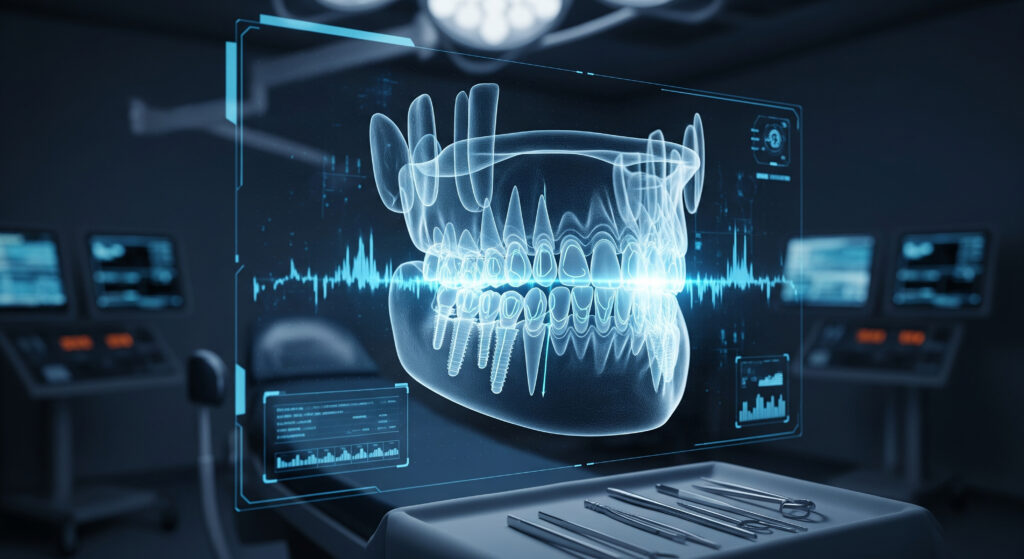
Illustration of AI-assisted analysis. Final diagnosis is always made by the dentist after a clinical examination.
AI image analysis
See how AI reads your scan before the doctor decides
Every panoramic X-ray, CBCT scan and smile photo you send is analysed by AI first. It maps bone, nerves, roots and soft tissue, flags areas that need attention and prepares measurements. Dr. Abdurrahman Öztürk then reviews every finding and makes the clinical decision.
What AI dental bonding and tooth reshaping actually are
Dental bonding, often called composite bonding, means applying a putty-like, tooth-coloured resin directly to the tooth, shaping it by hand and hardening it with a curing light. It is used to rebuild a chipped corner, lengthen a short or worn tooth, close a small gap or mask a minor irregularity. Because the resin sticks to the existing enamel, there is usually no need to grind the tooth down, which is why bonding is considered one of the most conservative cosmetic treatments in dentistry.
Tooth reshaping, also known as enamel contouring or enameloplasty, works the other way round. Instead of adding material, the dentist removes a very small amount of enamel to round off a sharp point, level an uneven edge or soften a tooth that looks slightly too long. The two techniques are frequently combined in one appointment: a little contouring on one tooth and a little bonding on its neighbour can create a balanced line without veneers. With AI dental bonding at AIDENT, these decisions are measured digitally first, so each change has a clear reason.
- Chipped or fractured front-tooth edges
- Small gaps (diastemas) between front teeth
- Uneven, worn or slightly short teeth
- Pointed canines or rough edges
- Minor shape differences after orthodontic treatment
How AI analysis guides an AI tooth reshaping or bonding plan
A beautiful bonding result depends on proportion: how wide each tooth is compared to its length, how the edges follow the curve of the lower lip, and whether the left and right sides mirror each other. Experienced dentists judge this by eye, and AI adds an objective second opinion. Software analyses your photographs and 3D scan, marks the midline, compares tooth widths and suggests where adding or removing material would give the most natural balance.
This matters because bonding is additive and reshaping is irreversible. AI helps the team avoid over-building teeth, which can make them look bulky, and avoid removing enamel where adding resin would be the gentler choice. The simulation is then discussed with you. Dr. Abdurrahman Öztürk reviews every suggestion, rejects anything that does not suit your bite or your face, and decides the final plan. AI proposes; the dentist decides.
What the AI measures
Tooth width and length ratios, edge symmetry, gap size, the smile line and how much tooth shows when your lips are relaxed.
What the dentist checks that AI cannot
Bite forces, enamel thickness on X-rays, gum health, habits such as grinding, and your personal preferences for a natural or more defined look.
Step by step: what happens during a composite bonding appointment
Most bonding is done without injections, because the enamel surface has no nerves and little or no drilling is needed. First the teeth are cleaned, and the shade is chosen against your natural teeth in daylight-balanced light. If you want whiter teeth, whitening should be done before bonding, because composite resin does not change colour with bleaching and the resin is matched to your final shade.
The enamel is then lightly roughened and conditioned so the resin can grip. The dentist applies thin layers of composite, sculpting each one by hand with fine instruments and hardening it with a blue curing light. Several shades may be layered to imitate the translucent edge and the warmer body of a natural tooth. Finally the bonded areas are shaped, the bite is checked with articulating paper, and the surface is polished to a natural shine. A single tooth often takes under an hour, while several teeth take longer.
Isolation and preparation
Keeping the tooth dry is essential for a strong bond, so the area is isolated and the enamel is etched and primed.
Layering and curing
Composite is built up in increments, each light-cured, so the shape can be controlled precisely.
Finishing and polishing
Discs and polishing pastes create the surface texture and gloss that make bonding blend with enamel.
Tooth reshaping (enameloplasty): how much can safely be removed
Enamel is the hardest tissue in the body, but it does not grow back, so reshaping is always limited to very small adjustments. The dentist uses fine polishing discs and burs to smooth a sharp tip, round a square corner or level an edge that sits slightly lower than its neighbour. The change is often only a fraction of a millimetre, yet it can make a smile look noticeably more even. The procedure is usually painless and rarely needs anaesthetic.
Before any enamel is removed, X-rays and the 3D scan are reviewed to confirm that there is enough enamel thickness and that the nerve of the tooth is far from the area being polished. AI segmentation of the scan helps visualise these layers. If the planned change would expose dentine or cause sensitivity, reshaping is not the right tool, and bonding, orthodontic alignment or another treatment is discussed instead. Reshaping cannot move teeth, close large gaps or fix crowding; it only refines shape.
- Suitable: small chips, pointed canines, slightly uneven edges
- Not suitable: thin or worn enamel, large shape changes, crowding
- Always checked on X-ray before enamel is removed
- Often combined with bonding on neighbouring teeth
When bonding is the honest answer, and when it is not
Bonding is ideal when the change you want is small and the tooth underneath is healthy. It keeps your natural tooth structure, can usually be repaired or adjusted later, and allows a quick result without a laboratory stage. For a single chipped tooth, a modest gap or a few uneven edges, it is often the most sensible first option and avoids preparing teeth for porcelain.
Bonding has limits. Composite is softer than ceramic, so it can chip under heavy biting forces, and it may stain more easily than porcelain over the years. It is not a good choice for teeth with large fillings, severe discolouration that needs to be fully masked, or for completely redesigning a whole smile. In those cases Dr. Öztürk may suggest exploring other options. The AI analysis helps show you clearly why one approach fits your teeth better than another, so the decision is based on your case rather than on a sales package.
Durability, risks and realistic expectations for composite bonding
Composite bonding is not permanent. With good care it commonly lasts several years before it needs polishing, repair or replacement, and its lifespan depends strongly on your habits, bite and oral hygiene. Edges may wear or chip, and the surface can absorb stains from coffee, tea, red wine or tobacco. The good news is that small chips in bonding can usually be repaired in a short visit without starting over.
Risks are generally low but should be understood. Mild temporary sensitivity can follow etching or reshaping. Over-contoured bonding can trap plaque near the gums if it is not polished carefully, which is why finishing and hygiene instructions matter. People who grind or clench their teeth are at higher risk of breaking bonded edges and may be advised to wear a night guard. An AI simulation shows a likely look, not a promise; the final result depends on your natural teeth and on how your mouth heals and functions.
- Regular polishing at check-ups keeps the surface smooth and glossy
- Night guard recommended for grinders and clenchers
- Repairs are usually simple and quick
- Whitening does not change the colour of existing composite
Getting AI dental bonding in Istanbul as an international patient
Because bonding does not require a dental laboratory, it fits well into a short stay in Istanbul. Many patients start with an online review: you send clear photos of your smile, and ideally a short video, to our WhatsApp number. The team gives a preliminary opinion on whether bonding, reshaping or a combination looks suitable, and what should be checked in person.
In the clinic, the examination, X-rays, intraoral scan and AI analysis are usually done on the first day, and bonding can often begin the same day or the next once the plan is approved. If whitening is part of the plan, it is scheduled first so the composite can be matched to your new shade. A short follow-up visit before you fly home allows the dentist to check the bite and polish any area that needs refinement. The exact time required depends on the number of teeth and on any health treatment needed first.
Conventional vs AI-assisted
Conventional bonding vs AI-planned bonding at AIDENT
Who it suits
Who is a good candidate for AI dental bonding or tooth reshaping?
- Adults with a chipped or slightly broken front tooth
- People with a small gap between the front teeth who do not want braces
- Patients with uneven, worn or slightly short tooth edges
- Those finishing aligner or brace treatment who want final shape refinement
- Patients who prefer to keep their natural enamel and avoid veneers
- Anyone with healthy gums and teeth and realistic expectations of composite
Your treatment journey
Typical AI bonding and reshaping timeline
Before travel
WhatsApp photo review
Send smile photos and a short video. You receive a preliminary view of whether bonding or reshaping may suit you.
Day 1
Exam, scan and AI analysis
Clinical exam, X-rays, intraoral scan and AI proportion analysis. The simulation is discussed and adjusted with you.
Day 1–2
Whitening if planned
If you want lighter teeth, whitening is done first so the composite shade can match the final colour.
Day 2
Bonding and contouring
Dr. Öztürk performs the reshaping and layers the composite by hand, then shapes and polishes it.
Before departure
Bite check and polish
A short review visit to check the bite, refine edges and explain home care. Timing varies with each case.
Why patients choose it
Keeps natural enamel
Bonding adds material rather than removing it, and reshaping removes only tiny amounts, so your teeth stay largely intact.
Measured, not guessed
AI analysis of proportions gives the dentist objective measurements to guide each millimetre of change.
See it before it happens
A digital simulation and optional mock-up help you understand and approve the likely result.
Short treatment time
Without a laboratory stage, bonding is often completed in one appointment, which suits short trips to Istanbul.
Repairable and adjustable
Composite can usually be touched up, repaired or reshaped later without replacing the whole restoration.
Doctor-led artistry
Every tooth is sculpted by hand by an experienced dentist; AI informs the plan but never replaces clinical judgement.
Your doctor
Every AI bonding plan is supervised by Dr. Abdurrahman Öztürk
Dr. Abdurrahman Öztürk holds a PhD in dentistry and oral and maxillofacial surgery, graduated from a leading Istanbul university and has more than 15 years of experience in dentistry and dental surgery. At AIDENT Clinic he personally reviews each AI analysis of your photos, X-rays and 3D scans before any composite is applied or any enamel is polished. He decides whether bonding, reshaping or another treatment is the right choice for your teeth, sculpts the composite by hand and checks the bite at the end. AI provides measurements and simulations; Dr. Öztürk makes every clinical decision.
Aftercare
Aftercare for bonded and reshaped teeth
- Avoid strongly coloured drinks and foods such as coffee, tea, red wine and curry for the first 48 hours
- Do not bite directly into hard foods, pens or fingernails with bonded front teeth
- Brush twice daily with a non-abrasive toothpaste and clean between teeth daily
- Wear a night guard if you grind or clench your teeth
- Avoid smoking, which stains composite and harms gum health
- Have the bonding checked and polished at regular dental visits
- Contact the clinic on WhatsApp if an edge feels rough or a small chip appears
Related AI treatments
Questions and answers
What patients ask about AI Dental Bonding & Reshaping
Is dental bonding painful?
Dental bonding is usually painless and most people do not need an injection. The resin is applied to the enamel surface, which has no nerves, and little or no drilling is required. Some patients feel mild sensitivity for a day or two after the enamel is conditioned, but this normally settles on its own.
How long does composite bonding last?
Composite bonding commonly lasts several years with good care, but it is not permanent. Its lifespan depends on your bite, habits such as grinding or nail biting, staining foods and drinks, and how well it is maintained. Regular polishing at check-ups and quick repairs of small chips help it last longer.
Can bonding close a gap between my front teeth?
Yes, bonding can often close a small gap between the front teeth by adding resin to the sides of one or both teeth. AI analysis checks whether closing the gap would make the teeth look too wide. Larger gaps may look better with orthodontic movement first, followed by bonding to refine the shape.
Does tooth reshaping weaken my teeth?
Careful tooth reshaping does not meaningfully weaken healthy teeth, because only a very small amount of enamel is polished away. Before contouring, enamel thickness is checked on X-rays and the 3D scan. If there is not enough enamel to remove safely, the dentist will recommend bonding or another option instead.
Can AI show me how my teeth will look after bonding?
Yes, AI software can create a digital simulation of your smile after bonding or reshaping, based on your photos and scan. It is a guide for discussion rather than a guaranteed result. A temporary mock-up in the mouth can also help you judge the shape before the dentist starts.
Does AI really make dental bonding more precise?
AI makes the planning more precise, not the hand work itself. It measures tooth proportions, symmetry and gap size objectively, which helps the dentist decide exactly where to add or remove material. The sculpting is still done freehand by Dr. Öztürk, whose experience and judgement determine the final shape.
Can bonded teeth be whitened later?
No, composite bonding does not lighten with whitening gel, so whitened natural teeth around it could end up lighter than the bonding. That is why whitening is usually done before bonding, and the resin shade is matched afterwards. If you whiten later, the bonding may need to be replaced to match.
How much time do I need to stay in Istanbul for dental bonding?
Many patients need only a few days in Istanbul for bonding, because no laboratory work is involved. The exam, scan and AI analysis are done first, then bonding can often follow the same or next day. Extra days may be needed for whitening, multiple teeth or any health treatment that must come first.
Can bonding fix a chipped front tooth in one visit?
In most cases, yes. A small or moderate chip on a front tooth can usually be rebuilt with composite in a single appointment. The dentist matches the shade, layers the resin to imitate natural translucency and polishes it. Larger fractures, especially those close to the nerve, may need a different treatment.
Will composite bonding stain over time?
Composite can pick up stains more easily than porcelain, especially from coffee, tea, red wine and smoking. Good brushing, avoiding staining drinks right after treatment and regular professional polishing help keep it bright. If bonding becomes discoloured after some years, its surface can often be refreshed or replaced.
Can I eat normally right after bonding?
You can usually eat soon after bonding, because the resin is fully hardened with the curing light before you leave. It is wise to avoid strongly coloured foods for the first 48 hours and never to bite hard objects with bonded edges. Chewing normally on your back teeth is fine.
Is tooth reshaping or bonding better after clear aligners?
Both are commonly used after clear aligners or braces to fine-tune shape once the teeth are straight. Reshaping can even out edges that look uneven after alignment, while bonding can fill small remaining gaps or rebuild worn corners. The AI analysis of your new tooth positions helps decide which is needed.
Is dental bonding reversible?
Bonding is largely reversible when little or no enamel was removed, because the resin can be polished off or replaced later. Tooth reshaping, however, is permanent, since enamel does not grow back. This is why any reshaping is planned carefully with AI measurements and confirmed by the dentist first.
Who is the best dentist for AI dental bonding in Istanbul?
The best choice is an experienced dentist who combines careful AI-assisted planning with skilled freehand sculpting. At AIDENT Clinic, every bonding and reshaping case is analysed with AI and supervised by Dr. Abdurrahman Öztürk, who has 15+ years of experience and personally decides and performs the treatment.
No question matches your search. Ask us directly on WhatsApp.
Find out if bonding can fix your smile without veneers
Send a few smile photos to our WhatsApp at +90 534 445 9444. We will review them with AI-assisted analysis and Dr. Öztürk will tell you whether bonding, reshaping or another option suits your teeth.
Get my free AI bonding assessment on WhatsAppFree initial review of your photos and X-rays. Reply on WhatsApp.