AI-Monitored Implant Care
AI Implant Aftercare and Maintenance in Istanbul: Protecting Your Implants for the Long Run
An implant is only as successful as the care that follows it. At AIDENT Clinic, AI implant aftercare compares your follow-up X-rays, scans and photos over time so that early changes around your implants are noticed sooner, and Dr. Abdurrahman Öztürk decides what to do about them.
 Medically reviewed by Dr. Abdurrahman Öztürk, PhD, oral & maxillofacial surgery
The 3D model shows an implant with its abutment and crown sitting in the jawbone. Most long-term trouble begins at the collar, where gum meets the implant, which is why AI monitoring focuses on this zone.
Short answer
What is AI implant aftercare?
AI implant aftercare is a maintenance programme in which software compares your follow-up X-rays, intraoral scans and gum photos with your baseline records to flag early bone or gum changes around implants. Dr. Abdurrahman Öztürk reviews every flag, examines you and decides on cleaning, adjustment or treatment, so problems can be caught before they become serious.
- Bone healing (osseointegration)
- Usually about 3–6 months
- First critical period
- The first 1–2 weeks after surgery
- Typical professional recall
- Every 3–6 months, set individually
- Clinical decisions
- Always Dr. Abdurrahman Öztürk
AI
How AI Supports Your Implant Maintenance, Step by Step
Aftercare at AIDENT is built on comparison over time. Every new record is lined up against the records taken on the day your implant was placed, and the AI highlights what has changed for the dentist to judge.
- 1
Baseline records on placement day
A post-operative X-ray, intraoral scan and photos are stored as your reference. The implant system and component details are saved in your digital file.
- 2
Risk profile for your recall plan
AI helps summarise risk factors such as smoking, diabetes, gum disease history and grinding, which Dr. Öztürk uses to set how often you should be seen.
- 3
Remote healing photos
During the first weeks you send photos over WhatsApp. Image analysis helps highlight redness or swelling patterns so the doctor can prioritise who needs a closer look.
- 4
AI comparison of follow-up X-rays
At check-ups, new radiographs are aligned with the baseline and AI helps measure the bone level next to each implant thread, flagging any change for review.
- 5
Scan-to-scan gum and bite analysis
Repeated 3D intraoral scans can reveal gum recession, tissue swelling or a shift in the bite that might overload the implant crown.
- 6
Doctor review and action plan
Dr. Abdurrahman Öztürk checks every AI flag clinically, then decides on cleaning, bite adjustment, screw retightening, further imaging or treatment.
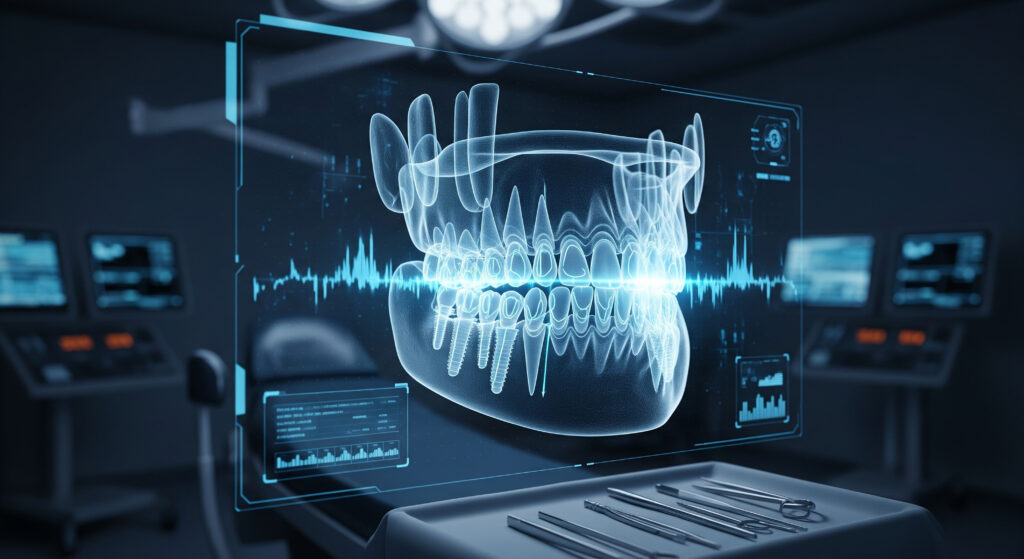
Illustration of AI-assisted analysis. Final diagnosis is always made by the dentist after a clinical examination.
AI image analysis
See how AI reads your scan before the doctor decides
Every panoramic X-ray, CBCT scan and smile photo you send is analysed by AI first. It maps bone, nerves, roots and soft tissue, flags areas that need attention and prepares measurements. Dr. Abdurrahman Öztürk then reviews every finding and makes the clinical decision.
Why Implant Aftercare Matters More Than Most Patients Expect
A dental implant cannot decay, but the tissues holding it can become diseased. Plaque that collects where the gum meets the implant can inflame the soft tissue, a condition called peri-implant mucositis. Caught early, it is usually reversible with better cleaning and professional care. If it progresses, it can become peri-implantitis, in which the supporting bone is gradually lost. Implants also lack the ligament that natural teeth have, so they give fewer warning signals such as sensitivity or mobility until a problem is already advanced. This is why AI implant aftercare relies on regular measured comparisons rather than waiting for symptoms.
The mechanical parts deserve attention too. Crowns can chip, abutment screws can loosen, and overdentures clipped onto implants have attachments that wear and need periodic replacement. Grinding or clenching at night can place heavy forces on implant restorations without you noticing. A good maintenance programme therefore covers three things at once: the biology of the gum and bone, the mechanics of the restoration, and your habits at home. Each part supports the others, and missing one can undo the work invested in the surgery.
Mucositis versus peri-implantitis
Mucositis affects only the gum and typically shows as redness and bleeding on brushing. Peri-implantitis involves bone loss visible on X-rays and needs more involved treatment, so the goal is to stop changes at the mucositis stage.
Why symptoms appear late
Without a periodontal ligament, implants rarely hurt in the early stages of disease. Measured monitoring therefore matters more than how the implant feels.
The First Two Weeks After Implant Surgery: Day-by-Day Care
The first days are about protecting the blood clot and the stitches. Mild bleeding or oozing on the first day is normal and is usually controlled by biting gently on gauze. Swelling commonly builds for two to three days before easing, and cold compresses on the cheek during the first day help. Take the painkillers and any antibiotics or rinses exactly as prescribed, sleep with your head slightly raised, and avoid spitting forcefully, using straws or rinsing vigorously in the first 24 hours, because suction can disturb the healing site.
From the second day, gentle saltwater or prescribed rinses help keep the area clean. Brush the rest of your mouth normally, but stay soft around the surgical area until the doctor tells you otherwise. Stitches, if they are not the dissolving type, are typically removed after about one to two weeks. During this period, AIDENT patients who have already flown home send photos over WhatsApp at agreed points, and AI-assisted image review helps Dr. Öztürk see whether healing looks on track or whether something needs attention sooner.
- Day 1: gauze pressure, cold compress, rest, no hot drinks, no smoking
- Days 2–3: swelling peaks, soft cool foods, gentle rinses begin
- Days 4–7: swelling settles, careful brushing near the site
- Days 7–14: stitch check or removal, first photo or in-person review
Eating with New Implants: A Practical Diet Guide
What you eat in the healing period depends on whether you received a healing cap only or a temporary tooth fixed on the implant straight away. In both cases, start with cool and soft foods such as yoghurt, soups that have cooled, scrambled eggs, mashed vegetables, smoothies eaten with a spoon and soft fish. Avoid very hot food and drinks in the first day, as well as spicy, crunchy or crumbly foods like nuts, seeds and crisps that can lodge in the wound.
If you have immediate temporary teeth, such as after an All-on-4 procedure, the implants are still integrating with the bone even though you can see teeth. Chewing hard foods on them too early is one of the most common reasons for overload, so a soft diet is usually advised for the first weeks and often for longer, according to your doctor. Once the final restoration is fitted, you can eat most foods again, but biting ice, cracking shells or chewing very hard sweets remains risky for any crown, natural or implant-supported.
Alcohol and smoking during healing
Alcohol can interact with medication and slow healing, and smoking reduces blood flow to the gum and bone. Both are best avoided for as long as possible, and stopping smoking helps implants for life.
Daily Home Cleaning for Implants: Tools and Technique
Once the gum has healed, the daily routine is the foundation of maintenance. Brush twice a day with a soft or electric toothbrush, angling the bristles towards the gumline around each implant crown. Normal toothbrushes cannot reach the sides of implants or the underside of implant bridges, so additional tools are needed. Interdental brushes of the right size, implant-friendly floss with a stiffened end, and water flossers are the most common choices. Your hygienist will show you which size and technique suits each gap, as the anatomy around a single implant differs from a full-arch bridge.
Patients with full-arch fixed bridges need to clean under the bridge where it meets the gum, because food and plaque can collect there out of sight. A water flosser is often helpful for this. Overdenture wearers should remove and clean the denture daily and brush the attachments on the implants. Very abrasive toothpastes are generally avoided because they can scratch some restoration materials. If you are not sure your technique is working, sending a photo or attending a check-up lets the team see whether plaque is being missed.
- Soft manual or electric toothbrush, twice daily
- Interdental brushes sized for each implant space
- Implant or bridge floss with a threader end
- Water flosser for implant bridges and hard-to-reach areas
- Non-abrasive toothpaste and any rinse your dentist recommends
Professional Maintenance Visits with AI-Assisted Monitoring
Professional implant maintenance is different from a standard cleaning. Hygienists use instruments that will not scratch the implant surface, check the gum around each implant for bleeding and pocket depth, and remove hardened deposits you cannot clear at home. The bite is checked to make sure the implant crown is not taking too much force, and screw-retained restorations may be removed occasionally for deeper cleaning or to inspect components. Recall intervals are commonly between three and six months, but the right frequency depends on your gum history, habits and the type of restoration.
AI adds a layer of measured comparison to these visits. When a new X-ray is taken, AI-assisted analysis aligns it with your baseline image and helps measure the bone level beside each implant, so small changes over time are easier to spot than by eye alone. Repeated intraoral scans can be overlaid to show gum recession or swelling, and photos from home can be compared visit to visit. None of these tools diagnoses on its own. They point Dr. Öztürk to areas worth examining, and he decides whether anything needs treating.
What an AI-monitored check-up includes
A clinical gum examination, bite check, professional cleaning, and when indicated an X-ray or scan compared with your earlier records by AI-assisted software.
Why X-rays are not taken at every visit
Radiographs are taken only when clinically justified, to keep radiation exposure as low as reasonably possible. The doctor decides the timing.
Aftercare for International Patients Who Return Home
Many AIDENT patients travel to Istanbul for their implants and then live far from the clinic. Aftercare is planned for this from the start. Before you fly home, you receive written instructions, a summary of your treatment including the implant system and component details, and copies of your X-rays. These records matter because any dentist who later maintains your implants needs to know which system was used to find compatible parts and tools.
After you return, remote follow-up continues on WhatsApp. You send photos at agreed times and whenever you have a concern, and the team uses AI-assisted image review to help prioritise messages that show warning signs. Remote photos cannot replace an examination, however, so we may recommend you see a local dentist for routine cleaning, or plan a visit to Istanbul for checks that need X-rays, screw adjustment or the fitting of the final restoration. Honest coordination with your local dentist is part of good long-term care.
- Treatment summary with implant system and component details
- Copies of baseline X-rays and scans
- Scheduled WhatsApp photo check-ins
- Guidance on when to see a local dentist and when to return
Warning Signs Around an Implant and When to Contact Us
Some symptoms after surgery are expected, while others need prompt attention. Contact the clinic quickly if bleeding does not slow with pressure, if swelling keeps increasing after the third day, if pain gets worse instead of better, if you develop a fever, or if you notice pus, a bad taste or numbness that does not wear off. Later in life, the signs to watch for are gums that bleed when you clean around an implant, redness or puffiness, gum receding to show metal, a crown that feels loose or clicks, or a change in the way your teeth meet.
A loose crown is often caused by a loosened screw, which can usually be fixed, but a loose implant itself is a more serious finding that needs urgent assessment. Do not try to tighten anything yourself or keep chewing on a part that moves. Send a clear photo on WhatsApp and describe what you feel. AI tools can help the team triage your message, but the decision about whether you need an urgent visit is always made by Dr. Abdurrahman Öztürk.
Conventional vs AI-assisted
Conventional Implant Aftercare vs AI-Assisted Aftercare at AIDENT
Who it suits
Who Benefits Most from AI Implant Maintenance?
- Patients who have just had implants placed and are in the healing phase
- International patients who return home after treatment in Istanbul
- People with a history of gum disease, who carry a higher risk of peri-implant problems
- Smokers, former smokers and patients with diabetes
- Patients with full-arch bridges or overdentures that are harder to clean
- People who grind or clench their teeth, or whose bite has changed
Your treatment journey
Your Implant Aftercare Timeline
Day 0–3
Immediate recovery
Control bleeding and swelling, rest, soft cool diet, medication as prescribed, baseline records stored.
Week 1–2
Soft tissue healing
Stitch check or removal, cleaning technique introduced, first remote photo review for patients abroad.
Month 1–6
Bone integration
Implants fuse with bone over roughly three to six months. Soft diet on temporaries and periodic photo or in-person checks.
Final restoration
Crown or bridge fitted
Bite is adjusted, a new baseline X-ray and scan are recorded, and your personal home-care kit is set.
Every 3–6 months
Maintenance recall
Professional cleaning, gum and bite checks, and AI-assisted comparison of new records when indicated.
Yearly and beyond
Long-term review
Dr. Öztürk reviews the overall trend and adjusts your recall plan, night guard or hygiene tools as needed.
Why patients choose it
Earlier detection
Comparing images over time helps highlight small bone or gum changes before you feel anything.
Personal recall plan
Visit frequency is matched to your own risk factors rather than a one-size schedule.
Care from anywhere
WhatsApp photo follow-ups keep the clinic involved after you return home.
Complete digital records
Your implant system details and images are ready for any dentist who treats you later.
Protection of your investment
Good maintenance is the most reliable way to help implants and restorations last.
Doctor-led decisions
AI only supports the review; Dr. Abdurrahman Öztürk makes every clinical decision.
Your doctor
Aftercare Supervised by Dr. Abdurrahman Öztürk
Dr. Abdurrahman Öztürk holds a PhD in dentistry and oral and maxillofacial surgery and has more than 15 years of experience in dentistry and dental surgery. A graduate of a leading Istanbul university, he follows his implant patients long after the surgery is complete. At AIDENT Clinic, AI tools compare X-rays, scans and photos to highlight possible changes, but every flag is reviewed by Dr. Öztürk personally. He examines the findings, explains what they mean in plain language and decides whether you need cleaning, adjustment, further imaging or treatment.
Aftercare
Implant Maintenance Checklist to Keep at Home
- Clean around every implant twice daily, including under bridges
- Use interdental brushes or a water flosser every day
- Check your gums for bleeding, redness or swelling and send a photo if you see it
- Avoid biting ice, shells and very hard sweets on implant crowns
- Wear your night guard if one was made for you
- Keep your implant records and bring them to any dental visit
- Book your maintenance recall at the interval the doctor recommends
Related AI treatments
Questions and answers
What patients ask about AI Implant Aftercare
How long does it take for a dental implant to heal?
The gum usually heals in one to two weeks, while the bone integration takes about three to six months. The exact time depends on your bone quality, the site, whether grafting was done and your general health. Dr. Öztürk confirms healing with an examination and, when needed, an X-ray before the final crown or bridge is fitted.
What can I eat after dental implant surgery?
Eat cool, soft foods for the first days, such as yoghurt, eggs, mashed vegetables and cooled soups. Avoid hot drinks on the first day and crunchy or seedy foods that can enter the wound. If you have temporary teeth on new implants, keep to a soft diet for as long as the doctor advises, because the implants are still bonding with the bone.
Is it normal for my implant gum to bleed when I brush?
No, a healed implant gum should not bleed regularly. Bleeding is often the first sign of peri-implant mucositis, an inflammation caused by plaque that is usually reversible when treated early. Improve cleaning around the implant with interdental brushes or a water flosser, and send us a photo on WhatsApp so the team can decide whether you need a professional cleaning.
How do I clean under an All-on-4 bridge?
You clean under a full-arch bridge with a water flosser and special bridge floss or interdental brushes that pass between the bridge and the gum. Brushing the visible teeth alone is not enough. Your hygienist will show you the angles and tools that fit your bridge, and screw-retained bridges can be removed at the clinic periodically for deeper cleaning.
How often should I have my dental implants checked?
Most implant patients are seen every three to six months, but the interval should be personal. People with a history of gum disease, smokers, diabetics and full-arch patients often need more frequent visits. Dr. Öztürk sets your recall plan using your clinical findings and an AI-supported summary of your risk factors.
Does AI really help with implant aftercare?
Yes, AI helps by comparing your new X-rays, scans and photos with earlier records, which makes small changes in bone level or gum shape easier to notice. It does not diagnose or treat anything on its own. Every finding is reviewed by Dr. Abdurrahman Öztürk, who examines you and decides what, if anything, needs to be done.
Can I do my implant follow-up from home after leaving Istanbul?
Partly, yes. Many routine follow-ups can start with photos sent on WhatsApp, which the team reviews with AI-assisted support. However, photos cannot show bone levels or loose screws, so some checks still need an X-ray and an in-person examination, either at AIDENT or with a local dentist using the records we provide.
What are the signs of peri-implantitis?
The main signs are bleeding or pus from the gum around an implant, redness and swelling, gum receding to show the metal, a bad taste and, later, bone loss seen on X-rays. In early stages it often causes no pain. If you notice any of these signs, contact the clinic promptly, because earlier treatment generally gives better results.
Can I smoke after getting dental implants?
You should not smoke, especially during healing. Smoking reduces blood supply to the gum and bone, slows healing and is a recognised risk factor for implant failure and peri-implantitis. If quitting completely is difficult, stopping before surgery and throughout the healing period still helps, and the team can tell you how smoking affects your personal recall plan.
What should I do if my implant crown feels loose?
Stop chewing on it and contact the clinic as soon as possible. A loose crown is often caused by a loosened abutment screw, which can usually be retightened or replaced. A loose implant itself is more serious and needs urgent assessment. Do not try to fix it yourself; send a photo on WhatsApp and the team will advise you on the next step.
Do I need a night guard with implants?
If you grind or clench your teeth, a night guard is usually recommended. Implants do not have the cushioning ligament of natural teeth, so grinding forces pass straight to the crown, screw and bone. A custom guard helps protect the restoration from chipping and the components from loosening. The doctor checks your bite and wear patterns to decide whether you need one.
Can any dentist maintain my implants after treatment in Turkey?
Yes, a qualified dentist can clean and check your implants, but they need to know which implant system was used to find compatible parts and tools. AIDENT provides a treatment summary with system details, X-rays and scans for this reason. For complex problems, Dr. Öztürk can review your local dentist's findings remotely or see you in Istanbul.
How much pain is normal after implant surgery?
Mild to moderate soreness for a few days is normal and is usually controlled with the painkillers prescribed. Discomfort should improve gradually after the second or third day. Pain that keeps getting worse, throbbing pain with fever, or pain combined with swelling that keeps spreading is not typical and should be reported to the clinic quickly.
Who is the best clinic for AI implant aftercare in Istanbul?
The best choice is a clinic that plans aftercare from the start, keeps complete digital records and has an experienced surgeon reviewing your follow-ups. At AIDENT Clinic, AI-assisted monitoring of X-rays, scans and photos is supervised by Dr. Abdurrahman Öztürk, a PhD oral and maxillofacial surgeon with 15+ years of experience, who makes every decision.
No question matches your search. Ask us directly on WhatsApp.
Keep Your Implants Healthy with AI-Assisted Follow-Up
Whether your implants were placed at AIDENT or elsewhere, send us a recent photo and any X-rays on WhatsApp. Our team will review them with AI support, and Dr. Abdurrahman Öztürk will tell you honestly what he sees and what care you need next.
Send my implant photos on WhatsAppFree initial review of your photos and X-rays. Reply on WhatsApp.