AI-Planned Full Mouth Reconstruction
AI Full Mouth Dental Implants in Istanbul: New Teeth for Both Jaws, Planned as One Bite
When most or all of your teeth are missing or failing, AI full mouth dental implants let us plan both jaws together: bone, nerves, sinuses, bite height and smile line are analyzed digitally, then Dr. Abdurrahman Öztürk confirms every decision before a single implant is placed.
 Medically reviewed by Dr. Abdurrahman Öztürk, PhD, oral & maxillofacial surgery
The 3D model shows upper and lower jaws with planned implant positions, the nerve and sinus zones that AI highlights, and the full-arch bridges that will sit on top.
Short answer
What are AI full mouth dental implants?
AI full mouth dental implants are a complete reconstruction of the upper and lower teeth on implants, planned with artificial intelligence. AI analyzes CBCT scans, photos and the bite to map bone, nerves and sinuses and to simulate the new smile, while Dr. Abdurrahman Öztürk makes every clinical decision and performs the treatment in Istanbul.
- Arches treated
- Upper, lower or both
- Typical implants per arch
- 4 to 8, or more for separate bridges
- Planning
- AI-analyzed CBCT + 3D scan
- Supervision
- Dr. Abdurrahman Öztürk, 15+ years
AI
How AI Plans a Full Mouth Implant Reconstruction
A full mouth case is not two separate jaws; it is one bite. Our AI-assisted workflow brings every scan into a single digital patient so the upper and lower arches are designed to work together, and Dr. Öztürk reviews each step.
- 1
Remote photo and X-ray review
You send smile photos and any existing X-rays on WhatsApp. AI helps sort and pre-analyze them so the doctor can give you an honest first opinion before you travel.
- 2
CBCT scan with AI segmentation
In Istanbul, a 3D CBCT scan is taken and AI software separates bone, nerve canals, sinuses and remaining teeth, giving the doctor a clear map of both jaws.
- 3
Intraoral and facial scanning
A digital scan of the gums and any remaining teeth is merged with facial photos so the new teeth can be designed around your lips, face and speech.
- 4
Bite and vertical height simulation
Many full mouth patients have lost bite height over the years. The digital plan simulates how tall the new teeth should be so the face, jaw joints and chewing muscles work comfortably.
- 5
Implant positions and surgical guide
Implant angles, lengths and positions are planned in the 3D model for both arches, and when appropriate a guide is produced so the surgery follows the approved plan.
- 6
Prosthesis design and outcome preview
The temporary and final bridges are designed with CAD/CAM and an outcome simulation is shown to you. It is a preview, and the final result is confirmed after clinical examination.
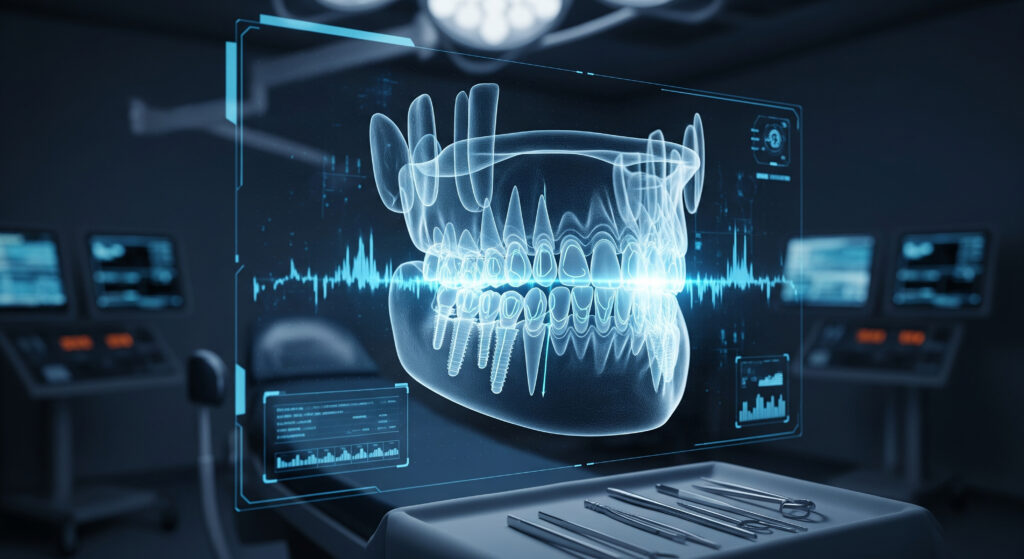
Illustration of AI-assisted analysis. Final diagnosis is always made by the dentist after a clinical examination.
AI image analysis
See how AI reads your scan before the doctor decides
Every panoramic X-ray, CBCT scan and smile photo you send is analysed by AI first. It maps bone, nerves, roots and soft tissue, flags areas that need attention and prepares measurements. Dr. Abdurrahman Öztürk then reviews every finding and makes the clinical decision.
What Full Mouth Dental Implants Mean, and Why AI Planning Matters Here
Full mouth dental implants replace all the teeth in the upper jaw, the lower jaw, or both, using implants as the foundation instead of the gums. It is the right path for people who already wear complete dentures, who have lost most of their teeth, or whose remaining teeth are so damaged by decay, fractures or advanced gum disease that they cannot be saved predictably. Unlike replacing one or two teeth, a full mouth case rebuilds the entire chewing system, so small planning errors can affect the face, speech and jaw comfort.
That is exactly where AI full mouth dental implants make a difference. Instead of planning each jaw in isolation, our software combines the CBCT scan, the intraoral scan and facial photos into one digital patient. AI segmentation highlights the available bone and anatomical risk zones, and the design tools let Dr. Abdurrahman Öztürk test different implant layouts and tooth shapes before treatment. The AI does not choose the plan; it shows the doctor more information, faster, so that his decisions are based on a complete picture of both arches.
- For complete denture wearers who want fixed or implant-retained teeth
- For failing dentitions where extraction of the remaining teeth is advised
- For patients who need one arch now and the other arch later
- For people with worn, collapsed bites that need height restored
Choosing the Right Full Mouth Design: Fixed Bridges, Segmented Bridges or Overdentures
There is no single full mouth implant solution. The best design depends on how much bone you have, the condition of your gums, your budget, how easy you need cleaning to be and how much lip support the teeth must provide. With AI-assisted planning, we can show you side by side what each option would look like on your own scans, which makes the decision far easier to understand.
Our dedicated pages explain All-on-4, All-on-6 and All-on-8 concepts and implant-supported prostheses in depth. On this page we focus on how those options are combined across a whole mouth, for example a fixed upper arch with a different design on the lower arch, and how the two are balanced so they bite together correctly.
One-piece fixed full-arch bridge
A single bridge is screwed onto several implants in each jaw. It is fixed, so only the dentist removes it. It suits patients who want teeth that feel as close as possible to natural ones and who have enough bone, sometimes with angled implants to avoid the sinus or nerve.
Segmented implant bridges
When bone volume is good throughout the jaw, the arch can be rebuilt with several shorter bridges on more implants. This usually needs more implants and sometimes more time, but a problem in one segment can be fixed without replacing the whole arch.
Implant-retained overdenture
A removable denture clips onto implants with attachments or a bar. It is more stable than a conventional denture, easier to clean and can work with fewer implants, which makes it an option when bone, health or budget limit a fixed solution.
How AI Analyzes Bone, Nerves and Sinuses Across Both Jaws
People who have been missing teeth for years usually have uneven bone loss. The upper back jaw often shrinks toward the sinus, while the lower back jaw may have little height above the nerve that gives feeling to the lip and chin. In a full mouth case, these limits exist in four zones at once, so a careful three-dimensional reading of the CBCT is essential.
AI segmentation software traces the nerve canals, the sinus floors and the bone outline slice by slice, and helps measure the width and height available at each potential implant site. Dr. Öztürk then checks these measurements himself and decides where implants can go safely, where they should be angled, and whether bone grafting or a sinus lift is needed for a particular design. Sometimes the analysis shows that a fixed bridge is possible without grafting by adjusting implant angles; sometimes it shows that grafting is the more predictable choice. Either way, you see the reasoning on your own scan.
- Bone height and width measured at each planned implant site
- Lower jaw nerve canal and chin nerve exit highlighted
- Upper sinus floor and nasal floor mapped
- Areas that may need grafting identified before surgery
Restoring Your Bite Height and Facial Support with AI Simulation
A detail that is often overlooked in full mouth treatment is vertical dimension: the distance between the upper and lower jaw when you bite. After years of missing teeth, worn teeth or old dentures, this height often collapses. The result can be deep lines around the mouth, thin lips, a shorter-looking lower face and strain on the jaw joints.
Because both arches are being rebuilt at the same time, full mouth implants are an opportunity to correct this. Digital smile design and bite simulation let us test how much height to restore, where the edges of the front teeth should sit relative to the lips, and how the teeth meet when you chew from side to side. The plan is first tried in the mouth with the temporary teeth, so the doctor can confirm comfort, speech and appearance before the final bridges are made. Restoring height is done carefully, because too much can feel tiring for the muscles and too little may not give the facial support you hoped for.
Speech and phonetics check
Sounds such as f, v and s depend on where the front teeth sit. The temporary teeth are used to test speech before the final design is locked in.
Lip support and smile line
Facial photos show how much tooth and gum is visible when you smile, which guides whether a pink gum section is needed on the bridge.
From Failing Teeth to Fixed Teeth: The Full Mouth Treatment Sequence
When some teeth remain but are failing, treatment often begins with their removal. Depending on the bone and the absence of active infection, implants may be placed in the same session and a fixed temporary bridge attached soon after, a protocol known as immediate loading. When infection, bone quality or general health makes this unwise, the doctor may recommend healing first, with a temporary denture in the meantime.
After implant placement, the implants need time to integrate with the bone, typically a few months, before the final bridges are fitted. This is why most international patients come to Istanbul for two visits: the first for scans, extractions, implant surgery and temporary teeth, and the second for the final full-arch prostheses once healing has been checked. The AI plan from the first visit is kept, so the final design is built from the same digital patient rather than started from scratch.
- Visit one: consultation, CBCT, AI planning, surgery and temporary teeth
- Healing at home with remote follow-up via WhatsApp photos
- Visit two: new scans, try-in and final bridges for both arches
Risks and Honest Limits of AI Full Mouth Dental Implants
Full mouth implant treatment is major surgery spread across both jaws, and it carries real risks. These include swelling, bruising and discomfort after surgery, infection, implants that fail to integrate, temporary or rarely lasting numbness if a nerve is irritated, sinus complications in the upper jaw, and fractures or wear of the bridge over time. Smoking, uncontrolled diabetes, grinding and poor cleaning all raise the risk of problems such as peri-implantitis, an inflammation around implants that can cause bone loss.
AI planning reduces uncertainty, but it does not remove biology. A digital simulation is a preview, not a guarantee, and guided surgery still depends on the surgeon's judgment when real bone is exposed. Some patients learn during assessment that a removable overdenture or a staged approach is safer for them than fixed teeth placed in one day. We would rather tell you that honestly than promise a result your bone or health cannot support.
Conventional vs AI-assisted
Full Mouth Implant Planning: Conventional vs AI-Assisted
Who it suits
Who Is a Good Candidate for AI Full Mouth Dental Implants?
- Adults missing all or nearly all teeth in one or both jaws
- Complete denture wearers tired of loose, uncomfortable plates
- People with many failing teeth due to decay, fractures or advanced gum disease
- Patients in reasonable general health, with diabetes or other conditions under control
- Non-smokers, or smokers willing to stop around the surgery period
- Patients able to travel to Istanbul for two visits and keep up long-term cleaning
Your treatment journey
Typical Full Mouth Implant Timeline for International Patients
Before travel
Online AI pre-assessment
Photos and X-rays sent on WhatsApp are reviewed, and Dr. Öztürk gives an initial opinion and an outline of possible options.
Visit 1, days 1–2
Scans and final planning
Clinical exam, CBCT and 3D scans, AI analysis of both jaws and a detailed discussion of the plan and its risks.
Visit 1, days 2–4
Surgery
Extractions if needed and implant placement for one or both arches, with grafting when the plan requires it.
Visit 1, final days
Temporary teeth
Where immediate loading is suitable, fixed temporary bridges are fitted; otherwise a temporary denture is provided while the implants heal.
Around 3–6 months
Healing at home
Implants integrate with the bone. You send photos for remote checks and follow a soft diet and hygiene routine.
Visit 2, about 1 week
Final full-arch bridges
New scans, try-in, bite adjustment and fitting of the final prostheses, followed by cleaning instructions.
Why patients choose it
One coordinated bite
Upper and lower teeth are designed together, which supports even chewing forces and a comfortable jaw position.
Fewer surprises in surgery
AI-assisted mapping of nerves, sinuses and bone lets the doctor anticipate challenges before the procedure begins.
A preview of your new face
Smile and bite simulations help you understand the expected change in lip support and tooth display before treatment.
Stable teeth instead of loose dentures
Implant-supported teeth do not rely on suction or adhesive, so eating and speaking usually feel more secure.
Bone preservation
Implants transmit chewing forces into the jaw, which helps slow the bone shrinkage that follows tooth loss.
Plan kept for the long term
Your digital records stay on file, making future repairs, replacements or adjustments more precise.
Your doctor
Full Mouth Cases Led by Dr. Abdurrahman Öztürk
Every AI full mouth implant case at AIDENT Clinic is supervised by Dr. Abdurrahman Öztürk, who holds a PhD in dentistry and oral and maxillofacial surgery and has more than 15 years of experience in dentistry and dental surgery. He graduated from a leading Istanbul university and personally reviews the AI analysis of each CBCT scan, the proposed implant positions and the bite design for both jaws. Software can highlight nerves, measure bone and simulate a smile, but the decisions about whether to graft, how many implants to place and which prosthesis suits you are always his clinical judgment.
Aftercare
Caring for Full Mouth Implants
- Follow a soft diet in the first weeks and avoid biting into hard foods with the temporary bridges
- Clean under each full-arch bridge daily with a water flosser, interdental brushes or special floss
- Use any prescribed mouth rinse and medication exactly as instructed
- Avoid smoking, especially during healing, as it raises the risk of implant problems
- Wear a night guard if you grind or clench your teeth
- Have professional check-ups and cleaning at least once or twice a year, with X-rays when advised
- Send photos on WhatsApp if you notice bleeding, looseness, pain or a cracked tooth
Related AI treatments
Questions and answers
What patients ask about AI Full Mouth Implants
Can I replace all my teeth with implants in one go?
Yes, in many cases both jaws can be treated during the same visit to Istanbul. Whether that is wise depends on your bone, gum health, general health and how you tolerate surgery. AI analysis of your CBCT helps Dr. Öztürk decide if one long session, two shorter sessions or a staged plan with one arch first is safer and more comfortable for you.
How many implants do I need for a full mouth?
Most full mouth reconstructions use between four and eight implants per jaw, depending on the design. A one-piece fixed bridge can work with fewer implants placed at strategic angles, while segmented bridges need more. Overdentures may need fewer. Your exact number is decided after AI-assisted bone mapping and a clinical examination, not in advance.
How long do I need to stay in Istanbul for full mouth implants?
Most patients plan two trips. The first usually takes about a week for scans, AI planning, surgery and temporary teeth. After a healing period of roughly three to six months, the second trip of around a week is for the final bridges. Grafting or complex cases may need extra time, which we will tell you before you book.
Is full mouth implant surgery painful?
The surgery itself is done under local anaesthesia, and sedation can be discussed if you are anxious, so you should not feel pain during the procedure. Afterwards, swelling, soreness and bruising are common for several days and are managed with prescribed medication, cold compresses and a soft diet. Treating both jaws can mean more swelling than a single arch.
Will I leave with teeth on the same day?
Often yes, but not always. When bone is strong enough to hold the implants firmly at placement, fixed temporary teeth can be attached within a short time. If stability is not sufficient, or infection or grafting is involved, a temporary denture is safer while the implants heal. Dr. Öztürk decides this during surgery based on what he finds.
Does AI really make full mouth implants more accurate?
AI improves the planning stage, which is where much of the accuracy comes from. It helps identify nerves, sinuses and bone limits on the CBCT and lets the doctor test implant layouts and bite designs digitally. It does not perform surgery or guarantee a result. Accuracy still depends on the surgeon's skill, your anatomy and correct healing.
Can I get full mouth implants if I have worn dentures for many years?
Usually yes, although long-term denture wearers often have more bone loss. The AI-assisted CBCT analysis shows exactly how much bone remains in each area. Depending on the findings, the plan may use angled implants, bone grafting, a sinus lift or an implant-retained overdenture. The doctor will explain which approach is realistic for your jaws.
Can I do the upper jaw now and the lower jaw later?
Yes. Many patients treat one arch first for medical, comfort or budget reasons. We still plan both jaws together digitally so the first arch is designed with the future second arch in mind. This avoids an upper bridge that later clashes with the lower teeth or sits at the wrong bite height.
What are the final full mouth implant teeth made of?
Final full-arch bridges are usually made from zirconia, from layered ceramics, or from a strong framework covered with acrylic or composite teeth. Each material has trade-offs in strength, appearance, weight, repairability and cost. The choice is discussed with you after considering your bite force, grinding habits and aesthetic goals.
How do I clean full mouth implants?
You brush the bridges twice a day like natural teeth and clean underneath them daily, where food and plaque collect. A water flosser, interdental brushes and special floss are the usual tools. Professional maintenance visits allow the hygienist to check the gums around each implant and, when needed, the bridge can be removed for deep cleaning.
Who is the best dentist for AI full mouth dental implants in Istanbul?
The best choice is a surgeon with real full-arch experience who explains your scans, risks and alternatives honestly. At AIDENT Clinic, every AI full mouth case is planned and performed under Dr. Abdurrahman Öztürk, a PhD oral and maxillofacial surgery specialist with 15+ years of experience. You can send your photos and X-rays first and judge his advice.
Are full mouth implants better than new dentures?
For many people, yes, because implant-supported teeth are much more stable and help preserve jaw bone. However, they require surgery, healing time, careful cleaning and a higher investment. Some patients, for health or anatomical reasons, are better served by a well-made denture or an implant-retained overdenture. The AI assessment helps compare these options on your own case.
Can smokers or diabetics get full mouth implants?
It is often possible, but the risks are higher. Smoking reduces blood flow and increases the chance of implant failure and gum inflammation, so we strongly advise stopping before and after surgery. Diabetes should be well controlled, and your physician's information is reviewed. Dr. Öztürk may adjust the plan, such as staging treatment, to keep it safer.
How can I start my AI full mouth implant assessment from abroad?
Send clear photos of your smile and teeth, plus any panoramic X-ray or CBCT you already have, to our WhatsApp at +90 534 445 9444. The images are pre-analyzed with AI and reviewed by Dr. Öztürk, who replies with an honest first opinion. The final plan is only confirmed after a CBCT and examination in Istanbul.
No question matches your search. Ask us directly on WhatsApp.
Find Out What Full Mouth Implants Could Look Like for You
Send your photos and X-rays on WhatsApp for a free AI-assisted pre-assessment. Dr. Abdurrahman Öztürk will review your case and explain the realistic options for both jaws before you plan your trip to Istanbul.
Get my free AI full mouth assessment on WhatsAppFree initial review of your photos and X-rays. Reply on WhatsApp.