AI-Assisted Digital Dentistry
AI Digital Dentistry in Istanbul: Scan, Plan and Treat with Artificial Intelligence
At AIDENT Clinic, AI digital dentistry links 3D scanning, CBCT imaging, AI-supported diagnosis, virtual planning and CAD/CAM production into one connected workflow. Every AI result is reviewed, and every clinical decision is made, by Dr. Abdurrahman Öztürk.
 Medically reviewed by Dr. Abdurrahman Öztürk, PhD, oral & maxillofacial surgery
This interactive model shows the kind of 3D scan an intraoral scanner produces. The same digital model is used for AI analysis, virtual planning and CAD/CAM design.
Short answer
What is AI digital dentistry?
AI digital dentistry is dental care in which 3D scans, X-rays and photos are captured digitally and analyzed with artificial intelligence software to support diagnosis, treatment planning, guided surgery and the design of restorations. The AI highlights findings and simulates options, while a qualified dentist examines the patient, checks every result and decides on the treatment.
- Supervising dentist
- Dr. Abdurrahman Öztürk
- Experience
- 15+ years in dentistry and dental surgery
- Core digital tools
- Intraoral 3D scan, CBCT, CAD/CAM, 3D printing
- First step
- Free online review of photos via WhatsApp
AI
How the AI digital dentistry workflow works at AIDENT
Each case moves through the same connected digital chain, so information captured at the start is reused accurately at every later step instead of being re-measured by hand.
- 1
Online pre-assessment
You send smile photos and any existing X-rays on WhatsApp. They are organized and reviewed so the doctor can give a first opinion before you travel.
- 2
Digital capture
In Istanbul, an intraoral scanner records your teeth in 3D and, where clinically justified, a CBCT scan images the bone, roots and nerves.
- 3
AI analysis
AI software helps segment teeth, bone and nerve canals and flags possible findings such as decay or bone loss for the dentist to verify.
- 4
Virtual treatment plan
Dr. Abdurrahman Öztürk builds the plan on a 3D model of your mouth, comparing options and their risks before anything is done.
- 5
Outcome preview
Where relevant, a simulation shows how the final teeth or smile could look, so you can discuss changes in advance.
- 6
Guided treatment and CAD/CAM
The approved plan is transferred to surgical guides and digitally designed restorations that are milled or 3D-printed, then fitted and checked clinically.
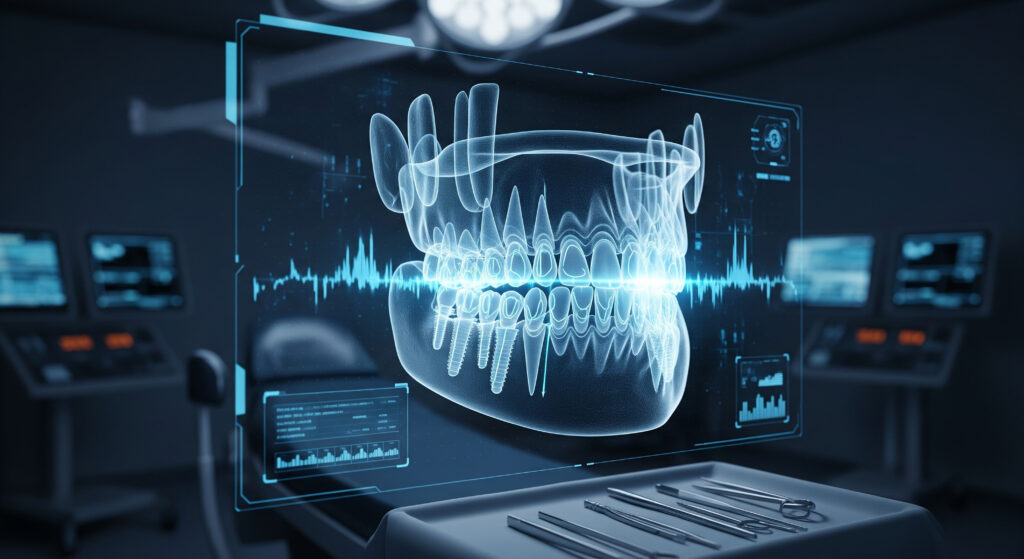
Illustration of AI-assisted analysis. Final diagnosis is always made by the dentist after a clinical examination.
AI image analysis
See how AI reads your scan before the doctor decides
Every panoramic X-ray, CBCT scan and smile photo you send is analysed by AI first. It maps bone, nerves, roots and soft tissue, flags areas that need attention and prepares measurements. Dr. Abdurrahman Öztürk then reviews every finding and makes the clinical decision.
What AI digital dentistry means at AIDENT Clinic
Digital dentistry replaces many manual, analogue steps with digital ones: impressions become 3D scans, film X-rays become digital images, and plaster models become virtual models that can be measured, rotated and planned on screen. AI digital dentistry adds another layer. Software trained on large sets of dental images helps recognise structures and patterns in your scans, speeds up repetitive measurements and simulates possible treatment results. At AIDENT Clinic in Istanbul, this is the backbone of almost every treatment we offer, from a single crown to full-mouth rehabilitation.
The key idea is that AI is an assistant, not the dentist. The software can outline a nerve canal, suggest where a tooth edge sits, or mark an area on an X-ray that may be worth a closer look. It cannot examine your mouth, feel tissue, understand your medical history or weigh your personal wishes. That is why every AI output at AIDENT is checked by Dr. Abdurrahman Öztürk, who confirms or corrects it and makes the final clinical decision together with you.
- Digital capture: intraoral 3D scans, digital X-rays, CBCT and clinical photos
- AI support: segmentation, measurement, pattern detection and simulation
- Digital execution: surgical guides, CAD/CAM design, milling and 3D printing
- Human control: diagnosis and treatment decisions remain with the dentist
How AI changes each stage of dental treatment
Traditional dentistry already uses images and models, but much of the interpretation and design work is done manually and step by step. In an AI-assisted digital workflow, data captured once can be reused across the whole treatment. The 3D scan that records your bite today becomes the base for the plan, the surgical guide and the final restoration. This continuity reduces the number of times information has to be re-created, which is where small errors and extra appointments usually creep in.
AI tools also make complex information easier to understand for patients. Instead of describing bone height or tooth position in technical terms, the dentist can show you a coloured 3D model, a virtual implant inside the bone or a simulation of the final smile. Many patients find that seeing their own case in three dimensions makes it much easier to ask the right questions and give truly informed consent.
Diagnosis
AI can help screen X-rays and scans for signs such as decay, bone loss or periapical changes, acting as a second pair of eyes. Every flagged finding is verified clinically before it influences treatment.
Planning
Treatment options are compared on a virtual model of your mouth, so the doctor can test implant positions, crown shapes or tooth movements before committing to one.
Execution
Approved plans are transferred to guides and digitally designed restorations, so what was planned on screen is reproduced as closely as possible in the mouth.
Review
Follow-up scans can be compared with earlier ones to monitor healing, gum changes or wear over time.
Choosing the right AI digital dentistry service for your case
AI digital dentistry is not one single procedure; it is a set of related services. Most patients need several of them in sequence, and the right combination depends on whether your goal is diagnosis, replacing missing teeth, improving the look of your smile or simply understanding your options. The overview below explains what each part does, so you can go to the dedicated page that matches your question. Dr. Abdurrahman Öztürk will recommend which steps are actually necessary after reviewing your case, because not every patient needs every scan or technology.
AI 3D Dental Scanning & Digital Imaging (CBCT)
The starting point of most digital cases. Intraoral scanning records teeth and gums in 3D without traditional impression trays, and CBCT shows bone and nerves when surgery or complex diagnosis is planned. See our dedicated scanning page for how each scan works.
AI Dental Diagnostics & Treatment Planning
For patients who want a thorough assessment or a second opinion. AI-assisted review of X-rays, CBCT and photos helps the doctor build a complete, prioritised treatment plan.
AI Guided Implant Surgery (Digital Implant Planning)
For anyone replacing missing teeth with implants. Implants are positioned virtually in relation to bone and nerves, and a surgical guide helps transfer that plan to the operation.
AI CAD/CAM & 3D Printing in Dentistry
For crowns, bridges, veneers, implant restorations, guides and temporaries. Restorations are designed on screen and produced by milling or 3D printing.
AI Treatment Outcome Prediction & 3D Treatment Preview
For patients who want to see a likely result before agreeing to treatment, especially cosmetic or full-arch cases. The preview is a simulation that guides discussion, not a guarantee.
Which AI digital dentistry path fits your goal?
If you have pain, a broken tooth or an unclear problem, the usual path starts with AI-supported diagnostics: digital X-rays, an intraoral scan and, if needed, a CBCT, followed by a written plan. If you are missing one or more teeth, digital implant planning and guided surgery are typically combined with CAD/CAM restorations. If your main concern is the appearance of your smile, a 3D scan and a treatment preview are often the most useful first steps, followed by digitally designed veneers or crowns.
Patients with complex needs, for example worn teeth, several missing teeth and gum problems at the same time, benefit most from the full chain, because each stage informs the next. On the other hand, a simple filling or a routine check-up rarely needs advanced 3D planning. Part of the doctor's job is to keep the digital workflow proportionate: using CBCT only when it adds real diagnostic value, and choosing guided surgery when the anatomy or the number of implants makes it worthwhile.
- Unclear symptoms or a second opinion: start with AI diagnostics and treatment planning
- Missing teeth: CBCT, digital implant planning, guided surgery and CAD/CAM crowns
- Cosmetic goals: 3D scan, outcome preview and digitally designed veneers or crowns
- Full-mouth rehabilitation: the complete digital chain from scan to final prosthesis
What AI can and cannot do in dentistry: an honest view
AI tools in dentistry are genuinely useful, but they have limits that patients deserve to know. Image-analysis software can miss findings or flag something that turns out to be harmless, especially when image quality is poor, metal restorations cause artefacts or a case is unusual. Simulations of a future smile are based on digital models and cannot fully predict how gums heal, how your lips move or how natural tissues respond. Guided surgery improves the transfer of a plan, but small deviations remain possible and the surgeon must still adapt to what is found during the procedure.
For these reasons, AIDENT does not present AI as a replacement for clinical skill or as a promise of perfect results. AI makes analysis more systematic and planning more visual; Dr. Abdurrahman Öztürk's examination, training and judgement decide what is safe and appropriate. If an AI result does not match what the doctor sees clinically, the clinical findings take priority. Every treatment, digital or not, still carries the normal risks of dentistry, which are explained to you before you agree to anything.
Where AI helps most
Consistent measurement, structure segmentation on CBCT, screening large image sets, comparing scans over time and producing clear visual explanations.
Where human judgement is essential
Medical history, soft-tissue assessment, bite function, patient preferences, risk balancing and any decision about surgery or irreversible tooth preparation.
Planning AI digital dentistry in Istanbul as an international patient
Because so much of the work is digital, a large part of your planning can begin before you arrive in Turkey. You can send clear photos of your teeth, a short description of your concerns and any recent panoramic X-ray or CBCT files over WhatsApp. These are reviewed and you receive an initial opinion on likely options and the probable number of visits. This preliminary assessment is not a final diagnosis; it is confirmed or adjusted after the clinical examination and new scans in Istanbul.
Once you are at the clinic, the digital chain helps make the most of your stay. Scans and planning usually happen early, so treatment steps can be scheduled efficiently. The time you need in Istanbul depends heavily on the treatment: diagnostics and simple restorations may need only a few days, while implants require a healing period, often meaning two separate trips. Your digital records stay on file, which makes follow-up, remote check-ins and future treatment easier wherever you live.
- Send photos and existing X-rays or CBCT files on WhatsApp: +90 534 445 9444
- Receive a preliminary, doctor-reviewed opinion before booking travel
- Confirm the final plan after examination and fresh scans in Istanbul
- Keep your digital records for follow-up and future care
Safety, radiation and data privacy in digital dentistry
Intraoral scanners use light, not X-rays, so the 3D scan of your teeth involves no ionising radiation. Digital X-rays and CBCT do use radiation, which is why they are only taken when they add diagnostic value and with settings appropriate to the clinical question. A CBCT is not a routine scan for every patient; it is chosen when bone volume, nerve position, impacted teeth or complex anatomy need to be seen in three dimensions. Pregnant patients should always tell the clinic before any imaging.
Your scans, photos and plans are personal health data. At AIDENT they are used for your diagnosis and treatment, stored securely and shared only with the people involved in your care, such as the dental laboratory producing your restorations. You can ask for copies of your digital records to take home or to share with your local dentist. If you have questions about how a particular AI tool processes your images, the team will explain it before your appointment.
Conventional vs AI-assisted
Conventional dentistry vs AI digital dentistry at AIDENT
Who it suits
Who benefits from AI digital dentistry?
- Patients planning dental implants who want precise, guided placement
- International patients who want a clear digital plan before travelling to Istanbul
- People with complex cases involving several teeth, bone loss or bite problems
- Patients considering veneers, crowns or a smile makeover who want to preview results
- Anyone seeking a detailed second opinion on an existing diagnosis or treatment plan
- Patients who find traditional impression trays difficult because of a strong gag reflex
Your treatment journey
A typical AI digital dentistry journey
Before travel
WhatsApp pre-assessment
Send photos and any X-rays. You receive a preliminary, doctor-reviewed overview of possible options.
Day 1
Examination and digital capture
Clinical examination, intraoral 3D scan, digital X-rays and CBCT if indicated.
Day 1–2
AI analysis and planning
AI-supported analysis of your scans, followed by a virtual treatment plan and, where relevant, an outcome preview discussed with Dr. Abdurrahman Öztürk.
Following days
Treatment
Guided procedures and fitting of CAD/CAM restorations or temporaries according to the approved plan.
Later visit (if needed)
Final restorations
For implants and other cases that need healing, final restorations are completed on a second trip.
After you return home
Remote follow-up
Photo check-ins via WhatsApp and comparison with your stored digital records.
Why patients choose it
Clearer diagnosis
AI-assisted review of X-rays and CBCT adds a systematic second look, always confirmed by the dentist.
More predictable planning
Options are tested on a 3D model of your mouth before any irreversible step is taken.
Comfortable impressions
Intraoral scanning replaces traditional impression trays for most restorations.
Precise restorations
CAD/CAM design from scan data helps crowns, bridges and veneers fit accurately.
Better understanding
3D models and previews help you see your case and make informed decisions.
Efficient visits
Reusing digital data across all steps helps organise treatment for patients travelling to Istanbul.
Your doctor
Dr. Abdurrahman Öztürk supervises every AI-analyzed case
Dr. Abdurrahman Öztürk holds a PhD in dentistry and oral and maxillofacial surgery and has more than 15 years of experience in dentistry and dental surgery. He graduated from a leading Istanbul university. At AIDENT Clinic he personally reviews every scan, AI analysis and digital plan. The software can help measure, segment and simulate, but he examines each patient, checks whether the AI findings match the clinical reality and decides what treatment is appropriate. This combination of surgical training and modern digital tools is what makes AI-assisted dentistry at AIDENT both advanced and responsible.
Aftercare
Caring for your teeth after digital dental treatment
- Follow the specific instructions you receive for your procedure, such as diet and cleaning after implant surgery
- Brush twice daily and clean between teeth and around restorations with floss or interdental brushes
- Attend the follow-up appointments or remote check-ins recommended in your plan
- Send photos on WhatsApp if you notice pain, swelling, a loose restoration or a change in your bite
- Keep copies of your digital scans and plan to share with your local dentist
- Ask about a night guard if you grind or clench your teeth, to protect new restorations
- Have regular check-ups and professional cleaning wherever you live
Explore every treatment in this specialty
Questions and answers
What patients ask about AI Digital Dentistry
What does AI actually do in digital dentistry?
AI helps analyse dental images and models so the dentist can work more systematically. In practice it can outline teeth, bone and nerve canals on CBCT scans, highlight possible findings on X-rays, speed up measurements and simulate treatment results. It does not diagnose or treat on its own; Dr. Abdurrahman Öztürk reviews every output and makes all clinical decisions.
Does AI really make dental treatment more accurate?
AI can make analysis and planning more consistent, but accuracy still depends on the dentist and the quality of the data. Digital scans, virtual planning and guided surgery help transfer a plan more faithfully than many manual methods. However, no technology removes all deviation or risk, which is why every step is checked clinically at AIDENT.
Is AI digital dentistry safe?
Yes, when used under proper clinical supervision it is as safe as conventional dentistry and the normal risks of each procedure still apply. Intraoral scanning uses light and involves no radiation. X-rays and CBCT are used only when they add diagnostic value. AI software only supports analysis; the dentist remains responsible for every decision.
Which AI digital dentistry service do I need first?
Most patients start with a digital examination: an intraoral 3D scan, digital X-rays and, when indicated, a CBCT. From there, Dr. Abdurrahman Öztürk recommends the next step, whether that is diagnostics and planning, guided implant surgery, CAD/CAM restorations or a treatment preview. You can begin by sending photos on WhatsApp for a preliminary opinion.
Can I get an AI dental assessment online before coming to Istanbul?
Yes, you can get a preliminary assessment online. Send clear photos of your teeth, a description of your concerns and any recent X-ray or CBCT files to +90 534 445 9444 on WhatsApp. The doctor reviews them and suggests likely options. The final plan is confirmed only after a clinical examination and new scans in Istanbul.
How much time do I need to stay in Istanbul for digital dental treatment?
It depends on the treatment you need. A digital examination with planning and simple restorations may take a few days, while implant treatment usually involves two trips because the bone needs time to heal before final teeth are fitted. After reviewing your photos and X-rays, the clinic can give you a more specific estimate.
Is a 3D dental scan painful?
No, an intraoral 3D scan is not painful. A small wand is moved over your teeth while it records them with light, and you can usually see the model forming on screen. Many patients find it more comfortable than traditional impression trays, especially if they have a sensitive gag reflex.
Do I always need a CBCT scan?
No, a CBCT scan is not needed for every patient. It is recommended when three-dimensional information about bone, roots or nerves matters, for example before implants, wisdom tooth surgery or for complex diagnosis. For routine fillings or many cosmetic cases, an intraoral scan and standard digital X-rays are often sufficient.
Can AI show me what my teeth will look like after treatment?
Yes, AI-based software can create a 3D preview of a possible result, which is especially helpful for veneers, crowns and full-arch treatments. It is a simulation, not a guarantee. Healing, gum response and the final materials can change the result, so the preview is used to guide discussion and is refined with the doctor.
Will AI replace my dentist?
No, AI does not replace your dentist. It is a tool that supports analysis and planning. Examining your mouth, understanding your health history, balancing risks and performing treatment all require a qualified clinician. At AIDENT, Dr. Abdurrahman Öztürk makes every clinical decision and uses AI only as an assistant.
Who is the best dentist for AI digital dentistry in Istanbul?
The best choice is a dentist who combines digital tools with strong clinical and surgical training and who personally checks every AI result. At AIDENT Clinic, Dr. Abdurrahman Öztürk, who holds a PhD in dentistry and oral and maxillofacial surgery and has 15+ years of experience, supervises every AI-analyzed case from scan to final restoration.
What are the limitations of AI in dental diagnosis?
AI can miss findings or raise false alarms, particularly with poor-quality images, metal artefacts or unusual anatomy. It also cannot assess soft tissue by touch, read your medical history or understand your personal goals. That is why AI results at AIDENT are always treated as suggestions that the dentist confirms or rejects after clinical examination.
Are CAD/CAM crowns as strong as traditionally made crowns?
Yes, CAD/CAM crowns made from suitable materials are a well-established option and are widely used in modern dentistry. Their strength depends mainly on the material chosen and the clinical situation, not on whether they were designed digitally. The digital process mainly helps with accurate design and fit, and the doctor selects the material for each case.
Can I bring my existing X-rays or CBCT to AIDENT?
Yes, you can share existing images, ideally as digital files. Recent, good-quality X-rays or CBCT scans can help with the preliminary review and may reduce the need for repeat imaging. The doctor decides whether new images are needed based on how recent they are, their quality and what treatment is being considered.
Is my dental scan data kept private?
Yes, your scans and photos are treated as personal health data. They are used for your diagnosis and treatment, stored securely and shared only with those directly involved in your care, such as the dental laboratory. You can request copies of your digital records to keep or to give to your dentist at home.
No question matches your search. Ask us directly on WhatsApp.
Start your AI digital dentistry assessment
Send photos of your teeth and any X-rays on WhatsApp. Dr. Abdurrahman Öztürk will review your case and explain which AI-assisted digital steps could help you, before you plan your trip to Istanbul.
Get my free AI assessment on WhatsAppFree initial review of your photos and X-rays. Reply on WhatsApp.