AI-Guided Implantology
AI Dental Implants in Istanbul: Every Option, Planned with Artificial Intelligence
At AIDENT Clinic, AI dental implants means that your scans, photos and bite are analyzed by artificial intelligence before a single decision is made, and Dr. Abdurrahman Öztürk then reviews and confirms the plan. From one missing tooth to a full arch, this page helps you understand your options and choose the right path.
 Medically reviewed by Dr. Abdurrahman Öztürk, PhD, oral & maxillofacial surgery
The interactive model shows the three parts of a typical implant restoration as AI planning software sees them. Rotate it to understand how the screw, the connector and the visible tooth work together inside the jawbone.
Short answer
What are AI dental implants?
AI dental implants are standard titanium or zirconia implants whose treatment is planned with artificial intelligence. AI software reads your CBCT scan and intraoral 3D scan, maps bone, nerves and sinuses, and helps simulate implant position and the final smile. At AIDENT Clinic in Istanbul, Dr. Abdurrahman Öztürk reviews and approves every plan.
- Options covered
- Single tooth to full mouth
- Planning
- AI-analyzed CBCT and 3D scans
- Supervision
- Dr. Abdurrahman Öztürk, 15+ years
- First step
- Free online review via WhatsApp
AI
How AI Plans Your Dental Implants, Step by Step
Artificial intelligence does not place implants; it gives the surgeon a far more detailed picture before treatment begins. This is the digital workflow every implant case at AIDENT follows, whatever option you finally choose.
- 1
Photo and X-ray pre-screening
You send smile photos and any existing panoramic X-ray on WhatsApp. AI-assisted image analysis highlights missing teeth, visible bone loss and areas the doctor should examine closely.
- 2
CBCT scan with AI segmentation
In Istanbul, a 3D cone-beam CT scan is taken. AI software separates teeth, jawbone, the nerve canal and the sinus floor into labelled 3D structures in minutes.
- 3
Intraoral 3D scanning
A digital scanner records your teeth and gums without messy impression trays. The scan is merged with the CBCT so bone and soft tissue can be studied together.
- 4
Virtual implant positioning
Implants are placed virtually in the 3D model, guided by bone volume and the future tooth position. The doctor adjusts angle, depth and diameter until the plan is safe and functional.
- 5
Outcome and smile simulation
A digital preview shows how your new teeth could look and how they meet in your bite. It is a simulation to support discussion, not a guarantee of the final result.
- 6
Surgical guide and CAD/CAM
When indicated, a 3D-printed surgical guide transfers the plan to surgery, and CAD/CAM software designs the crowns, bridges or full-arch prosthesis that will sit on the implants.
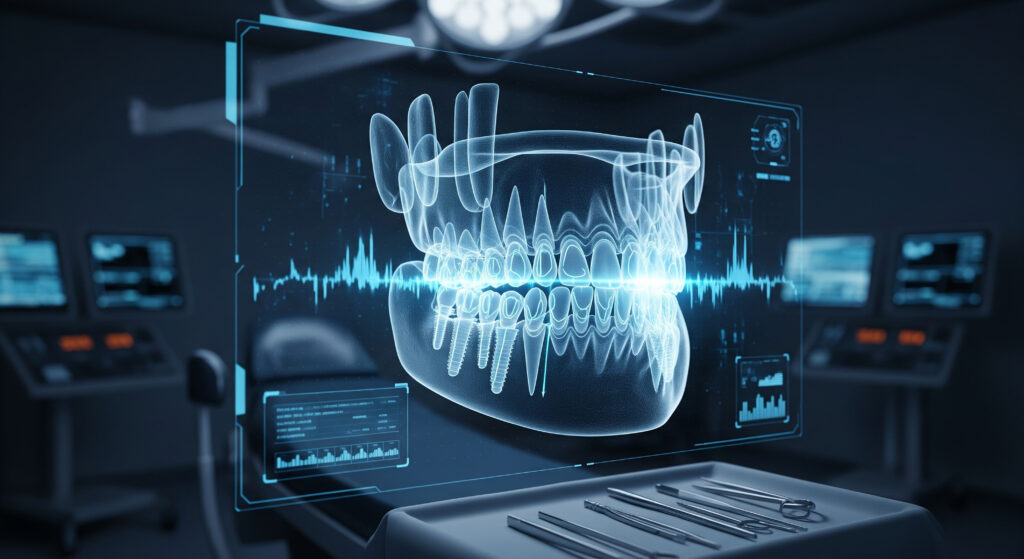
Illustration of AI-assisted analysis. Final diagnosis is always made by the dentist after a clinical examination.
AI image analysis
See how AI reads your scan before the doctor decides
Every panoramic X-ray, CBCT scan and smile photo you send is analysed by AI first. It maps bone, nerves, roots and soft tissue, flags areas that need attention and prepares measurements. Dr. Abdurrahman Öztürk then reviews every finding and makes the clinical decision.
What AI Dental Implants Really Are, and What They Are Not
A dental implant is a small post, usually made of titanium or ceramic zirconia, that is placed into the jawbone to replace the root of a missing tooth. Over the following weeks and months the bone grows tightly around it, a process called osseointegration, and the implant becomes a stable base for a crown, a bridge or a complete set of teeth. The implant itself is not 'intelligent'. What changes with AI dental implants is everything around the surgery: how your anatomy is measured, how options are compared and how precisely the plan is carried into the operating room.
At AIDENT Clinic in Istanbul, AI tools analyze your panoramic X-ray, your CBCT scan and your intraoral 3D scan. They help identify bone height and width, the course of the lower jaw nerve and the position of the maxillary sinus, and they let the team test different implant positions virtually before choosing one. This is decision support. Dr. Abdurrahman Öztürk reviews every AI output, corrects it where needed and makes each clinical decision himself. If a software suggestion does not match what he sees clinically, his judgement wins.
- AI reads and labels scans; it does not perform surgery
- Implants are proven medical-grade titanium or zirconia
- Every AI plan is checked and signed off by the supervising dentist
- Previews are simulations used for discussion, not promises
How AI Changes Implant Treatment Compared with Traditional Planning
Traditional implant planning often relied on a flat panoramic X-ray and the surgeon's experience to imagine the three-dimensional bone. Experienced surgeons do this well, but a 2D image can hide narrow ridges, sinus extensions or nerve positions. With an AI-assisted workflow, the CBCT volume is segmented automatically, so the doctor starts with a clear 3D map instead of building it by hand. That frees time for what matters most: thinking through the case, discussing it with you and checking the plan from every angle.
AI also makes it easier to compare options side by side. For a patient missing several back teeth, for example, the team can virtually test individual implants against an implant bridge on fewer fixtures, and see where bone is sufficient and where grafting might be needed. For a patient losing all teeth in one jaw, it becomes easier to show why All-on-4, All-on-6 or All-on-8 might suit their bone. You see the reasoning on screen, and you understand why the doctor recommends one plan over another.
Precision in planning
Virtual placement helps keep implants at a safe distance from nerves, roots and sinuses, and aligns them with the future teeth so the prosthesis can be designed for function and cleaning.
Clearer communication
3D views and smile simulations help international patients understand their treatment before travelling to Istanbul, which supports informed consent and realistic expectations.
Which AI Implant Option Is Right for You? A Guide to Our Treatments
Dental implants are not one treatment but a family of solutions. The right one depends on how many teeth are missing, the quantity and quality of your bone, your general health, your bite and your expectations. AI analysis of your scans gives a first indication, and the final choice is made with Dr. Öztürk after a clinical examination. Below is a short overview of each option; each has its own dedicated page where we explain it in depth.
If you are unsure where you fit, that is normal. Many patients arrive thinking they need a full arch and leave with a more conservative plan, while others discover that keeping a few weak teeth would compromise the long-term result. Sending photos and an X-ray on WhatsApp is the simplest way to get an initial, no-obligation opinion.
AI Single-Tooth Implant
One implant and one crown replace one missing tooth, without grinding down the neighbouring teeth. AI planning focuses on fitting the implant precisely between existing roots.
AI Multiple-Tooth Implants & Implant Bridges
When two or more neighbouring teeth are missing, an implant bridge can replace them using fewer implants than teeth. AI helps decide how many fixtures are needed and where.
AI All-on-4 Implants
A full fixed arch supported by four implants per jaw, typically with tilted rear implants to make use of available bone and often avoid grafting.
AI All-on-6 and All-on-8 Implants
Six or eight implants per arch distribute chewing forces over more supports. These options are considered when bone volume allows and extra stability is desirable.
AI Full Mouth Dental Implants
Rehabilitation of both upper and lower jaws, combining the most suitable implant concept for each arch into one coordinated plan.
AI Implant-Supported Prostheses and Aftercare
The crowns, bridges and dentures that attach to implants, plus the long-term maintenance that keeps them healthy for years.
Bone, Gums and Health: What AI Analysis Checks Before Implants
Implants need enough healthy bone to anchor in, healthy gums around them and a body that heals well. After a tooth is lost, the jawbone in that area naturally shrinks over time, so patients who have been missing teeth for years sometimes have less bone than expected. AI segmentation of the CBCT scan helps measure the ridge accurately and shows where additional procedures such as bone grafting or a sinus lift might be necessary. These are common, well-established treatments, but they add healing time and should be planned in advance rather than discovered on the day of surgery.
General health matters too. Uncontrolled diabetes, heavy smoking, untreated gum disease, certain medications that affect bone and radiation therapy to the head or neck can increase the risk of implant problems. AI cannot assess these factors from an image, which is why Dr. Öztürk reviews your medical history personally and may ask for information from your own doctor. Being honest about your health is one of the most important things you can do for a predictable result.
- Bone height and width at each planned implant site
- Distance to the mandibular nerve and the sinus floor
- Condition of remaining teeth and signs of gum disease
- Bite relationship and space for the future teeth
- Medical history, medications and smoking habits
AI Dental Implants in Istanbul for International Patients
Many of our patients travel to Istanbul from the Gulf, Europe and beyond. A digital, AI-assisted workflow suits this well, because much of the preparation can start before you book a flight. Your photos and existing X-rays are reviewed online, the likely treatment path is discussed with you, and once you arrive the CBCT and intraoral scans confirm or refine the plan. This reduces surprises and helps you organise realistic travel dates.
Implant treatment usually involves at least two phases. In the first visit the implants are placed and, depending on the case, temporary teeth may be fitted. The bone then needs time to integrate with the implants, commonly a few months, before the final teeth are made. Some full-arch cases allow fixed temporary teeth soon after surgery, while other cases need a longer healing period. The exact schedule is always individual, and we will explain it clearly before you commit.
Before you travel
Online review of photos and X-rays, a preliminary plan, and guidance on what to bring, including your medical records and current medication list.
While you are in Istanbul
Clinical exam, CBCT and 3D scanning, final AI-assisted plan approved by Dr. Öztürk, implant surgery and early follow-up checks.
Risks, Limits and Honest Expectations of AI-Assisted Implants
Implant surgery is a well-established procedure, but like any surgery it carries risks. Swelling, bruising and some discomfort are common for a few days. Less common complications include infection, delayed healing, temporary or, rarely, lasting numbness if a nerve is affected, sinus problems in the upper jaw and implants that fail to integrate with the bone. Over the long term, implants can be affected by peri-implantitis, an inflammation similar to gum disease, especially if hygiene is poor or the patient smokes.
AI planning helps reduce some of these risks by improving the information available before surgery, but it cannot remove them entirely. Software can misread low-quality images, and every patient heals differently. That is why AI suggestions are always reviewed by Dr. Öztürk and why smile simulations are presented as previews, not guarantees. A trustworthy clinic tells you what can go wrong as clearly as what can go right, and we prefer you make your decision with full information.
- Short-term: swelling, bruising and tenderness for several days
- Possible: infection, slow healing, sinus or nerve complications
- Long-term: peri-implantitis if hygiene and check-ups are neglected
- Smoking and uncontrolled diabetes raise the risk of failure
Living with Implants: Long-Term Care Planned from Day One
A successful implant is not only about the surgery; it is about how the restoration performs for many years. During AI-assisted planning, the prosthesis is designed not only to look natural but also to be cleanable, with shapes that allow floss, interdental brushes or water flossers to reach the gum line around each implant. The bite is checked digitally so that chewing forces are spread evenly and no single implant is overloaded.
After treatment, regular professional cleaning and check-ups are essential. Implants do not decay, but the gums and bone around them can become inflamed. Your home routine, routine X-rays when the dentist recommends them and early attention to bleeding or loosening help protect your investment. Our dedicated aftercare page explains maintenance in detail, including what to do when you are back home and far from Istanbul.
Conventional vs AI-assisted
Conventional Implant Planning vs AI-Assisted Planning at AIDENT
Who it suits
Who Is a Good Candidate for AI Dental Implants?
- Adults missing one tooth after injury, decay or extraction
- Patients missing several teeth who want a fixed alternative to a partial denture
- People who have lost most or all teeth in one or both jaws
- Denture wearers looking for more stability and comfort
- Patients with reduced bone who need careful 3D assessment for grafting or tilted implants
- International patients who want a clear digital plan before travelling to Istanbul
Your treatment journey
A Typical AI Dental Implant Journey
Before travel
Online AI pre-assessment
Send photos and X-rays on WhatsApp. The images are analyzed and Dr. Öztürk gives a preliminary opinion and likely options.
Day 1
Exam and 3D scans
Clinical examination, CBCT and intraoral scanning. AI segmentation and virtual planning produce a detailed plan for discussion.
Day 2–3
Implant surgery
Implants are placed under local anaesthesia, with sedation available, using a surgical guide when indicated.
First week
Checks and temporaries
Follow-up visits to check healing. Depending on the case, temporary teeth may be fitted before you fly home.
After a few months
Final teeth
Once the implants have integrated, you return for the final CAD/CAM-designed crowns, bridge or full-arch prosthesis.
Why patients choose it
Better informed decisions
Seeing your own anatomy in 3D, with options compared side by side, makes it easier to choose the right implant solution.
Safety-focused planning
AI mapping of nerves and sinuses supports the doctor in keeping implants at a safe distance from delicate structures.
Prosthesis-driven design
Implants are positioned for the teeth you will actually receive, which supports aesthetics, chewing and cleaning.
Fewer surprises
The need for bone grafting or a sinus lift is usually identified during planning rather than on the day of surgery.
Efficient trips to Istanbul
Remote pre-assessment and digital workflows help organise realistic travel dates and use your time in the clinic well.
Human expertise at every step
AI supports the process, but an experienced oral surgeon reviews every plan and makes every clinical decision.
Your doctor
Every AI Implant Plan Is Supervised by Dr. Abdurrahman Öztürk
Dr. Abdurrahman Öztürk holds a PhD in dentistry and oral and maxillofacial surgery and has more than 15 years of experience in dentistry and dental surgery. He graduated from a leading Istanbul university and has focused much of his career on implant surgery. At AIDENT Clinic, he personally reviews every AI-analyzed scan, checks each virtual implant position and decides which option is clinically right for you. Artificial intelligence gives him a more detailed view of your anatomy, but the diagnosis, the treatment plan and the surgery remain his responsibility from your first message to your final check-up.
Aftercare
Aftercare Essentials for Your Implants
- Follow the medication and mouth-rinse instructions given after surgery
- Eat soft foods for the first days and avoid chewing directly on new implants
- Avoid smoking, which slows healing and raises the risk of implant failure
- Brush twice daily and clean around implants with interdental brushes or a water flosser
- Attend all scheduled check-ups, including remote follow-ups after you return home
- Contact the clinic promptly if you notice bleeding, swelling, pain or a loose tooth
- Ask about a night guard if you grind or clench your teeth
Explore every treatment in this specialty
Questions and answers
What patients ask about AI Dental Implants
Does AI really place my dental implants?
No, AI does not place implants; an experienced surgeon does. Artificial intelligence analyzes your CBCT and 3D scans, maps bone, nerves and sinuses, and helps simulate implant positions. Dr. Abdurrahman Öztürk reviews those results, adjusts the plan and performs the surgery himself, sometimes using a 3D-printed guide made from the approved digital plan.
How do I know which implant option I need?
The right option depends on how many teeth are missing, your bone volume and your health. Sending photos and an X-ray on WhatsApp gives you a first opinion. In Istanbul, AI-analyzed CBCT and intraoral scans let Dr. Öztürk compare single implants, implant bridges and full-arch concepts on your own 3D model before recommending one.
Is getting dental implants painful?
Implant surgery itself is usually not painful because it is performed under local anaesthesia, and sedation is available for anxious patients. Afterwards, most people experience swelling and soreness for a few days, which is normally managed with prescribed pain relief, cold compresses and soft foods. Discomfort varies with the number of implants and any grafting performed.
How much time do I need to stay in Istanbul for dental implants?
Most patients need two trips. The first, for examination, scans and implant surgery, usually lasts around a week. After a healing period of commonly a few months, a second visit of several days completes the final teeth. Your exact schedule depends on the option chosen and on whether bone grafting is required.
Can AI tell me if I have enough bone for implants?
AI helps measure your bone very precisely, but the doctor makes the final judgement. On a CBCT scan, AI segmentation outlines the jawbone, so bone height and width can be measured at each planned site. Dr. Öztürk then decides whether implants can be placed directly, whether tilted implants could help, or whether grafting is needed.
What if I do not have enough bone?
Low bone volume does not always rule out implants. Depending on the situation, options include bone grafting, a sinus lift in the upper jaw, shorter or narrower implants, or full-arch concepts with tilted implants. AI-assisted 3D planning helps compare these approaches, and Dr. Öztürk explains the extra healing time and risks involved.
Who is the best dentist for AI dental implants in Istanbul?
The best choice is an experienced implant surgeon who uses modern digital planning and personally supervises every case. At AIDENT Clinic, Dr. Abdurrahman Öztürk, a PhD-qualified oral and maxillofacial surgeon with more than 15 years of experience, reviews every AI-analyzed plan. Ask any clinic you consider who makes the decisions and who performs the surgery.
How long do AI-planned dental implants last?
With good oral hygiene and regular check-ups, dental implants can last for many years, often decades. AI planning supports a stable, well-positioned result, but longevity also depends on smoking, gum health, grinding habits and general health. The crowns or bridges on top may need repair or replacement over time, even when the implants remain healthy.
Is AI implant surgery safe?
AI-assisted implant surgery is as safe as conventional implant surgery and can add an extra layer of precision in planning. Implant surgery still has risks such as infection, nerve or sinus complications and implant failure. AI mapping helps the doctor plan around delicate structures, but it never replaces his clinical judgement or careful surgical technique.
What is the difference between All-on-4, All-on-6 and All-on-8?
The difference is the number of implants supporting a full arch: four, six or eight per jaw. More implants spread chewing forces over more supports but need more available bone. AI analysis of your CBCT shows where bone is sufficient, helping Dr. Öztürk recommend the concept that fits your anatomy. Each option has its own detailed page.
Can I get implants if I have gum disease?
Usually yes, but the gum disease must be treated and controlled first. Active periodontal infection increases the risk of inflammation around implants later. During your assessment, remaining teeth and gums are examined, and the doctor will explain whether treatment, extractions or a waiting period is needed before implants can be placed safely.
Will the AI smile preview look exactly like my final teeth?
Not exactly; the preview is a simulation that shows the planned shape, length and position of your new teeth. The final result can differ because of healing, gum response and adjustments made during try-in. It is a tool to discuss your wishes with the doctor and agree on a realistic goal before treatment begins.
Can I start my AI implant consultation online?
Yes, you can begin online by sending clear smile photos and any recent panoramic X-ray or CBCT on WhatsApp to +90 534 445 9444. The images are reviewed with AI support and by Dr. Öztürk, who gives a preliminary opinion. A definitive plan is only confirmed after a clinical examination and new scans in Istanbul.
Are implants better than bridges or dentures?
For many patients, implants offer more stability and help preserve the jawbone, and a single implant avoids grinding down healthy neighbouring teeth. However, they require surgery, healing time and good health. Conventional bridges or dentures can still be sensible for some people. The doctor will compare these alternatives with you honestly during your assessment.
What are dental implants made of?
Most dental implants are made of medical-grade titanium, a biocompatible metal that bone grows around well; ceramic zirconia implants are an alternative in selected cases. The visible teeth on top are usually zirconia, porcelain or high-quality acrylic, depending on the option. The doctor recommends materials based on your bite, aesthetics and long-term maintenance needs.
No question matches your search. Ask us directly on WhatsApp.
Find Out Which AI Implant Option Fits You
Send your photos and X-rays on WhatsApp for a free, no-obligation AI-assisted review. Dr. Abdurrahman Öztürk will look at your case and explain the options that could suit you in Istanbul.
Get my free AI implant assessment on WhatsAppFree initial review of your photos and X-rays. Reply on WhatsApp.